
Sizing guide for a vacuum skin packaging machine: DQ380VST at 370 mm film and 480 trays/h, up to DQ440VSL at 440 mm film, 100 m3/h pump and 380 V three phase.
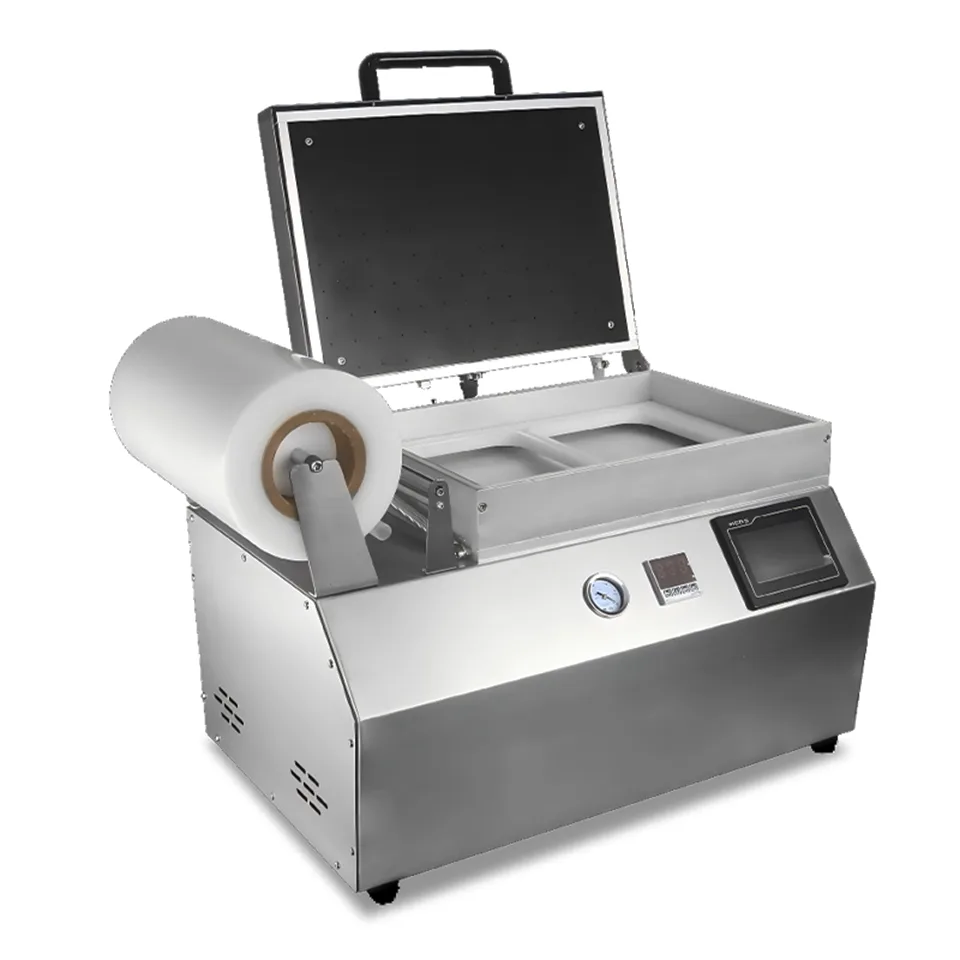
A vacuum skin packaging machine heats a film, drapes it over a loaded tray and draws vacuum underneath, so the film collapses onto the product instead of bridging across it. The Huayi Equipment DQ380VST sits in the middle of that class: 370 mm maximum roll film width, 20 m³/h pump displacement, 2.8 kW on 220 V/50 Hz, and a published output near 480 trays per hour at 4-out. The same series starts at the DQ240VST with 250 mm film and ends at the DQ440VSL vertical unit with 440 mm film and a 100 m³/h pump. This guide is written for meat, poultry, seafood and cheese packers sizing that one workstation before they ask for a price.
Key Takeaways
- Film width sets the largest tray you can run, not cabinet size: the tabletop family steps 250 mm → 305 mm → 320 mm → 370 mm, the vertical units 320 mm → 440 mm.
- Published output is cycles × cavities. At 2 cycles/min the DQ240VST and DQ300VST reach ≈240 boxes/h at 2-out, the DQ320VST and DQ380VST reach ≈480 boxes/h at 4-out, and the vertical DQ330VSL/DQ440VSL reach ≈300 and ≈500 boxes/h at 2-3 cycles/min.
- Pump displacement splits into two tiers for a reason: 10-20 m³/h on the 250-370 mm tabletop chamber, 63-100 m³/h on the vertical chamber, which is larger and cycles faster.
- Tabletop models run 220 V/50 Hz single phase at 2.2-2.8 kW; vertical models need 380 V/50 Hz three phase at 4.0-6.5 kW plus 0.6-0.8 MPa compressed air.
- Tray depth is published at 50 mm on the tabletop units and 40 mm on the vertical units. A 60 mm deep meal tray fits neither without different tooling.
- Housing is 304 stainless steel, the vacuum chamber is anodized 6061 aluminium, the heating plate is Teflon-coated. The film itself is the food-contact material, and its declaration has to come from the film supplier.
- Machine weight runs 35.3 kg to 386 kg. Anything above the DQ320VST needs a floor plan, not a bench.
What This Equipment Is Used For
A skin pack holds product under a film that follows its contour. That is the whole difference from a chamber vacuum sealer, where the bag collapses but still leaves a loose skirt around the product, and from a MAP tray sealer, where the film stays flat across the tray flange and gas does the work. Buyers reach for skin packaging when the pack has to show the product: a rib-eye, a salmon fillet, a cheese wedge, a chicken breast, a single-serve meal where the sauce has to read through the film.
The applications that come up in quotation requests most often are fresh and frozen red meat cuts, poultry portions, fish fillets and shellfish, hard and semi-hard cheese, cooked sliced meats, and ready meals in shallow trays. Retail case presentation is usually the driver. The secondary driver is drip loss: with the film tight against the surface there is no headspace for purge to collect in, so the pack reads the same on day seven as on day one. In practice the machine sits after the tray is filled and before labelling. Manual units run one tray in, one tray out, 30 seconds per cycle; vertical units index a shuttle, so the operator loads while the chamber works.
Start With the Tray, Not the Film Roll
Every sizing conversation should start with a physical tray on the table. Three numbers on that tray decide the model: outer length, outer width, and depth. The published maximum tray size already accounts for the seal frame and the film margin, which is why Huayi lists them per output configuration instead of as one figure.
Take the DQ380VST. At 1-out it lists 420 × 310 × 50 mm, at 2-out 310 × 205 × 50 mm, at 4-out 205 × 150 × 50 mm. The tray gets smaller as the cavity count rises, because the same 370 mm film and the same chamber have to cover more seals. That is the trade every buyer makes: fewer, larger packs or more, smaller packs at the same cycle time.
Depth is the trap. Fifty millimetres on the tabletop family and forty on the vertical family sounds generous until a 500 g ready-meal tray arrives at 60 mm. Then the answer is not a bigger machine, it is different tooling or a different pack format. Confirm depth on the drawing before the deposit, not after the container lands.
Match the Vacuum Skin Packaging Machine to Film Width and Pump Size
Film width is the hard ceiling of the whole station. A 320 mm roll cannot cover a tray that needs 340 mm of film, and no amount of chamber depth fixes it. The tabletop ladder is 250 mm on the DQ240VST, 305 mm on the DQ300VST, 320 mm on the DQ320VST and 370 mm on the DQ380VST. The vertical ladder is 320 mm on the DQ330VSL and 440 mm on the DQ440VSL.
Roll diameter matters for the same practical reason. Tabletop units take a 180 mm roll, vertical units a 220 mm roll. A bigger roll means fewer film changes per shift, which on a 480 boxes/h line is the difference between one stop and four.
Pump displacement then decides how fast the vacuum reaches the level the film needs to draw down. The DQ240VST runs a 10 m³/h pump, the DQ300VST, DQ320VST and DQ380VST run 20 m³/h, the DQ330VSL runs 63 m³/h and the DQ440VSL runs 100 m³/h. On a shallow tray with a thin film, 20 m³/h is enough. On a deep cavity or a thick film, the larger pump is what keeps the cycle at 20-30 seconds instead of stretching it.
That is also why the vertical units quote 2-3 cycles/min while the manual units quote 2. Cycle count, cavity count and pump size move together. Changing one without the others just moves the bottleneck to the next station.
Core Specifications Buyers Should Compare
| Specification | Why It Matters | What Buyers Should Check |
|---|---|---|
| Maximum roll film width | It sets the largest tray that can be sealed; no other adjustment recovers the shortfall. | Measure your widest tray including the flange, then add the seal margin the supplier specifies. |
| Maximum tray size per output | 1-out, 2-out and 4-out give different tray sizes at the same cycle time. | Pick the output configuration against your actual tray, not against the headline figure. |
| Vacuum pump displacement | It governs evacuation speed and how tight the film draws down on a deep product. | Compare m³/h at the same tray depth and film thickness you will run. |
| Cycle time and hourly output | Labor planning and line balance depend on it. | Convert boxes/h into trays per shift with your own downtime allowance, not the brochure number. |
| Power supply and total power | 220 V/50 Hz single phase and 380 V/50 Hz three phase are not interchangeable on site. | Confirm the plant voltage, phase and breaker size before ordering; ask whether other voltages are built. |
| Working air pressure | Vertical units need 0.6-0.8 MPa; tabletop manual units do not use air at all. | Check compressor capacity and air quality at the point of use, plus dryer and filter. |
| Chamber and housing material | Washdown and corrosion resistance in a wet packing room. | Ask for 304 stainless housing and anodized 6061 chamber, and for the material certificate. |
| Machine weight and footprint | 35.3 kg to 386 kg changes handling, floor loading and where the unit can go. | Match the footprint to the bench or floor space, and plan clearance for the film roll swing. |
Compare the DQ Series Model by Model
The published data for the six models reads like a ladder, and it is easier to see the steps in one table than in six product pages.
| Model | Type | Film width | Max output | Pump | Power | Weight | Machine size (mm) |
|---|---|---|---|---|---|---|---|
| DQ240VST | Manual tabletop | 250 mm | ≈240 boxes/h (2-out) | 10 m³/h | 2.2 kW, 220 V/50 Hz | 35.3 kg | 490 × 360 × 430 |
| DQ300VST | Manual tabletop | 305 mm | ≈240 boxes/h (2-out) | 20 m³/h | 2.5 kW, 220 V/50 Hz | 51.9 kg | 610 × 420 × 430 |
| DQ320VST | Manual tabletop | 320 mm | ≈480 boxes/h (4-out) | 20 m³/h | 2.5 kW, 220 V/50 Hz | 55.7 kg | 630 × 460 × 430 |
| DQ380VST | Manual tabletop | 370 mm | ≈480 boxes/h (4-out) | 20 m³/h | 2.8 kW, 220 V/50 Hz | 64.8 kg | 680 × 510 × 450 |
| DQ330VSL | Vertical | 320 mm | ≈300 boxes/h (2-out) | 63 m³/h | 4.0 kW, 380 V/50 Hz | 237 kg | 1020 × 1005 × 1400 |
| DQ440VSL | Vertical | 440 mm | ≈500 boxes/h (4-out) | 100 m³/h | 6.5 kW, 380 V/50 Hz | 386 kg | 1170 × 1145 × 1510 |
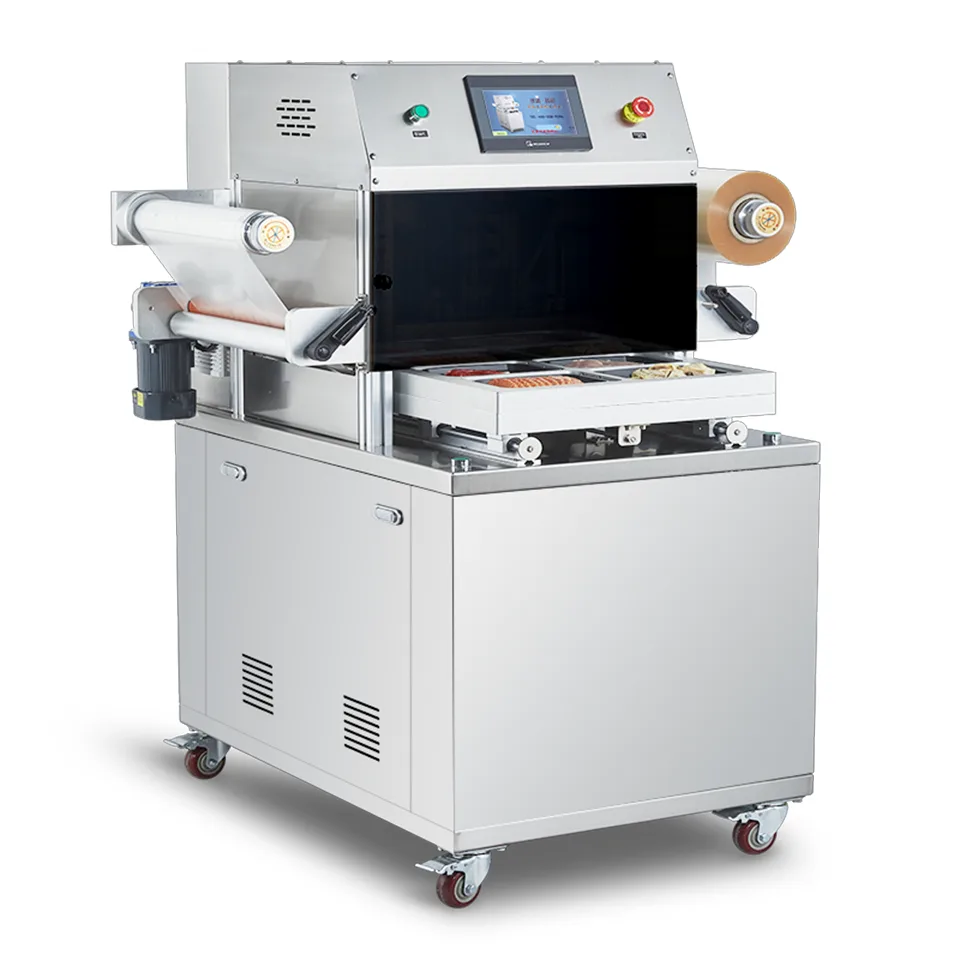
Two details in that table decide most projects. First, the jump from the DQ300VST to the DQ320VST is only 15 mm of film, but it buys a fourth cavity and doubles the published output. Second, the jump from the DQ380VST to the DQ330VSL is not an output jump at all — the vertical unit is slightly slower per cycle at 2-out — it is a labor and consistency jump. The shuttle lets the operator load the next tray during the seal, and the closed chamber gives a repeatable draw that a manual pressure frame does not.
How to Choose the Right Model
Work through four questions in order: how big is the tray, how many per hour, what does the site supply, and who cleans it. Most wrong purchases come from answering the second question before the first.
Production Capacity
Start from trays per hour, not boxes per hour, then add the allowance the brochure leaves out. A DQ380VST at 4-out publishes 480 boxes/h, which is 2 cycles/min × 4 cavities × 60 minutes. In a real packing room, film changes, jam clearing and shift handover take a bite. Planning at 70-80% of published output is defensible; planning at 100% is not.
Then check the upstream station. If the filling line delivers 300 trays/h, a 480 trays/h machine does not create 480 trays of work — it creates idle time. Where the line runs below the machine's ceiling, the vertical DQ330VSL at ≈300 boxes/h may already be the balanced choice.
Food Contact Materials
The machine's wetted surfaces are simple to specify: 304 stainless steel for the housing and frame, anodized 6061 aluminium for the vacuum chamber, Teflon coating on the heating plate. Ask for the material certificate for the stainless parts and confirm the anodized layer is intact on delivery, because a scratched chamber is a cleaning problem that never goes away.
The film is the part buyers forget. Skin film is normally a PA/PE structure, and its compliance is a film supplier document, not a machine document. For EU destinations that means a declaration under Regulation (EU) No 10/2011 with migration test data; for the US, a statement against FDA 21 CFR Part 177. For metal parts in contact with food, GB 4806.9-2016 is the reference used in China. Final specifications should be confirmed according to the selected model and supplier documentation.
Cleaning and Maintenance
A skin packer is a wet-room machine. The chamber, the seal frame and the tray carrier all see product contact and need a daily washdown. Look for a chamber that lifts out or opens fully, no exposed wiring in the wash zone, and a heating plate that can be wiped without dismantling the frame.
Daily: wipe the chamber, clear film trim from the seal area, check the Teflon sheet for cuts. Weekly: inspect the seal gasket for compression set, clean the pump intake filter, check the air filter and regulator on vertical units. Monthly: verify the temperature controller against a probe, inspect the vacuum hose for cracking, and log the pump's running hours. On a two-shift line that log is what tells you when to plan a pump service instead of discovering it during a retail order.
Plan the Cell Around Power, Air and Film Storage
Tabletop units are single phase at 220 V/50 Hz and 2.2-2.8 kW, which at 220 V is roughly 10-13 A — plan a dedicated 16 A circuit so a kettle or a labelling head on the same ring does not trip it mid-cycle. Vertical units are 380 V/50 Hz three phase at 4.0-6.5 kW and additionally need 0.6-0.8 MPa air with a dryer and a 5 µm filter at the point of use.
Film storage belongs in the plan. A 220 mm roll on a vertical unit and a 180 mm roll on a tabletop unit take different shelf space, and film stored in a cold store will fog when it enters a warm packing room. Keep the working stock in the room, keep the rest sealed, and write the roll change into the shift routine.
Weight decides handling. The DQ240VST at 35.3 kg goes on a bench with two people. The DQ380VST at 64.8 kg needs a stable table rated for it. The DQ440VSL at 386 kg arrives on castors with a 1170 × 1145 mm footprint and needs a floor that takes point loads plus room for the chamber to open and the film roll to swing. That clearance is the item most often missing from a layout drawing.
Buyer Checklist
- Put the actual tray on the table and record outer length, width and depth in millimetres.
- Convert your weekly volume into trays per hour, then into the output configuration that fits it.
- Confirm the film width covers the tray plus seal margin, and ask which film structure the supplier has run on that model.
- Confirm plant voltage, phase and breaker size; state clearly if 220 V/50 Hz single phase is all you have.
- For vertical units, confirm compressor capacity at 0.6-0.8 MPa, plus dryer and filter.
- Ask for the material certificate for 304 parts and the food-contact declaration for the film.
- Ask for a video of the machine running your tray size and film, not a stock clip.
- Agree the spare parts list: seal gasket, Teflon sheet, heating element, vacuum hose, pump filter.
- Agree who trains the operators, and in what language the manual and the HMI are supplied.
- Confirm the packing dimensions and gross weight against your container plan — 350-430 kg gross on the vertical units is not a parcel.
Common Mistakes to Avoid
The first mistake is buying on cavity count. A 4-out machine looks like twice the capacity of a 2-out machine until the tray is too large for a 4-out cavity and the operator runs it as 2-out anyway. Size the tray first, then the cavities.
The second is treating the published output as a production figure. It is a cycle time multiplied by cavities, measured on a bench. Add film changes, breaks, cleaning and reject rate before you compare it with your demand.
The third is a film decision made after the machine order. Film thickness, structure and shrink behaviour change the draw and the cycle. A machine that runs well on a 100 µm film can struggle on a 150 µm one, and the fix is usually pump capacity, which is fixed at purchase.
The fourth is ignoring the tray depth footnote — forty millimetres on a vertical unit is a real limit, and a 45 mm tray with a domed lid does not negotiate. The fifth is assuming the site power is fine because the workshop "has 380 V". Check the breaker, the cable run and what else shares the circuit.
FAQ
Q:What is the difference between vacuum skin packaging and vacuum chamber packaging?
A:In skin packaging the film is heated and drawn down onto the product, so it follows the contour and leaves no headspace. In chamber packaging a pre-made bag is evacuated around the product and sealed, which leaves a loose skirt and some trapped air in the folds. Skin packs present better and purge less; chamber bags are cheaper per pack and handle irregular shapes with more tolerance.
Q:Which model fits a 320 × 220 mm tray at 300 trays per hour?
A:The DQ380VST at 2-out lists 310 × 205 mm, which is too small for a 320 mm tray, so that tray needs the 1-out configuration at 420 × 310 mm and the output drops to ≈120 boxes/h. Either move to the vertical DQ440VSL, which lists 380 × 260 mm at 2-out for ≈300 boxes/h, or reduce the tray. That is exactly the trade the sizing table exists to expose.
Q:How much film does a skin packaging machine use per tray?
A:One film length per cycle plus the seal margin, cut from the roll. For a 2-out cycle you consume one length covering both trays, not two. Ask the supplier for the film consumption per cycle for your tray layout and multiply by your shift volume — that number, not the machine price, is usually the largest line in the annual cost.
Q:Can a tabletop skin packer run 380 V?
A:The tabletop models in this series are published at 220 V/50 Hz, 2.2-2.8 kW. Do not assume a 380 V variant exists. If the site is 380 V three phase only, plan a step-down transformer with adequate rating, or move to the vertical models that are built for 380 V/50 Hz. Confirm the available voltage with the supplier in writing before ordering.
Q:What air pressure do the vertical units need?
A:0.6-0.8 MPa working pressure, with dry, filtered air at the point of use. Size the compressor with margin for simultaneous users on the same ring, and fit a dryer and a 5 µm filter — moisture in the pneumatic circuit shows up as sticky valves and inconsistent shuttle movement.
Q:How deep a tray can the DQ440VSL take?
A:Forty millimetres in the published configurations: 380 × 260 × 40 mm at 2-out and 260 × 175 × 40 mm at 4-out. If your product needs more depth, that is a tooling question for the supplier, not a standard option.
Q:Is the vacuum chamber really aluminium?
A:Yes — 6061 aluminium, anodized, with a 304 stainless housing and frame. Inspect the anodized surface on arrival and avoid abrasive pads, because once the coating is broken the chamber corrodes and pits.
Sources
- Codex Alimentarius CXC 1-1969, General Principles of Food Hygiene (revised 2020), FAO/WHO — hygiene principles for packing areas and food-contact surfaces.
- Regulation (EU) No 10/2011 on plastic materials and articles intended to come into contact with food — declaration of compliance and migration limits for skin films.
- US FDA 21 CFR Part 177, Indirect Food Additives: Polymers — the reference US buyers ask film suppliers to declare against.
- GB 4806.9-2016, National Food Safety Standard — food contact metal materials and articles, used as the reference for stainless parts in China-built machinery.
- EN 1672-2:2005+A1:2009, Food processing machinery — Basic concepts, hygiene requirements; EN ISO 14159:2008, Safety of machinery — Hygiene requirements for the design of machinery.
- Directive 2006/42/EC on machinery, and IEC 60204-1 for the electrical equipment of machines — the two documents an export buyer should see in the technical file.
- Huayi Equipment product listings for the DQ vacuum skin packaging series, accessed 1 November 2026 — film width, tray sizes, pump displacement, cycle time, output, power, weight and dimensions.
Related Examples
- DQ380VST manual vacuum skin packaging machine — 370 mm film, 20 m³/h pump, 2.8 kW, 480 boxes/h at 4-out.
- DQ320VST vacuum skin packaging machine — 320 mm film, 4-out, 55.7 kg.
- DQ300VST tabletop VSP sealer — 305 mm film, 2-out, 51.9 kg.
- DQ440VSL vertical skin and MAP vacuum packaging machine — 440 mm film, 100 m³/h pump, 380 V/50 Hz.
- DQ330VSL vertical skin packaging machine — 320 mm film, 63 m³/h pump, 4 kW.
- Skin packaging machine category — the full DQ range with current listings.
- Tray sealer buying guide for ready meals and meal kits — the flat-film alternative to skin packaging.
- MAP packaging machine gas replacement rate explained — where gas flushing, not skin, is the right answer.
- Contact Huayi Equipment — send tray dimensions, hourly target and destination market for a model recommendation.
Work the decision in one order and the model picks itself: tray footprint first, then film width, then cavity count against hourly output, then power and air against what the site can supply, then materials and cleaning against the hygiene regime the buyer has to pass. The DQ380VST covers most mid-volume meat and seafood rooms at 370 mm film and 480 boxes/h; the DQ440VSL takes the same work when the tray grows past 370 mm or when one operator has to keep a line moving. Final specifications should be confirmed according to the selected model and supplier documentation. Send your tray drawing, hourly target and site voltage to Huayi Equipment and ask for the model recommendation in writing — that is the document the purchase order should be built on.
苏涛;舜翔央厨、华艺智能
Published 1 November 2026