
A B2B guide to MAP packaging machine gas replacement rate — oxygen residual targets, gas mix ratios, and line speed checks for fresh meat and ready meals.
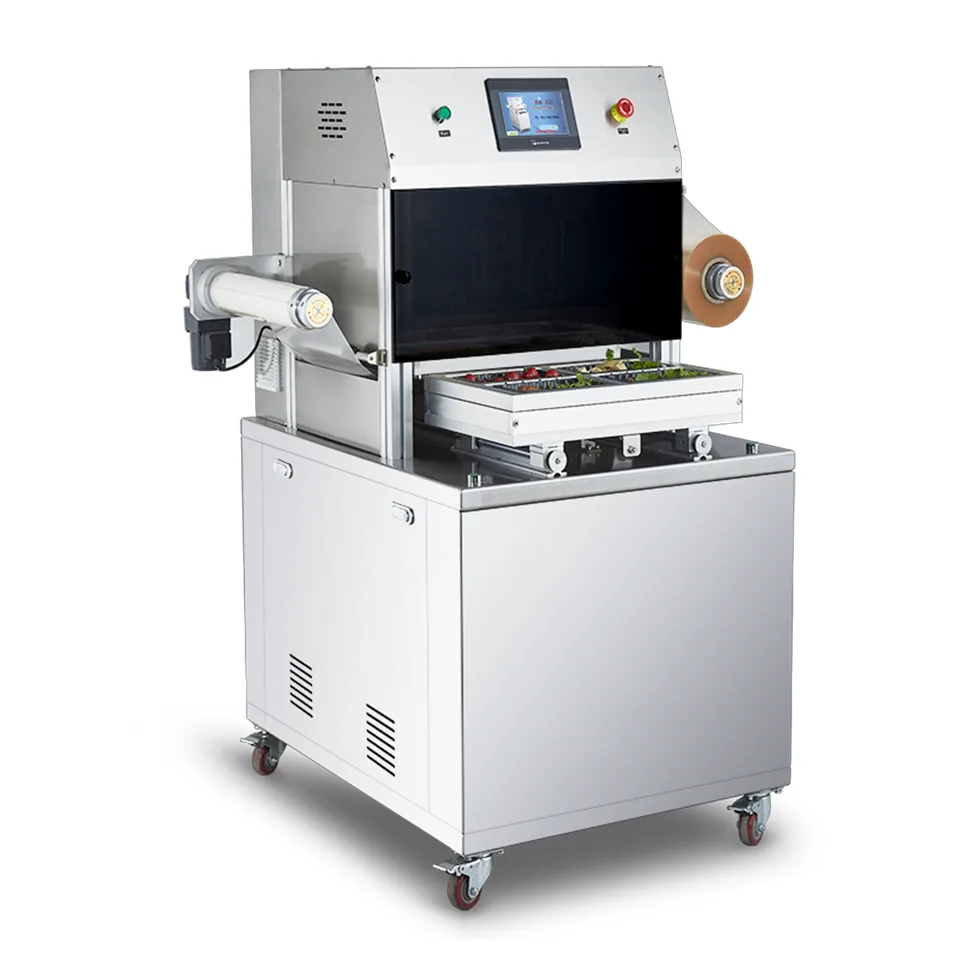
A MAP packaging machine (Modified Atmosphere Packaging machine) replaces the air inside a sealed tray with a controlled gas mix, typically nitrogen (N₂), carbon dioxide (CO₂), and in some cases a small oxygen (O₂) residual. The gas replacement rate — how completely the chamber air is exchanged before the film seals — is the single parameter that most directly drives shelf life, colour stability, and microbial growth on fresh meat, poultry, fish, ready meals, and fresh-cut produce. For B2B buyers sourcing a MAP tray sealer, understanding how gas replacement rate is measured, what target ranges apply to each product, and how the specification translates into line performance is the difference between a 5-day and a 14-day shelf life at retail. This guide is written for procurement managers, production engineers, and export buyers evaluating MAP packaging equipment for a 2026 production line.
Key Takeaways
- Gas replacement rate is the percentage of chamber air replaced by the target gas mix before sealing; for most fresh meat and ready meal applications, a residual O₂ of 0.5–2% is the working target.
- A higher replacement rate requires a larger vacuum pump, longer evacuation time, or a smaller chamber — each of these parameters changes machine price and throughput.
- For red meat, 60–80% CO₂ + 20–40% N₂ is the standard mix; for fresh-cut salad, O₂ can stay at 3–5% to suppress anaerobic bacteria while keeping colour.
- Buyers should request the O₂ analyser reading at the supplier’s FAT, not just a brochure number. A machine that prints 99.9% on the spec sheet can still deliver 96–97% in real production if the seal dwell time is too short.
- Final gas mix and replacement targets must be confirmed against the actual product, tray volume, line speed, and cold-chain temperature. Supplier documentation is the binding reference, not generic industry rules.
What Gas Replacement Rate Means on a MAP Packaging Machine
Gas replacement rate, sometimes called gas flushing efficiency or residual oxygen rate, describes how much of the original chamber atmosphere is removed and replaced by the protective gas mix before the top film heat-seals onto the tray. It is the inverse of residual oxygen percentage: a 99% gas replacement rate means the residual O₂ inside the sealed package is approximately 1%, assuming the supply gas is clean.
The parameter matters because oxygen drives two failure modes in packaged food: aerobic bacterial growth on fresh meat and bakery, and lipid oxidation that turns red meat brown and fish oily. Carbon dioxide at 60–80% concentration suppresses Pseudomonas and Brochothrix growth on beef and pork, extending shelf life from 3–4 days under air to 7–10 days at 0–4‰C. Nitrogen is inert and acts as a filler gas to prevent the tray from collapsing under high CO₂ dissolution into the product.
Core Specifications Buyers Should Compare
| Specification | Why It Matters | What Buyers Should Check |
|---|---|---|
| Residual O₂ (gas replacement rate) | Drives shelf life and microbial growth ceiling. | Ask for a measured value, not a brochure target. Test on your product, not water. |
| Chamber volume (L) | Larger chambers need more pump capacity to reach the same residual. | Match chamber size to your largest tray + headspace, not to the largest box the machine can fit. |
| Vacuum pump capacity (m³/h) | Pump size sets evacuation time and achievable ultimate vacuum (50–100 Pa). | Confirm pump model and brand; a Busch or Leybold pump is the production-grade reference. |
| Gas mix accuracy | Wrong CO₂ percentage ruins shelf life and can collapse trays on cheese or fish. | Request a gas mixer with mass flow controllers, not just two pressure regulators. |
| Cycle time (seconds per tray) | Determines hourly throughput and downstream line balance. | Calculate on your tray size at your residual O₂ target — not at the machine’s fastest cycle. |
| Seal temperature and dwell time | Under-sealed film leaks gas within 24–48 hours; over-sealed film burns through. | Confirm PID temperature control and a settable dwell time on the HMI. |
| Food-contact material grade | SUS304 is the standard; SUS316 is required for high-salt or acidic products. | Ask for a material certificate, not a sales claim. |
How to Choose the Right MAP Packaging Machine for Your Product
Match the Residual O₂ Target to the Product
Different products tolerate different oxygen residuals. Fresh red meat and poultry typically need 0.5–1% O₂ to keep the bright red colour and slow aerobic spoilage. Fresh fish and seafood run at 1–3% O₂ with 40–60% CO₂ to suppress trimethylamine formation. Fresh-cut salad and vegetables need 3–5% O₂ because going below that drives anaerobic fermentation and off-odours. Bakery and dried products stay close to air (under 1% O₂ is wasted gas and money). Buyers should agree the residual target with the QA team before finalising the order, because the residual target drives pump size and cycle time on the price list.
Calculate Chamber Volume Against Your Largest Tray
The chamber must fully enclose the tray with enough headspace for gas to flow around the product. A common mistake is to size the chamber to the largest box the machine can physically accept, then run small trays in it. The result is a poor gas replacement rate because the pump has to evacuate 8–10 L of empty air for every 250–500 ml of product headspace. A 4-tray machine with a chamber volume around 8–12 L typically delivers better residual O₂ on a 250 g steak tray than the same machine run with one tray and 10 L of dead volume. Match the chamber to your real production mix, not to your largest possible pack.
Confirm the Gas Supply Architecture
A MAP packaging machine needs three gas supplies: nitrogen from a generator or cylinder bank, carbon dioxide from a cylinder bundle or bulk tank, and in some cases a calibrated O₂/CO₂/N₂ premix. The machine itself only needs a gas mixer with mass flow controllers and a supply pressure of 6–8 bar. Buyers should ask the supplier to specify gas consumption per cycle (typically 1.5–3 L per 250 g tray at 99% replacement) and confirm whether the gas mixer is integrated into the machine or supplied as a separate skid. A separate mixer is easier to service and to calibrate on a HACCP schedule.
Plan the Throughput Against Your Line
Cycle time is the sum of tray loading, evacuation, gas flush, seal dwell, and ejection. A semi-automatic MAP tray sealer typically runs at 4–6 cycles per minute on a 250 g tray at 99% replacement. A fully automatic rotary MAP line can run 15–30 cycles per minute but needs a conveyor infeed, denester, and an outfeed conveyor matched to the cycle. Build the line balance around the slowest station: if seal dwell is 2.5 seconds, that is 24 cycles/min maximum, regardless of tray loader speed. Order the machine after the line layout is locked.
Buyer Checklist
- Confirm product type, tray size, and target residual O₂ percentage before quoting.
- Request measured gas replacement rate on the actual product, not on water or empty trays.
- Confirm vacuum pump brand and model; ask for service intervals and pump oil type.
- Check seal temperature control: PID controller with thermocouple feedback, not a thermostat.
- Ask for an HMI recipe system that stores product-specific cycle parameters (at least 20 recipes).
- Confirm food-contact material grade (SUS304 or SUS316) with a mill certificate.
- Verify gas supply pressure, consumption per cycle, and whether the gas mixer is integrated.
- Request a FAT protocol that includes residual O₂ reading at 1%, 2%, and 5% targets.
- Confirm spare parts package: seal gaskets, heater bars, film cutting blades, vacuum pump oil.
- Ask for after-sales response time and on-site commissioning in the destination country.
Common Mistakes to Avoid
The most common error is buying a machine sized for the largest theoretical tray and running it on small retail packs. The second most common error is trusting the brochure residual O₂ figure without testing on the real product; pump performance drops 10–15% between an empty chamber and a loaded chamber with moist protein. The third is ordering a single-stage evacuation when the product needs two-stage evacuation to reach sub-1% O₂ without overheating the film seal. The fourth is failing to budget for a nitrogen generator or cylinder rental, which adds 8–15% to the total installed cost and is often missed until installation week.
A fifth error is specifying cycle time based on the fastest machine cycle rather than the cycle needed to reach the agreed residual O₂. A 2-second cycle is meaningless if it only delivers 95% gas replacement. Buyers should always lock the cycle time, residual O₂ target, and product type together in the purchase order.
FAQ
What is a good gas replacement rate on a MAP packaging machine?
For fresh red meat and ready meals, a residual O₂ of 0.5–1% is the working benchmark — a 99–99.5% gas replacement rate. For fresh-cut produce and salad, 3–5% O₂ (95–97% replacement) is the correct target because going lower drives anaerobic fermentation. Confirm the target against the buyer’s product specification and the cold-chain temperature, not against the machine supplier’s default brochure.
How is gas replacement rate measured on a production line?
Use a handheld O₂ analyser (typically a zirconia or electrochemical sensor) to pierce the sealed package 30–60 minutes after sealing, once the gas has equilibrated with the product. Read three packs per production lot, record the result, and compare to the agreed target. Online in-line O₂ sensors exist but add cost; most food plants run batch QA checks at 1–2 hour intervals.
What is the difference between MAP and vacuum packaging?
Vacuum packaging removes nearly all air and seals under negative pressure. MAP replaces air with a controlled gas mix and seals at atmospheric or slight positive pressure. Vacuum is cheaper for dry goods, cheese, and cured meat. MAP is correct for fresh meat, fish, ready meals, and produce where shape, colour, or moisture loss rules out vacuum.
Can one MAP machine run multiple gas mixes?
Yes, a modern MAP tray sealer with a mass flow gas mixer stores 20–50 product recipes on the HMI. The operator selects a recipe and the machine automatically sets the gas mix ratio, evacuation time, seal temperature, and seal dwell time. Verify the recipe count and the changeover time during the FAT — recipe changeover should be under 30 seconds on a semi-automatic line.
What maintenance does a MAP packaging machine need?
Daily: wipe seal bars, check film alignment, verify gas supply pressure. Weekly: inspect chamber gasket, clean vacuum pump inlet filter. Monthly: change vacuum pump oil, calibrate O₂ sensor if fitted, check seal temperature uniformity with a contact probe. Quarterly: replace chamber gasket if compressed, inspect gas mixer flow controllers. Annual: full pump service, replace heater bars if seal quality drifts. Budget 4–6 hours per week of planned maintenance on a single-shift operation.
Final specifications — including gas mix ratio, residual O₂ target, cycle time, and throughput — should always be confirmed against the selected model and the supplier’s application documentation. The numbers in this guide are industry reference points, not guaranteed performance figures for any specific machine.