
Stainless steel work table sizing from the ZZJYGZ-1060 to the ZZJYGZ-2070: 600 vs 700 mm depth, 850 mm height, backsplash, 201 vs 304, and pan counts per length.
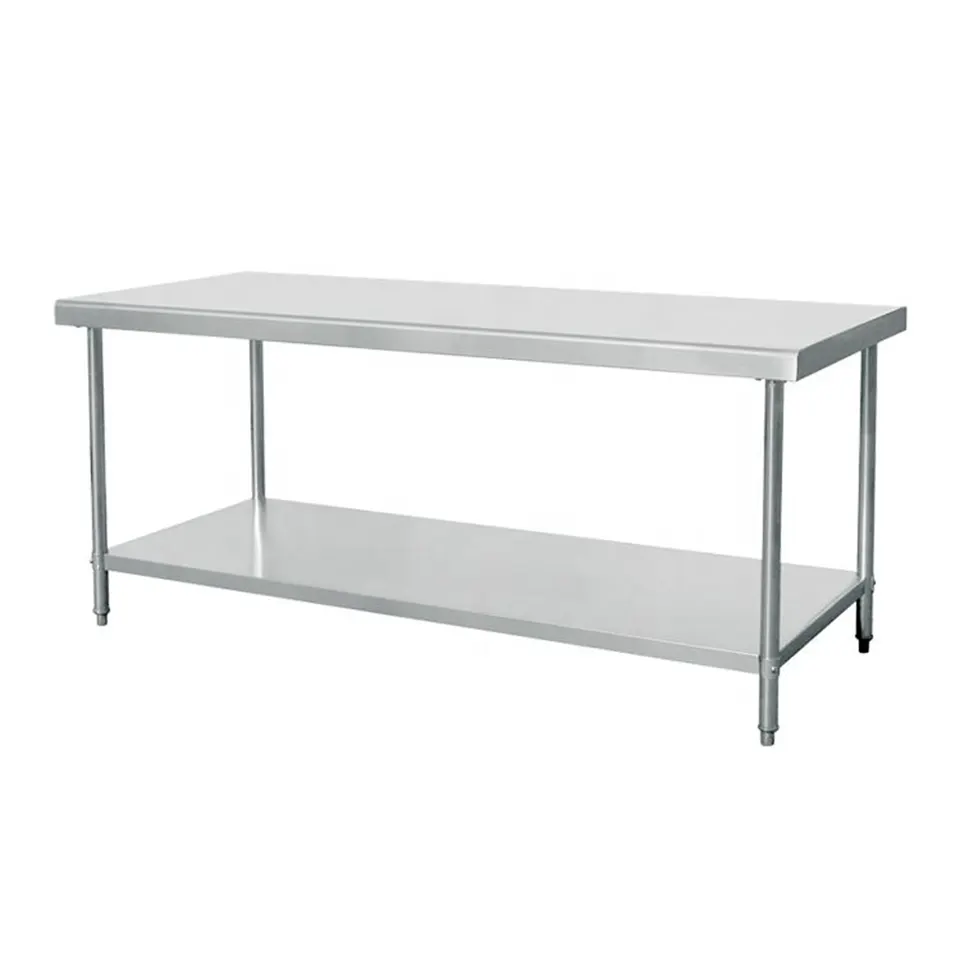
A stainless steel work table is a fixed-height prep surface, and in the Huayi Equipment range it arrives in fourteen stock sizes between 1000 × 600 × 850 mm and 2000 × 700 × 850 mm. The ZZJYGZ-1060 is the shortest 600 mm-deep unit at 1000 mm; the ZZJYGZ-2070 is the longest 700 mm-deep unit at 2000 mm. Both stand at 850 mm, both use 0.8–1.2 mm stainless sheet, and both are built to be worked at standing up. That 1000 mm to 2000 mm spread is where most buying mistakes happen: the length gets picked from a catalogue photo, and the station that has to live around it is drawn afterwards. This guide is for overseas buyers, central kitchen planners, and catering equipment importers specifying a stainless steel work table, wall shelf, or trolley before a quote.
Key Takeaways
- Depth decides the station, length only decides the run. A 600 mm table leaves 275 mm of working strip beside a GN 1/1 pan; a 700 mm table leaves 375 mm.
- The stock length list is 1000, 1200, 1400, 1500, 1600, 1800, and 2000 mm, at 600 mm or 700 mm depth. Fourteen combinations, one height: 850 mm.
- A GN 1/1 pan measures 530 × 325 mm, so a 1200 mm table takes two pans along its length (1060 mm used) and a 1600 mm table takes three (1590 mm used).
- The 100 mm backsplash on the YDLGZT-WS and ZZFGGZT-WS series is not cosmetic. It turns an 850 mm table into a 950 mm object and it changes what fits under a window or a wall shelf.
- Sheet thickness on these tables is listed at 0.8–1.2 mm and steel grade at SUS201 or SUS304. The grade matters more than the thickness wherever the table sees daily washdown, dairy, brine, or acidic marinade.
- Unit weights run from 30 kg for a 1800 mm solid-shelf rack to 60 kg for the OBDLMGZT-WS cabinet. Measure the door and the lift before the shipping date.
- On an 1800 mm or 2000 mm table with a 0.8 mm top, ask whether a centre leg or a 1.2 mm top is available. A long span loaded in the middle is the one thing a size list cannot show you.
What This Equipment Is Used For
A work table is the least technical item on a kitchen equipment list and the one every other station is measured against. It is the surface where product is received, trimmed, portioned, plated, packed, or staged before it moves. It carries no motor, no burner, and no control panel, which is why it usually gets bought last, from a photograph, at whatever length the corridor allows.
In a central kitchen the table does four jobs in sequence. Crates come off a trolley onto a receiving table, product is trimmed and portioned at a prep table with pans under the top, trays are assembled at a plating table beside the pass, and the same surface is wiped down and reused for packing at the end of the shift. Each of those jobs wants a different depth and a different understructure. None of them wants a table chosen at random.
In a restaurant kitchen the table is usually a prep and pass surface at 850 mm, sitting between the cooking line and the cold room. In a food plant it becomes a stainless bench inside a washdown area, where the washdown routine and not the menu decides the steel grade. In a bakery it holds dough benches and cooling trays, and in a retail or dark-kitchen setup it doubles as a packing bench under a wall shelf of gastronorm pans.
What the table is not is a storage unit. Cabinets with doors and drawers — the OBDLMGZT-WS at 1200 × 700 × (850 + 100) mm, or the ZHL-SCG sink cabinet at 2000 × 1100 × 850 mm — solve a different problem, and buying a cabinet where an open undershelf was needed is one of the more expensive habits in kitchen fit-out.
Core Specifications Buyers Should Compare
| Specification | Why It Matters | What Buyers Should Check |
|---|---|---|
| Top length and depth | Sets how many pans, boards, and operators the station can hold at once. | Ask for both figures in mm. Stock lengths are 1000, 1200, 1400, 1500, 1600, 1800, and 2000 mm; depth is 600 mm or 700 mm (ZZJYGZ-1060 through ZZJYGZ-2070). |
| Working height | Decides whether staff stand upright or stoop for eight hours. | 850 mm is the standard on the ZZJYGZ and YDLGZT series; the E-ZXD-120 island is listed at 800 + 85 mm. Match it to operator height, not to the room. |
| Backsplash height | Adds to total height and to the clearance needed behind the unit. | The YDLGZT-WS and ZZFGGZT-WS are listed as 850 + 100 mm. Treat the top of the splash, 950 mm, as the real height when checking windows and shelves. |
| Sheet thickness | Thicker sheet resists dents from stock pots and stays flat under a point load. | Listed at 0.8–1.2 mm across the range. On 1800 mm and 2000 mm tops, ask for 1.2 mm or a centre leg. |
| Steel grade | Grade decides corrosion life in wet, salty, or acidic duty. | SUS304 or SUS201 is offered on most models. Specify 304 for washdown areas, dairy, brine, and daily chlorinated sanitiser. |
| Understructure | Open shelf, sliding doors, drawers, or sink — the choice is about workflow, not price. | Open undershelf (ZZJYGZ), two-tier (YDLGZT-WS), sliding doors (YDLZZLM-1270WS), sink and drawers (ZHL-SCG), corner cabinet (ZZWGT-8282). |
| Unit weight | Sets handling, floor loading, and whether two people can move it. | 40 kg for the YDLZZLM-1270, 60 kg for OBDLMGZT-WS, 30 kg for the ZZSCPBHJ rack. Check the door width and the lift. |
| Legs, feet, and levelling | Floor fall shows up as a rocking table and a puddle at one end. | Ask for the adjustment range of the feet in mm, and whether feet are plastic, stainless, or rubber-booted. |
| Edge and weld finish | Folded or welded edges catch soil; radiused corners clean out. | Ask for the edge type, whether welds are ground flush, and whether tube ends are capped or open. |
Map the Station Before You Read the Size List
The size list is a menu, and reading it first is how buyers end up with a table that fits the wall but not the work. Start with the station role instead. Six roles cover most kitchens.
Receiving and decanting. Crates and boxes come off a trolley, get opened, and go into pans. This station wants 700 mm depth and an open undershelf so crates can be slid under without lifting. A 2000 mm table on this duty replaces two smaller tables and removes a double handling step.
Trim and portion. A cutting board, a pan for trim, and a pan for product. This is the depth-critical station, and it is where 600 mm tables fail. The arithmetic is in the next section.
Plating and passing. Plates go out, not product. A 600 mm depth is enough because nothing is stored on the surface for long, and the narrower top keeps the pass aisle open.
Wash-down. Sinks, hoses, and wet trays. This is where the 1100 mm depth of the ZHL-SCG sink cabinet earns its footprint: one sink, one faucet, two drawers, four doors on a 2000 × 1100 × 850 mm body.
Packing. Trays, film, labels, and a scale. Wants 700 mm depth and a 100 mm backsplash so spill and film offcuts stay on the table. The ZZJYGZ series has no splash; the YDLGZT-WS does.
Holding and issue. Closed storage at working height. Sliding doors, not hinged, wherever a walkway runs in front of the unit — the OBDLMGZT-WS is 1200 × 700 × (850 + 100) mm with two sliding doors and weighs 60 kg.
Write the six roles down, put a length against each, then add them. The total is your run length, and the run length is what the drawing has to absorb. Doing it in the other order — picking a 2000 mm table because it looks generous, then discovering the aisle is 780 mm — is the common failure.
Compare 600 mm and 700 mm Depth Before Length
Depth is the decision most buyers skip, and it is the one that decides whether the table works. Take a gastronorm 1/1 container: 530 × 325 mm under EN 631-1. That single dimension settles the argument.
- 600 mm depth. A pan set down with its 325 mm side across the depth leaves 275 mm of strip. A pan set with its 530 mm side across the depth leaves 70 mm, which is a pan and nothing else.
- 700 mm depth. The same pan leaves 375 mm with the short side across, or 170 mm with the long side across. The second arrangement is how most prep stations actually run: pan behind, board in front.
Now add the board. A standard 450 × 300 mm cutting board placed beside a GN 1/1 pan along the length needs 300 + 530 = 830 mm of frontage. That fits a 1000 mm table with 170 mm to spare, which is why the 1000 mm table is a real one-person prep station and not just an entry size. Two boards and one pan need 300 + 300 + 530 = 1130 mm, so the next stock length, 1200 mm, is the correct answer rather than forcing it onto a 1000 mm top.
Choose 600 mm depth for pass lines, bars, narrow corridors, food trucks, and any station where the operator works from one side and nothing is stored on the surface. Choose 700 mm for trim, portion, packing, and receiving, where a pan and a board have to coexist. Where the station is worked from both sides — an island in a central kitchen — neither depth applies: the E-ZXD-120 drawer island is 1200 × 800 × (800 + 85) mm, and 800 mm is the depth that lets two people face each other.
One more number that gets missed: the gap to the wall. A 700 mm table pushed against a wall with a 100 mm backsplash sits 950 mm tall at the back, and a 50–100 mm gap behind it is what lets a cloth reach the joint. That gap has to be in the room dimension before the table is ordered, not after.
Set the 850 mm Height Against the Operator
Every table in the ZZJYGZ and YDLGZT range is 850 mm to the top. That figure is a convention, not a law, and it suits a standing operator of roughly 1700–1800 mm doing light prep: the surface lands about 200–250 mm below the elbow, which keeps the forearm level and the wrist straight.
Two cases pull away from 850 mm. Heavy knife work — butchery, splitting, large-format vegetable prep — is easier on a surface 800–850 mm, because the stroke comes down rather than across. Two-sided island work pulls the other way in appearance but ends up lower in practice: the E-ZXD-120 is listed at 800 + 85 mm, so the working surface is 800 mm for staff facing each other across it.
The backsplash is where height planning goes wrong. An 850 + 100 mm table is 950 mm tall at the rear edge. If the unit goes under a window sill at 900 mm, or under a wall shelf set at 1450 mm with 600 mm brackets, the splash decides whether it fits. Put 950 mm in the drawing, not 850 mm.
Then check what feeds the table. The DLT02 two-tier and TLT03 three-tier trolleys are 940 mm to the top deck, which is 90 mm above an 850 mm table. A 90 mm lift is nothing for a tray of buns and a real problem for a 20 kg stock pot, so where heavy product moves between trolley and table, plan the transfer in the downhill direction or add a low deck. Trolley depth is 500 mm or 600 mm against a table depth of 600 mm or 700 mm, and that mismatch is what makes a trolley feel unstable when it is pushed against the table edge.
Finally, ask for the adjustment range of the feet. Floors fall by 5 mm over 2 m in a lot of buildings, and a table with 10 mm of adjustment sits flat where one with 3 mm rocks. Levelling feet are a small line item that decides whether the whole run looks installed or improvised.
Match the Stainless Steel Work Table Length to the Station
Length is the number buyers fix first and should fix last. Once role and depth are set, the length follows from two counts: how many operators stand at the table, and how many pans sit on it.
Frontage per operator is the first count. Light prep needs about 600 mm of clear table in front of a person; knife work with a board needs 800 mm; butchery and large-product work needs 1000 mm. A 2000 mm table therefore holds two operators at 800 mm each with 400 mm left as shared landing space. A 1000 mm table is one operator, and it is honest about it.
Pan count is the second. With a GN 1/1 pan at 530 mm along the length: 1000 mm takes one pan, 1200 mm takes two (1060 mm used), 1400 mm takes two with 340 mm spare, 1500 mm takes two with 440 mm spare, 1600 mm takes three (1590 mm used), 1800 mm takes three with 210 mm spare, and 2000 mm takes three with 410 mm spare. Those spare millimetres are where the board, the scale, or the label roll goes — and where a table that looked generous turns out to be tight.
The stock ZZJYGZ sizes, with the station each one usually serves:
| Model | L × W × H (mm) | Typical station |
|---|---|---|
| ZZJYGZ-1060 | 1000 × 600 × 850 | Single-operator pass or bar prep |
| ZZJYGZ-1070 | 1000 × 700 × 850 | One board plus one GN 1/1 pan |
| ZZJYGZ-1260 | 1200 × 600 × 850 | Two pans, no board, narrow aisle |
| ZZJYGZ-1270 | 1200 × 700 × 850 | Two pans or two boards, prep |
| ZZJYGZ-1460 | 1400 × 600 × 850 | Plating line, one side worked |
| ZZJYGZ-1470 | 1400 × 700 × 850 | Prep with two pans and landing space |
| ZZJYGZ-1560 | 1500 × 600 × 850 | Pass with plate stack and garnish |
| ZZJYGZ-1570 | 1500 × 700 × 850 | Prep with two pans, 440 mm spare |
| ZZJYGZ-1660 | 1600 × 600 × 850 | Long pass or packing bench |
| ZZJYGZ-1670 | 1600 × 700 × 850 | Three GN 1/1 pans, 1590 mm used |
| ZZJYGZ-1860 | 1800 × 600 × 850 | Two operators, narrow depth |
| ZZJYGZ-1870 | 1800 × 700 × 850 | Two-operator prep, three pans |
| ZZJYGZ-2060 | 2000 × 600 × 850 | Receiving run against a wall |
| ZZJYGZ-2070 | 2000 × 700 × 850 | Receiving or two-operator prep |
Two structural checks ride on length. Above 1800 mm, a 0.8 mm top with legs only at the corners will flex under a point load in the middle, so ask for a centre leg, a 1.2 mm top, or a welded frame with a centre rail. And every length has a matching packing size — 1.03 × 0.63 m for a 1000 mm 600 mm-deep table up to 2.03 × 0.73 m for the ZZJYGZ-2070 — which is the number a freight forwarder will ask for before you have thought about it.
How to Choose the Right Model
Production Capacity
Capacity on a work table is positions, not kilograms. Count how many pans can be filled at once, how long a fill takes, and how many operators can work without crossing arms.
Worked example on the ZZJYGZ-1670. It is 1600 × 700 mm and takes three GN 1/1 pans along its length with 10 mm of slack. Two operators stand at it, one at each end, at 800 mm of frontage each — 1600 mm exactly. If a three-pan fill takes 12 minutes including weighing and labelling, the station turns out five batches an hour, or fifteen pans an hour. Push the target to twenty-five pans an hour and the answer is not a faster operator; it is a second table or a 2000 mm unit with a third position.
Run the same arithmetic on the ZZJYGZ-1270: 1200 mm holds two pans, one operator at 800 mm has 400 mm of landing, and a two-pan fill at 12 minutes gives ten pans an hour. That is a real number for a small central kitchen and it is a quarter of what the 2000 mm table with two operators delivers.
The understructure changes capacity more than the top does. A two-tier YDLGZT-WS puts a second surface within reach and cuts walking; an open undershelf holds crates but requires bending; a sliding-door cabinet keeps clean pans dust-free but blocks the shelf for wet crates. Choose the understructure for the flow, then confirm the top size against it. These figures are planning arithmetic on published dimensions, not measured throughput.
Food Contact Materials
Work tables are food contact surfaces and should be specified as such, in writing. Two grades are offered across this range: SUS304 and SUS201.
SUS304 carries roughly 18–20% chromium and 8–10.5% nickel, which is what gives it its resistance to chloride pitting. SUS201 carries roughly 16–18% chromium and 3.5–5.5% nickel, with manganese substituted for part of the nickel; it is cheaper and it is visibly less resistant to salt, brine, dairy residues, and chlorinated sanitiser left standing on a surface. In a dry prep area a 201 table will last. In a washdown area, a fish or meat room, or anywhere a chlorinated sanitiser is used daily, 304 is the grade to specify and the price difference is small against replacing a run in three years.
Thickness is listed at 0.8–1.2 mm. Thicker sheet resists denting at the corners where stock pots land, and it holds a flat plane across a long span. Ask which thickness applies to the top as opposed to the undershelf — they are not always the same.
Finish and fabrication matter as much as the grade. Welds should be ground flush where product touches, corners should be radiused rather than square, and tube ends should be capped so water cannot sit inside a leg. For export markets, ask for the declaration against the destination rule set: GB 4806.9-2016 for stainless steel in China, the EU framework regulation 1935/2004 with its national implementing rules, and FDA 21 CFR Parts 175–178 for the United States. For a food plant rather than a kitchen, EN 1672-2:2005+A1:2009 is the hygiene standard the auditor will reference, and it is the one that turns a table from furniture into equipment.
Cleaning and Maintenance
A work table is cleaned several times a shift, so the routine has to be short. Wipe down, sanitise, dry. The failure modes are all in the details.
Water left standing at a leg joint or under a folded edge is what starts the pitting that eventually becomes a hole. Wipe the joint dry rather than flooding it, and do not leave a chlorinated sanitiser to evaporate on the surface — rinse and dry it. Steel wool and wire brushes leave free iron that rusts on its own; use a nylon pad and, where scouring is needed, a stainless-compatible one.
Keep 150 mm of clear floor under the undershelf so a mop reaches the whole footprint. A table pushed flat to the floor traps water and debris and the smell starts there, not on the top. Where the unit sits against a wall, the 50–100 mm gap behind it is a cleaning access point, not wasted space.
Weekly checks that catch most problems: run a hand along the top for a bowed plane, look at every weld for a rust bloom, lift each pan and check the underside of the top for moisture, and confirm the feet still sit flat. On units with sliding doors, clean the track — a track packed with flour or grease is what makes a door jump rather than slide.
Fit Shelving, Trolleys, and Cabinets into the Same Drawing
A table on its own is a surface. The run around it is what makes a station, and the pieces are all drawn to the same 850 mm logic — until they are not.
Wall shelving above the table is the cheapest capacity in the room. The GQJ-2 double wall-mount flat shelf comes in 1000, 1200, 1400, 1500, 1600, 1800, and 2000 mm lengths at 300 mm or 400 mm depth, listed with a 600 mm height dimension and sold at a minimum of 10 sets. For gastronorm storage specifically, the ZZDCQJ series holds 3–6 pans at 900, 1200, 1500, or 1800 × 300 mm. Keep a 450–500 mm gap between the table top and the underside of the shelf so a board can stand on end and a hand can reach the back of the top pan.
Free-standing storage is the ZZSCPBHJ and ZZSCFGHJ solid-shelf racks: 1000 mm to 2000 mm long, 400 mm or 500 mm deep, 1800 mm high, 0.8–1.2 mm sheet, about 30 kg per unit. Four shelves at 1800 mm high is roughly 1.6 m² of storage in a 0.5 m² footprint, which is why these racks do the work that a second table cannot.
Trolleys move the product between those surfaces. The DLT02 two-tier and TLT03 three-tier units run 800 × 500 × 940 mm up to 1200 × 600 × 940 mm in SUS201 or SUS304 at 0.8–1.2 mm. Their 940 mm top is 90 mm above an 850 mm table, and their 500 mm or 600 mm depth is narrower than a 700 mm table — both facts change how the transfer is done, and neither is on a catalogue photo.
Closed storage comes in three shapes worth separating. Sliding-door cabinets — YDLZZLM-1270WS at 1200 × 700 × (850 + 100) mm with two doors, OBDLMGZT-WS at the same footprint and 60 kg — suit a walkway in front. Drawer units — the E-ZXD-120 island at 1200 × 800 × (800 + 85) mm — suit a two-sided station. Sink units — the ZHL-SCG at 2000 × 1100 × 850 mm with one sink, one faucet, two drawers, and four doors — suit a wash-down position where the sink and the landing space belong together. Corner units fill the leftover: ZZWGZT-8282 at 827 × 850 + 100 mm and ZZWGZT-7272 at 727 × 850 + 100 mm.
The rule that keeps a run looking and working like one installation: one height plane, one steel grade, one sheet thickness, one edge treatment. Mixed 201 and 304 in the same run is visible within a year, because the two grades discolour differently.
Buyer Checklist
- Name the station role: receiving, trim, plating, wash-down, packing, or holding.
- Confirm the pan format and count — GN 1/1 at 530 × 325 mm, GN 1/2, or trays — before choosing depth.
- Set depth at 600 mm for single-sided, narrow work and 700 mm where a board and a pan coexist.
- Set the height at 850 mm for standing prep, 800–850 mm for heavy knife work, and check islands separately.
- Add the 100 mm backsplash to the height stack and put 950 mm in the drawing.
- Count operators and multiply by 600, 800, or 1000 mm of frontage to confirm the length.
- Above 1800 mm, ask for a centre leg, a 1.2 mm top, or a centre rail.
- Specify SUS304 wherever washdown, dairy, brine, fish, or daily chlorinated sanitiser is involved.
- Ask which sheet thickness applies to the top and which to the undershelf.
- Confirm the understructure: open shelf, two-tier, sliding doors, drawers, or sink.
- Check the route: door width, lift capacity, and turning space for 30 kg to 60 kg units.
- Request the food contact declaration, the packing dimensions, and the foot adjustment range in writing.
Common Mistakes to Avoid
Choosing length before depth. A 2000 mm table at 600 mm depth cannot hold a board and a GN 1/1 pan side by side in comfort. Length buys run; depth buys work. Get depth right first and the length list becomes obvious.
Forgetting the backsplash in the height stack. An 850 + 100 mm table is a 950 mm object at the rear edge. Buyers who check 850 mm against a 900 mm window sill order a unit that does not fit, and the fix is a fabrication job rather than a return.
Mixing 201 and 304 in one run. The saving is real on paper and disappears at the first rust bloom on one table out of six. Write the grade on the purchase order per line item, not once for the project.
Ignoring the 90 mm trolley step. A 940 mm trolley against an 850 mm table means every transfer is a small lift. Fine for trays, wrong for stock pots and full pans — and the answer is a low deck or a different trolley, not more training.
Putting a 2000 mm table into an 800 mm aisle. Staff need 900–1200 mm of clear aisle to work at a table and pass behind each other. A generous table in a tight room produces a station nobody uses.
Buying a cabinet when an open shelf was needed. Doors keep clean pans clean and they also stop wet crates going under. Decide from the flow of the shift, not from how tidy the catalogue photo looks.
FAQ
Q: What is a stainless steel work table used for?
A: It is a fixed-height work surface for receiving, trimming, portioning, plating, packing, and staging product. In a central kitchen it is usually the surface between a trolley and a pan; in a restaurant it sits between the cooking line and the cold room; in a food plant it is a washdown bench. It carries no powered parts, which is why it is specified by dimensions, steel grade, and understructure rather than by performance.
Q: What is the standard height of a commercial work table?
A: 850 mm to the top across the ZZJYGZ and YDLGZT series, with the backsplash adding 100 mm for a 950 mm overall height. That suits a standing operator around 1700–1800 mm doing light prep. Heavy knife work is easier at 800–850 mm, and two-sided island units such as the E-ZXD-120 are listed at 800 + 85 mm.
Q: Should I choose 600 mm or 700 mm depth?
A: 600 mm for single-sided work where nothing is stored on the surface — pass lines, bars, narrow corridors, food trucks. 700 mm wherever a cutting board and a GN 1/1 pan have to sit together, because 700 mm leaves 375 mm of working strip beside a 325 mm-wide pan and 600 mm leaves 275 mm, which is not enough for a board plus product.
Q: How many GN 1/1 pans fit on a 1200 mm work table?
A: Two. A GN 1/1 pan is 530 × 325 mm under EN 631-1, so two pans take 1060 mm of a 1200 mm top and leave 140 mm. A 1600 mm table takes three (1590 mm used). A 1000 mm table takes one pan, or one pan plus a 300 mm-wide board.
Q: Is SUS201 good enough, or do I need SUS304?
A: SUS201 is adequate in a dry prep area with light cleaning. It carries less nickel than 304 — roughly 3.5–5.5% against 8–10.5% — and resists chlorides noticeably less. Anywhere the table sees daily washdown, brine, dairy, fish, or chlorinated sanitiser, specify SUS304. In a mixed run, keep one grade throughout so the tables age the same way.
Q: How much weight can a work table hold?
A: Ask the supplier for a per-shelf load rating in kg for the specific model and sheet thickness; it is not a figure to assume from the size. On 1800 mm and 2000 mm tops with a 0.8 mm sheet, a centre leg or a 1.2 mm top is the practical request. Distribute heavy pans over the legs rather than loading the middle of a long span.
Q: How should a stainless table be cleaned?
A: Wipe, sanitise, and dry, several times a shift. Avoid leaving chlorinated sanitiser to evaporate on the surface, avoid steel wool and wire brushes, and dry the leg joints instead of flooding them. Keep 150 mm of clear floor under the undershelf and 50–100 mm behind the unit so the whole footprint can be reached.
Q: Can I get a custom length or depth?
A: Most of this range is listed as customisable, and the stock list of seven lengths at two depths covers the majority of stations. Before going custom, check whether a 1500 mm or 1800 mm stock unit plus a 400 mm return does the same job — custom fabrication adds a drawing approval step and a separate packing size, and both affect the delivery date.
Sources
- EN 631-1:1993 — materials and articles in contact with foodstuffs, catering containers, dimensions of containers (gastronorm sizes).
- EN 10088-1 — stainless steels, list of stainless steel grades, including 1.4301 (AISI 304).
- GB 4806.9-2016 — food contact metallic materials and articles, migration limits for stainless steel.
- EU Regulation (EC) No 1935/2004 — materials and articles intended to come into contact with food.
- FDA, 21 CFR Parts 175–178 — indirect food additives: adhesives, coatings, and polymers for food contact surfaces.
- FAO/WHO, Codex Alimentarius CXC 1-1969, General Principles of Food Hygiene — smooth, impervious, corrosion-resistant food contact surfaces.
- EN 1672-2:2005+A1:2009 — food processing machinery, hygiene requirements, for plant rather than kitchen duty.
- HSE (UK), Health and safety in kitchens and food preparation areas — workstation layout, reach distances, and floor condition.
Related Examples
Model pages for the units referenced above, with the full specification tables:
- ZZJYGZ series stainless steel work table, 14 sizes from 1000 × 600 × 850 mm to 2000 × 700 × 850 mm
- YDLGZT-WS two-tier stainless steel work table, 850 + 100 mm, 14 sizes
- ZZFGGZT-WS detachable two-tier work table with backsplash
- YDLGZT two-layer work table with backsplash, 600 mm and 700 mm depth
- ZHL-SCG work table with sink, two drawers, and four doors, 2000 × 1100 × 850 mm
- E-ZXD-120 drawer center island worktable, 1200 × 800 × (800 + 85) mm
- OBDLMGZT-WS sliding-door cabinet, 1200 × 700 × (850 + 100) mm, 60 kg
- DLT02 two-tier stainless steel trolley, 800 × 500 × 940 mm to 1200 × 600 × 940 mm
- TLT03 three-tier utility trolley, SUS201/304 at 0.8–1.2 mm
- ZZSCPBHJ solid-shelf rack, 400 mm and 500 mm deep, 1800 mm high
- GQJ-2 double wall-mount flat shelf, 300 mm and 400 mm deep
- ZZDCQJ wall-mounted GN pan holder, 3–6 pans, 900–1800 mm
- Work tables collection
- Shelving collection
- Related guide: HC-95 bone cutting station for central kitchens
- Related guide: steam jacketed cooking kettle sizing
- Send station drawings, pan counts, and site conditions for a size recommendation
Sizing a stainless steel work table comes down to three moves in order: the station role for the depth, the operator count for the length, and the steel grade for the duty. Model numbers follow from those three answers — ZZJYGZ-1070 for a single prep position, ZZJYGZ-1670 for three pans and two operators, ZZJYGZ-2070 for a receiving run — and not from the price list. Final specifications should be confirmed according to the selected model and supplier documentation.
Published on 2026-11-03. Author: 苏涛;舜翔央厨、华艺智能