
How to choose a steam jacketed cooking kettle for central kitchens: HR-17 batch volume, jacket area, ramp time, steam draw and acceptance tests.
A steam jacketed cooking kettle succeeds on three numbers a quotation rarely shows together: usable batch volume, jacket area in square metres, and heat input at your real ramp time. Divide the batch weight in kilograms by product density, then by a fill ratio of 0.75 for sauces or 0.55 for foaming products. Then treat jacket area as a selection limit rather than a marketing feature: 0.5 to 0.9 square metres per 100 L is the workable band. The Huayi HR-17 runs 50 to 800 L in SUS304, in gas, electric, steam and thermal-oil versions. Final specifications should be confirmed according to the selected model and supplier documentation.
Key Takeaways
- Size the HR-17 on usable batch, not nominal litres: 60 to 80 percent fill for sauces, 50 to 60 percent for foaming products.
- Jacket area of 0.5 to 0.9 square metres per 100 L separates a soup kettle from a paste kettle. Under 0.4 and thick product scorches at the wall.
- Budget 20 to 22 kW of heat input per 100 L to lift a water-like product from 20 to 95 degrees Celsius in 30 minutes.
- A steam-heated kettle draws about 30 kg/h of steam per 100 L during the ramp, so size the boiler on simultaneous draw.
- Above 200 L, or for settling and gelatinising products, agitation is a process requirement, not an accessory.
- Sign off on a hydrostatic test at 1.5 times design pressure, a three-point temperature check and a measured discharge residue.
What a Steam Jacketed Cooking Kettle Is Used For
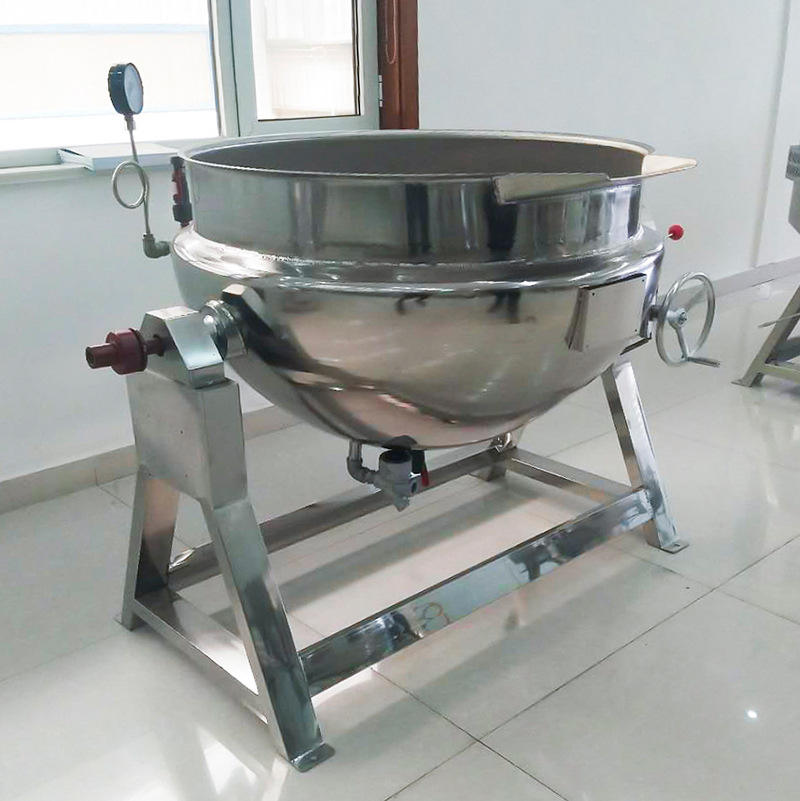
A jacketed cooking kettle carries heat in a sealed cavity between the product bowl and the outer shell. Saturated steam, hot oil or thermal fluid fills that cavity, so heat enters through the whole wetted surface rather than one burner under the bottom. In most central kitchens this equipment handles soup bases, curry, bean paste, fruit fillings, jam, caramel, dairy and confectionery, and pre-cooks vegetables and meat before portioning.
Contact area is the practical difference. An HR-17 at 300 L carries roughly 1.8 square metres of jacket, about six times the heated surface of a direct-fired pot with the same footprint. That capacity also sets the batch rhythm: 200 kg of sauce reaches 95 degrees Celsius in about thirty minutes, and the bottom layer does not scorch while the core is still cold.
How to Choose the Right Model
Production Capacity
Start with the batch sheet. A recipe calling for 250 kg per cook at 1.05 kg per litre is 238 L of product. At a 0.75 fill ratio that needs about 317 L of nominal capacity, so HR-17 at 300 L is marginal and the 400 L body is comfortable. Ordering 250 L for a 250 kg sauce batch puts you at 95 percent fill, and the first starch-thickened recipe will boil over.
Three fill ratios cover most work: 60 to 80 percent for sauces, stews and fillings, with 75 percent as the default; 50 to 60 percent for milk, soy milk and starch-thickened sauces that foam; 85 percent maximum for clear stock under gentle heat.
Jacket Area and Heat Source
Two kettles can both claim 300 L and 30 kW and behave nothing alike, because jacket area decides how much wall the product actually touches. Ask for the number in square metres; on a 300 L body it lands near 1.8 square metres. Bean paste, curry and caramel sit against the wall long enough to burn if the heated surface is small relative to volume, and extra kW does not fix a jacket that is simply too small.
In practice the heat source is decided by what the building already has. Steam jacket at 0.3 to 0.6 MPa suits sites with a boiler and two or more vessels cooking at once, and needs a trap set with condensate handling. Electric, at 24 to 36 kW three-phase for a 200 L unit, avoids the boiler but changes the panel. Gas suits food streets and remote plants without steam, provided a flue path is planned. Thermal oil suits caramel and work above 150 degrees Celsius, with oil change intervals as a maintenance item.
Coordinate Ramp Time With the Boiler or the Panel
For water-like products the energy is mass times specific heat times temperature rise. One hundred kilograms from 20 to 95 degrees Celsius is 31,350 kJ, which over 1,800 seconds equals 17.4 kW of net heat. Add 15 to 25 percent for heating the vessel and for losses, and the working figure is 20 to 22 kW per 100 L for a thirty-minute ramp.
That number propagates. Halve the ramp and you double the power, which changes the boiler or the electrical service rather than only the kettle. Steam at 0.4 MPa gauge carries about 2,100 kJ per kilogram of latent heat, so 17.4 kW works out to roughly 30 kg/h per 100 L. An 800 L HR-17 on a thirty-minute ramp therefore asks for about 240 kg/h, enough to matter when the same boiler also feeds a retort.
Thick product behaves worse than the formula, because the heat transfer coefficient collapses even though specific heat is lower. Budget 1.3 to 1.8 times the water time unless the kettle carries a scraper agitator.
Food Contact Materials
SUS304 covers general sauces, soups and dairy. Buyers should check 316L where the product is acidic, salted or high in chlorides, and should ask for mill certificates to EN 10204 3.1 rather than a statement on the quotation. Welds on product-contact surfaces should be continuous and ground flush, because a rough weld is where cleaning validation fails first. Insulation on the outer shell belongs in the specification too: above 45 degrees Celsius at the surface is both a burn risk and a standing heat loss.
Cleaning and Maintenance
Two similarly priced kettles often separate at washdown. Check whether the jacket drain, relief valve and gauge are reachable without dismantling pipework, and whether the agitator can be lifted for cleaning. Where the site runs CIP, confirm the spray path reaches the jacket-side fittings. Keep a spares shelf of relief valve, jacket pressure gauge, gasket set, scraper blades and one temperature probe; those five items stop production and are rarely available locally within a day.
Body Type, Discharge and Agitation
Discharge is where a good selection goes wrong. A bottom outlet alone leaves 5 to 8 percent of a viscous batch in the bowl, and on caramel that residue is a cost line rather than an inconvenience. Above 500 L, fixed body with a DN50 outlet is the practical choice. Between 100 and 300 L, a hand-wheel tilt body suits batch work and needs clearance of one vessel diameter plus 300 mm in front.
Agitation follows the product. Below 100 L most sauces are fine with manual stirring. Above 200 L, an anchor with a PTFE scraper keeps the boundary layer moving on high-solids products; a frame or paddle handles soups with particulates; a planetary head covers emulsions needing both sweep and shear. Speed matters more than power: 20 to 40 rpm for scraping, 60 to 120 rpm for dissolving.
Core Specifications Buyers Should Compare
| Specification | Why It Matters | What Buyers Should Check |
|---|---|---|
| Nominal capacity and usable batch | Nominal litres are brim volume; usable is 60 to 80 percent of it, or 50 to 60 percent for foaming products | Convert batch weight in kg to litres using density, then confirm the fill ratio in writing |
| Jacket heating area | Sets heat-up speed and how evenly heat spreads through thick product | Ask for square metres, not only kW; 0.5 to 0.9 square metres per 100 L is the normal band |
| Heat source and input | Decides whether the site needs a boiler or a larger electrical service | Confirm gas, electric, steam or thermal oil, plus kW or steam draw at your ramp time |
| Jacket design pressure | Governs maximum jacket temperature and the pressure safety file | Require design pressure, relief valve setting and a hydrostatic test at 1.5 times design pressure |
| Body type and discharge | Tilt or fixed changes labour, floor space and residual product | Above 500 L prefer fixed with a DN50 bottom outlet; for viscous product check residual volume or specify tilt |
| Agitation | Determines whether thick or settling products can be cooked at all | Confirm agitator type, scraper material and speed; 20 to 40 rpm scraping, 60 to 120 rpm dissolving |
| Product-contact material | Affects corrosion life and hygiene compliance | Ask for SUS304 or 316L certificates to EN 10204 3.1, and match the grade to chloride and acid exposure |
Final specifications should be confirmed according to the selected model and supplier documentation.
Buyer Checklist
- Confirm the product, target viscosity at discharge and batch weight in kilograms.
- Confirm the required ramp time in minutes, not only the target temperature.
- Check site services: available steam pressure and flow, or electrical capacity and phase.
- Confirm jacket heating area in square metres and design pressure with test report.
- Confirm body type, discharge method and expected residual volume on a viscous batch.
- Ask for equipment photos, dimensional drawings and a heat-up test record where available.
- Confirm the spare parts list, warranty terms and the technical file shipped with the unit.
Common Mistakes to Avoid
- Buying on nominal litres. A 250 L kettle cooking a 250 kg sauce batch is already at 95 percent fill.
- Comparing kW without comparing jacket area, which is what actually controls uniformity in thick product.
- Specifying a fast ramp without checking the boiler or the panel can support it.
- Choosing a bottom outlet only, then losing 5 to 8 percent of every viscous batch.
- Putting the temperature probe in the jacket instead of the product, so the controller reads 150 degrees while product sits at 70.
- Accepting a pressure test at working pressure instead of 1.5 times working pressure.
FAQ
Q:How do I convert a batch weight into kettle litres for an HR-17?
A:Divide the weight by product density, then by the fill ratio. Water is 1.00, dairy about 1.03, tomato sauce 1.05 to 1.10 and caramel 1.30 to 1.35. A 250 kg sauce batch at 1.05 and 0.75 fill needs about 317 L, so the 300 L body is marginal and 400 L is comfortable.
Q:Do I need a boiler for a 200 L jacketed cooking kettle?
A:Not necessarily. A 200 L electric unit at 24 to 36 kW avoids the boiler entirely, at the cost of a larger electrical service. Steam starts to make sense from about 300 L upward, or as soon as two or more vessels run at the same time.
Q:How much longer does a thick product take to heat?
A:Budget 1.3 to 1.8 times the water time without agitation, and 1.1 to 1.3 times with a scraper agitator. A batch that heats as water in 30 minutes takes 40 to 55 minutes at around 1,200 cP.
Q:Can one 800 L kettle replace two smaller ones?
A:Only if the batch schedule allows. A single 800 L body removes a full production day when the jacket needs repair, while two 400 L units keep running at half rate. That trade is usually worth the extra footprint in plants running five days a week.
Q:What spare parts should be kept on site?
A:Relief valve, jacket pressure gauge, gasket set, agitator scraper blades and one temperature probe. These five items stop production and are rarely available locally within a day.
Sources and References
- FAO, food processing equipment and hygiene guidance, on vessel cleaning and food-contact surfaces.
- HSE, Pressure Systems Safety Regulations guidance, on design pressure, relief protection and written schemes of examination.
- Directive 2014/68/EU on pressure equipment, on jacket design pressure and conformity documentation.
- FDA 21 CFR Part 177, on indirect food additives and polymer materials in food-contact construction.
- EN 10204:2004, on inspection documents including the 3.1 certificate for stainless steel.
- GB 4806.9-2016, on metal materials and articles in contact with food.
Related Examples
- Jacketed Cooking Vessels category
- Industrial SUS304 Steam Jacketed Cooking Kettle 50-800 L
- Electric SUS304 Jacketed Cooking Kettle 100-600 L, hand tilt
- Gas Heated SUS304 Jacketed Kettle 100-600 L, smart control
- Thermal Processing Equipment category
- Retort Sterilizers category
Conclusion
The decision order is short: batch weight and fill ratio, then jacket area, then heat source against site services, then ramp time against the boiler or the panel, and only then body type and discharge. Price, MOQ, lead time, warranty, project scope and site survey terms are quote items and belong in the same request. Huayi Equipment builds the HR-17 from 50 L to 800 L in SUS304, and is one example of a supplier that answers these questions with drawings rather than adjectives. Send your batch weights, target ramp times, site services and discharge method to start that conversation. Final specifications should be confirmed according to the selected model and supplier documentation.
苏涛;舜翔央厨、华艺智能