
Commercial ice maker sizing from SD-22 to SD-250: 23 to 250 kg/h output, 15 to 250 kg storage, 0.3 to 2.5 kW, and why kg/h and kg/24h are not the same.
Commercial ice maker sizing from SD-22 to SD-250: 23 to 250 kg of ice per hour, 15 to 250 kg of built-in storage, 0.3 to 2.5 kW on a 220 V supply, in footprints from 500 × 505 × 815 mm to 570 × 840 × 1750 mm.
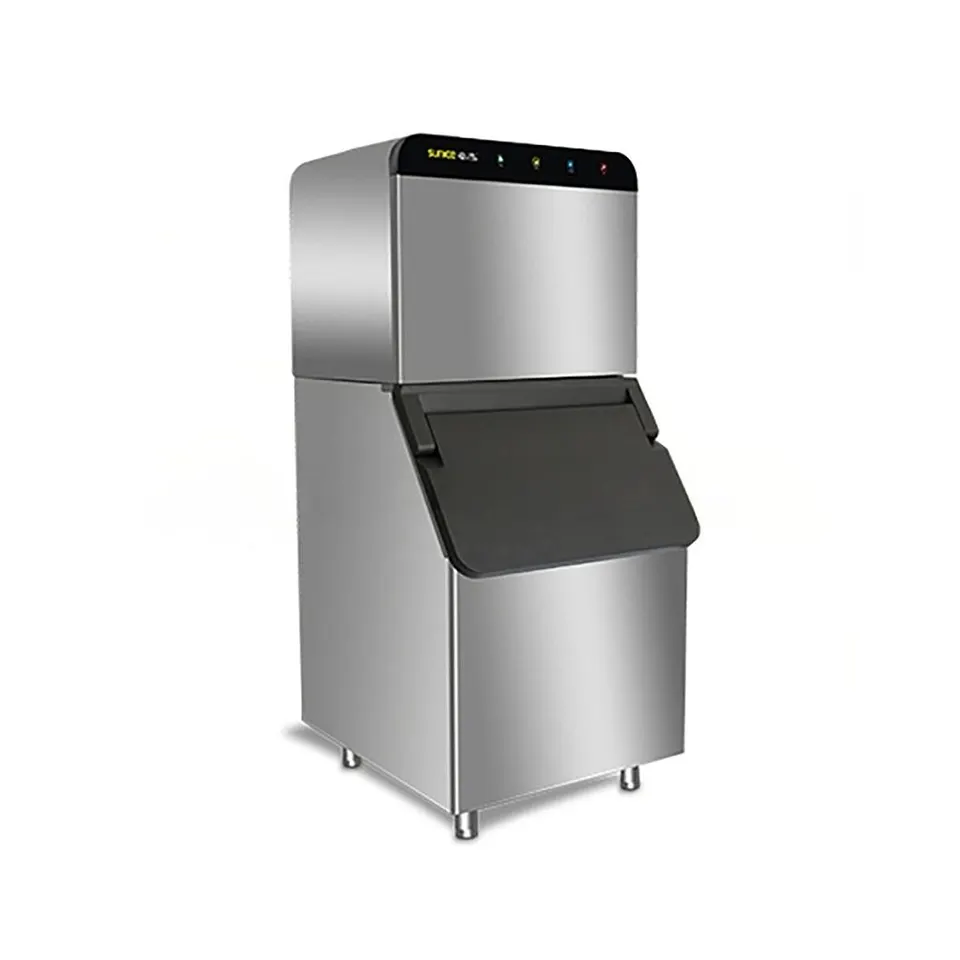
A 23 kg/h SD-22 fills a 15 kg bin and weighs 45 kg. A 250 kg/h SD-250 fills a 250 kg bin, stands 1750 mm tall and weighs 200 kg. Both are listed as commercial ice makers on the same 220 V supply, and the distance between them is the whole specification argument: kilograms per hour, kilograms of storage, and heat that has to go somewhere.
This guide is written for restaurant operators, central kitchen planners, seafood and meat processors, and importers who have to place an ice machine on a real floor plan and defend the capacity figure to a production manager.
Key Takeaways
- Ice output is quoted two ways on this site: the SD series in kg/h, the ZB block and YN snowflake machines in kg/24h. A 250 kg/24h block machine is about 10.4 kg/h, roughly 24 times smaller than a 250 kg/h SD-250.
- Bin capacity, not output, decides how often someone opens the door: SD-22, SD-28 and SD-43 all carry 15 kg of storage.
- Connected power runs from 0.3 kW on SD-22 to 2.5 kW on SD-250, all single phase at 220 V.
- SD-150 and SD-250 stand 1750 mm tall in a 570 × 840 mm footprint; ceiling height and service access fail more layouts than floor area does.
- Air-cooled and water-cooled snowflake machines share an output class but not an installation: air-cooled rejects heat into the room, water-cooled needs supply, drain and acceptable water hardness.
- R404A is the refrigerant listed across the snowflake range, so refrigerant rules at the destination market belong in the quotation, not in commissioning.
What a Commercial Ice Maker Is Used For
Ice in a food operation is process equipment, not a garnish. It pulls the temperature out of raw fish, poultry and leafy vegetables before packing, it holds product in a display or a transport crate, and it supplies the cold water that dough and meat mixing recipes assume. That is why the specification starts with kilograms per hour at a stated water and ambient temperature, not with how many cubes fit in a glass.
Three families cover that duty here. The SD series is the hourly-rated machine with an integral storage bin, from 23 kg/h to 250 kg/h. The ZB series makes solid block ice at 30 to 250 kg per 24 hours for slow-melting cooling in fishing and food processing. The YN series makes snowflake ice at 180 to 300 kg per 24 hours in air-cooled and water-cooled versions, and that flake form is what most seafood rooms actually want, because it beds around the product instead of bruising it.

Model Range at a Glance
| Model | Output (kg/h) | Storage (kg) | Power (kW) | Dimensions L × W × H (mm) | Weight (kg) |
|---|---|---|---|---|---|
| SD-22 | 23 | 15 | 0.3 | 500 × 505 × 815 | 45 |
| SD-28 | 28 | 15 | 0.38 | 500 × 505 × 815 | 48 |
| SD-43 | 40 | 15 | 0.32 | 500 × 505 × 815 | 50 |
| SD-48 | 48 | 28 | 0.36 | 500 × 560 × 885 | 54 |
| SD-60 | 60 | 46 | 0.4 | 500 × 560 × 885 | 58 |
| SD-90 | 90 | 60 | 0.5 | 700 × 560 × 945 | 80 |
| SD-120 | 120 | 100 | 0.95 | 820 × 585 × 965 | 100 |
| SD-150 | 150 | 100 | 1.6 | 570 × 840 × 1750 | 120 |
| SD-250 | 250 | 250 | 2.5 | 570 × 840 × 1750 | 200 |
Hourly Output and Daily Output Are Not the Same Number
Read the unit before the number. A ZB-500 rated 250 kg/24h makes roughly 10.4 kg of ice every hour. An SD-250 rated 250 kg/h makes 250 kg in the same hour, and around 6000 kg across a day if it runs continuously. Two catalogue pages, one identical figure, a 24-fold difference in plant capacity.
The same trap sits inside a single range. YN-130 and YN-160 are both listed at 255 kg/24h and both draw 1600 W, while YN-1752 at 180 kg/24h draws 1000 W. Compressor make, condenser build and evaporator design move the figure without changing the box outline. Ask for output at a defined ambient and water temperature, and ask whether the rating assumes 20 °C or 30 °C room temperature — a machine rated at 20 °C delivers visibly less in a 32 °C kitchen in August.
Core Specifications Buyers Should Compare
| Specification | Why It Matters | What Buyers Should Check |
|---|---|---|
| Output basis | kg/h and kg/24h are different scales and cannot be compared directly. | Confirm the unit, the ambient temperature and the water temperature behind the rating. |
| Storage bin capacity | Sets how often the shift empties the bin and whether service stops waiting. | 15 kg on SD-22 against 250 kg on SD-250 is a different working rhythm, not a bigger box. |
| Connected power | Drives breaker size, cable, and whether the existing board can take the circuit. | 0.3 kW on SD-22 is a lighting circuit; 2.5 kW on SD-250 needs its own breaker and a neutral. |
| Cooling type | Air-cooled rejects heat into the room; water-cooled rejects it into the drain line. | Room volume, air changes, water supply, drain fall and water hardness decide which one works. |
| Refrigerant | R404A carries a high global warming potential and is restricted in some markets. | Check the destination country's F-gas rules and service-gas availability before ordering. |
| Footprint and height | Height, not floor area, is the item that fails on site. | SD-150 and SD-250 need 1750 mm of height plus clearance to lift the top panel for service. |
| Weight and floor loading | 200 kg on SD-250 plus 250 kg of ice is a point load, not a furniture item. | Check the floor, the access route and the door width against the machine dimensions and weight. |
| Ice form | Flake beds around fish; block melts slowly; cube suits display and drinks. | Confirm the evaporator type for the exact model, because the same body can be built for different ice forms. |
| Hygiene and controls | Ice is food and is inspected as food. | Stainless bin and frame, removable scoop holder, cleanable gasket, and a controller that reports faults. |
Match the Bin to the Service Window
Bin size sets the rhythm of the shift. SD-60 makes 60 kg/h and holds 46 kg, so a full bin is 46 minutes of production; if the kitchen draws 60 kg across a lunch service, somebody bags ice twice. SD-250 holds four hours of its own output, which is what a processing hall needs when the machine sits away from the line.
The rule used on site: storage should cover the busiest two hours of draw, and hourly output should cover the daily total divided by the hours the machine is allowed to run. A machine switched off at night cannot count those hours, and a bin emptied faster than the evaporator refills it turns a correctly sized machine into a complaint.
Check Power, Water, Drain and Ambient Conditions
The electrical load is small; the installation around it is not. SD-22 draws 0.3 kW and SD-250 draws 2.5 kW, both at 220 V single phase. The circuit, not the kilowatts, damages schedules: a dedicated breaker, an isolator within reach, and a supply that survives compressor start current. On three-phase sites the single-phase machine still needs a neutral, and sharing a circuit with a fryer or combi oven is where nuisance tripping begins.
Water and heat are the second half. Water-cooled YN units need supply pressure, a drain with fall, and water that will not scale the condenser inside a year. Air-cooled units reject the compressor load into the room: a 1850 W YN-336F in a closed 12 m² back room warms that room and then works harder for the same output, which is why clearance and air changes belong on the drawing. R404A is the refrigerant listed across the snowflake range, so confirm the destination market's rules before the order leaves, not after the container arrives.
Choose Between SD, ZB and YN
| Family | Rating basis | Typical duty | Installation note |
|---|---|---|---|
| SD-22 to SD-250 | 23–250 kg/h | Restaurant service, central kitchen, processing support | Integral bin, 220 V, 0.3–2.5 kW |
| ZB-60 to ZB-500 | 30–250 kg/24h | Block ice for fishing, transport and slow cooling | Block moulds, 0.4–1.0 kW, taller service access |
| YN-100F to YN-268 | 180–300 kg/24h | Seafood display, processing rooms, flake ice beds | Air-cooled needs airflow; water-cooled needs drain and water quality |
How to Choose the Right Model
Production Capacity
Count kilograms, not glasses. Take the daily ice consumption of the kitchen or line, add the melt loss in the bin, and divide by the hours the machine is allowed to run. A 300 kg/day seafood counter open 12 hours needs roughly 25 kg/h before margin, which lands on SD-28 or SD-43. A processing hall needing 1.5 t/day across 16 hours needs about 90 to 100 kg/h, which lands on SD-90 or SD-120. Above that, two machines beat one, because a single 250 kg/h unit has no redundancy on the day the condenser is cleaned.
Food Contact Materials
Ice is food, and the surfaces that touch it are the evaporator, bin liner, scoop and discharge chute. The SD range is built in stainless steel, with 304 as the usual grade for bin and frame. Ask for the material certificate and check it against GB 4806.9-2016 for China-origin shipments, or EU 1935/2004 and FDA 21 CFR 175-178 for the destination market. Plastic scoops and door liners need a food-contact declaration of their own.
Cleaning and Maintenance
An ice machine is a wet, cold, food-contact box — the exact condition biofilm prefers. The cleaning routine has to reach the evaporator, bin walls, door gasket and scoop holder without tools, and the sanitising interval belongs on the shift sheet rather than in a folder. Condenser cleaning is the task that gets skipped: an air-cooled condenser matted with kitchen grease loses capacity slowly, and the first symptom is a longer production cycle, not a fault code. Water filters and scale control on water-cooled units follow the same logic.
Buyer Checklist
- Confirm whether the quoted figure is kg/h or kg/24h, and at what ambient and water temperature.
- Measure the daily ice draw and the hours the machine can actually run.
- Check bin capacity against the busiest two hours of service.
- Confirm supply voltage, phase, breaker size and whether a neutral is available.
- Decide air-cooled or water-cooled from room volume, drain and water quality.
- Check ceiling height and service clearance against the 1750 mm SD-150 and SD-250 bodies.
- Verify door width, lift access and floor loading against machine weight plus stored ice.
- Ask for the ice form and evaporator type for the exact model, not for the series.
- Request material certificates for bin, evaporator and scoop.
- Agree the commissioning test: output over one hour, ice thickness or flake quality, and bin temperature.
- List spare parts: water filter, door gasket, scoop, controller, condenser fan motor.
Common Mistakes to Avoid
The expensive mistake is comparing a daily-rated machine with an hourly-rated one. A buyer who reads 250 kg on a ZB-500 block machine and 250 kg on an SD-250 assumes the same capacity, orders the cheaper unit, and discovers a 24-fold shortfall in the first week of production.
The second is sizing on output and ignoring the bin. A 60 kg/h machine with a 46 kg bin is a good machine that still needs someone to empty it every 46 minutes; in a kitchen without that labour, it behaves like an undersized machine.
The third is putting an air-cooled unit in a closed room. The heat has to leave, and if it cannot leave through a wall or a duct it leaves through the compressor, which then runs longer and trips on overload in summer.
The fourth is treating water quality as someone else's problem. Scale on a water-cooled condenser is a slow, expensive failure, and it is invisible until the machine stops making ice on the busiest day of the season.
FAQ
Q: What does kg/h mean on a commercial ice maker?
A: It is the ice output the machine can produce in one hour at a stated ambient and water temperature. SD-250 is rated 250 kg/h, while a ZB-500 block machine rated 250 kg/24h produces about 10.4 kg/h — the same number on two different scales.
Q: How do I calculate the ice capacity my kitchen needs?
A: Take daily ice consumption in kilograms, add the melt loss in the bin, and divide by the hours the machine can run. A 300 kg/day counter open 12 hours needs about 25 kg/h, which points to SD-28 or SD-43 rather than the largest model in the range.
Q: Should I choose air-cooled or water-cooled?
A: Air-cooled is simpler to install and rejects heat into the room, so it needs volume and airflow. Water-cooled is quieter in the room and depends on water supply, drain fall and water hardness. Both appear in the YN range at 180 to 300 kg/24h.
Q: What material should the ice bin be?
A: Stainless steel, normally 304 for the bin and frame, with food-contact declarations for plastic parts. Verify against GB 4806.9-2016, EU 1935/2004 or FDA 21 CFR 175-178 depending on the destination market.
Q: How often does an ice machine need cleaning?
A: The bin, scoop and door area are cleaned daily, the evaporator and water circuit on a defined interval that follows water hardness and usage, and the condenser on its own schedule. Manufacturer instructions and local food-safety rules set the final interval.
Q: Do I need three-phase power?
A: The SD series is listed at 220 V single phase from 0.3 kW to 2.5 kW, so no. Confirm the actual supply requirement against the selected model's nameplate and supplier documentation before the electrician quotes the circuit.
Sources
- EN 1672-2:2005+A1:2009 — food processing machinery, hygiene requirements.
- EN 10088-1 — stainless steels, including grade 1.4301 (AISI 304).
- GB 4806.9-2016 — food contact metallic materials and migration limits.
- EU Regulation (EC) No 1935/2004 — food contact materials.
- FDA, 21 CFR Parts 175–178 — indirect food additives.
- FAO/WHO, Codex Alimentarius CXC 1-1969 — General Principles of Food Hygiene.
- ISO 22000:2018 — food safety management systems.
- EN 60335-1 — household and similar electrical appliances, safety.
- EU Regulation (EU) No 517/2014 — fluorinated greenhouse gases, refrigerant selection.
Related Models and Collections
- SD-22 to SD-250 commercial ice maker series — 23–250 kg/h, 15–250 kg storage, 220 V
- ZB-60 to ZB-500 automatic block ice maker — 30–250 kg/24h, 0.4–1.0 kW
- Water-cooled snowflake ice machine — 180–300 kg/24h, R404A
- Air-cooled snowflake ice machine — 180–290 kg/24h, 980–1850 W
- Ice maker collection — hourly and daily-rated machines in one place
- Refrigeration and freezing equipment — cold rooms, blast chillers, freezers
- Commercial freezer collection — storage and blast freezing
- Flash freezer collection — rapid chilling before cold storage
- Dual-temperature refrigerator sizing guide — HY-MWCR-A4D for cold rooms
- Contact Huayi Equipment — send daily ice demand, room size and supply details
Sizing a commercial ice maker comes down to four moves in order: fix the rating basis in kg/h or kg/24h, calculate daily demand against the hours the machine can run, check that the bin covers the busiest service window, and confirm the room can take the heat, the water and the 1750 mm height. Model numbers follow from those answers — SD-22 or SD-28 for a small service counter, SD-60 to SD-120 for a central kitchen, SD-250 or two smaller units for a processing hall, ZB and YN where block or flake ice is the working form.
Final specifications should be confirmed according to the selected model and supplier documentation.
Published on 2026-11-04. Author: 苏涛;舜翔央厨、华艺智能