
Central kitchen guide to sizing a dual-temperature refrigerator: HY-MWCR-A4D 750 L, 0 to 8°C and -5 to -22°C zones, 980 W defrost load, layout checks.
A dual-temperature refrigerator solves one narrow problem in a central kitchen: chilled prep stock and a frozen reserve inside the same square metre of floor. The HY-MWCR-A4D does it in a 1220 x 810 x 2050 mm cabinet with 750 L of published volume, one zone at 0 to 8°C and one at -5 to -22°C, on an Embraco compressor rated 740 W for cooling and 980 W for defrost. This guide is for kitchen planners, central kitchen project managers and importers quoting a refrigeration package, and it follows the number that decides the order: not the litre figure on the brochure, but how much of it survives the divider wall. Figures come from the Huayi Equipment listing for this series; final selection depends on your product mix, room temperature and the latest datasheet.
Key Takeaways
- Published volume is not usable volume. On the identical 1220 x 810 x 2050 mm cabinet, the HY-MWCR-A4D lists 750 L while the chiller-only A4C lists 950 L — roughly a fifth of the volume goes to the divider and the second evaporator.
- Two zones in one frame suit a kitchen with a small frozen reserve. They stop working as a freezer substitute once frozen throughput reaches a few hundred kilograms a day.
- Size the electrical circuit on defrost power. The A4D draws 980 W in defrost against 740 W in cooling, and the HF horizontal freezer draws 1300 W against 550 W.
- Height decides whether the cabinet reaches the room at all: 2050 mm will not pass a 2000 mm door frame, and the top grille needs clear air above it.
- Compressor brand changes the spare-part route, not just the price. The A family runs Embraco, the C family runs Kubing.
- Floor planning goes faster in litres per square metre: the A4D works out at roughly 760 L per m² of footprint, the BWC worktop counter at roughly 330 L per m².
Two zones inside one frame reads as free space on a quotation sheet. On the floor it behaves like two small rooms sharing a wall: each side has its own evaporator, its own defrost cycle, its own door openings and its own discipline problem. When the night shift loads warm product into the chilled side and leaves the door open while it does so, the frozen side keeps running and pays for it. That is not a defect of the design. It is the cost of putting two temperature regimes in one cabinet, and it has to be planned for before the purchase order, not after commissioning.
The decision order that works on most central kitchen projects runs: footprint and access, then zone split, then temperature band, then electrical load, then cleaning access, and only then price. Buyers who start from price tend to reopen the cold room layout three weeks before handover, when the cabinets are already on the water.
What This Equipment Is Used For
This equipment is commonly used for holding two storage regimes in a kitchen that has floor space but not enough of it for a dedicated chiller room and a dedicated freezer room. In a central kitchen the chilled side usually carries portioned protein waiting for the next cooking batch, blanched vegetables, sauces in lidded containers and dairy; the frozen side carries dumplings, frozen dough portions, semi-finished patties and a buffer of product bought on contract. In a hotel or restaurant kitchen the same cabinet sits between the prep line and the pass, taking the Chilled and frozen split that a single-temperature upright cannot offer.
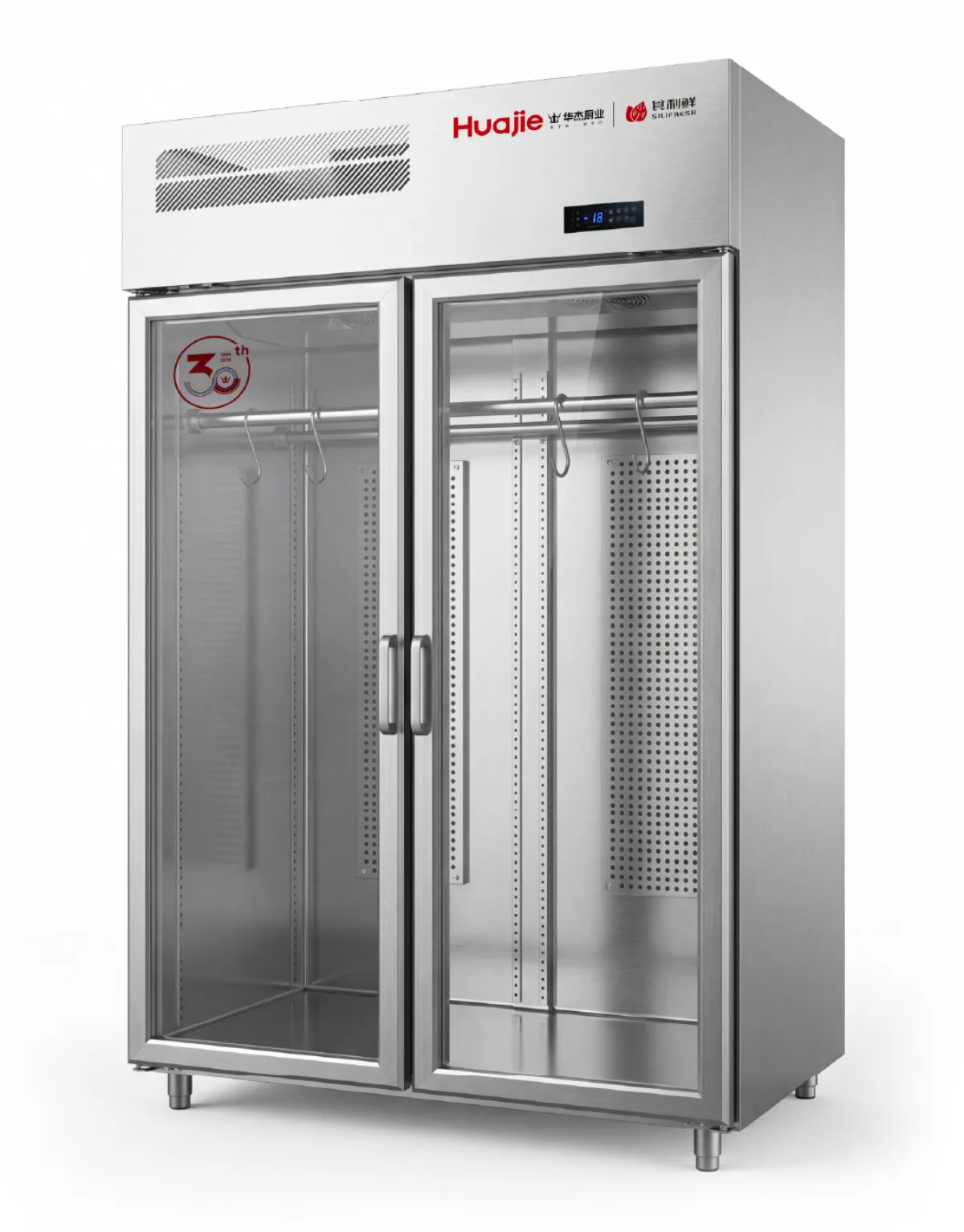
The same series answers four other station types. A meat room takes the A2M or C2M hanging chiller, both listed at 0 to -8°C, so primals hang instead of stacking. A prep line takes the BWC or CWC refrigerated worktop counter at 1800 x 800 x 800 mm, where the work surface is the point and the 480 L or 440 L below it is the bonus. A pass or a small frozen store takes the HF horizontal freezer at -22°C and 600 L. A front-of-house or back-bar position takes the HC horizontal chiller, listed at 2 to -2°C with 280 L and no defrost power figure published at all.
What the equipment is not used for matters as much. It is not a blast chiller, it is not a blast freezer, and it will not pull 40 kg of hot rice from 65°C to 5°C inside the two-hour window that a cook-chill process needs. It holds product that has already been cooled. Buyers who try to use the frozen side as a shock-freezing step end up with a cabinet that never reaches setpoint, a compressor that runs continuously, and a warranty conversation nobody enjoys.
Start With the Cabinet Footprint, Not the Litre Figure
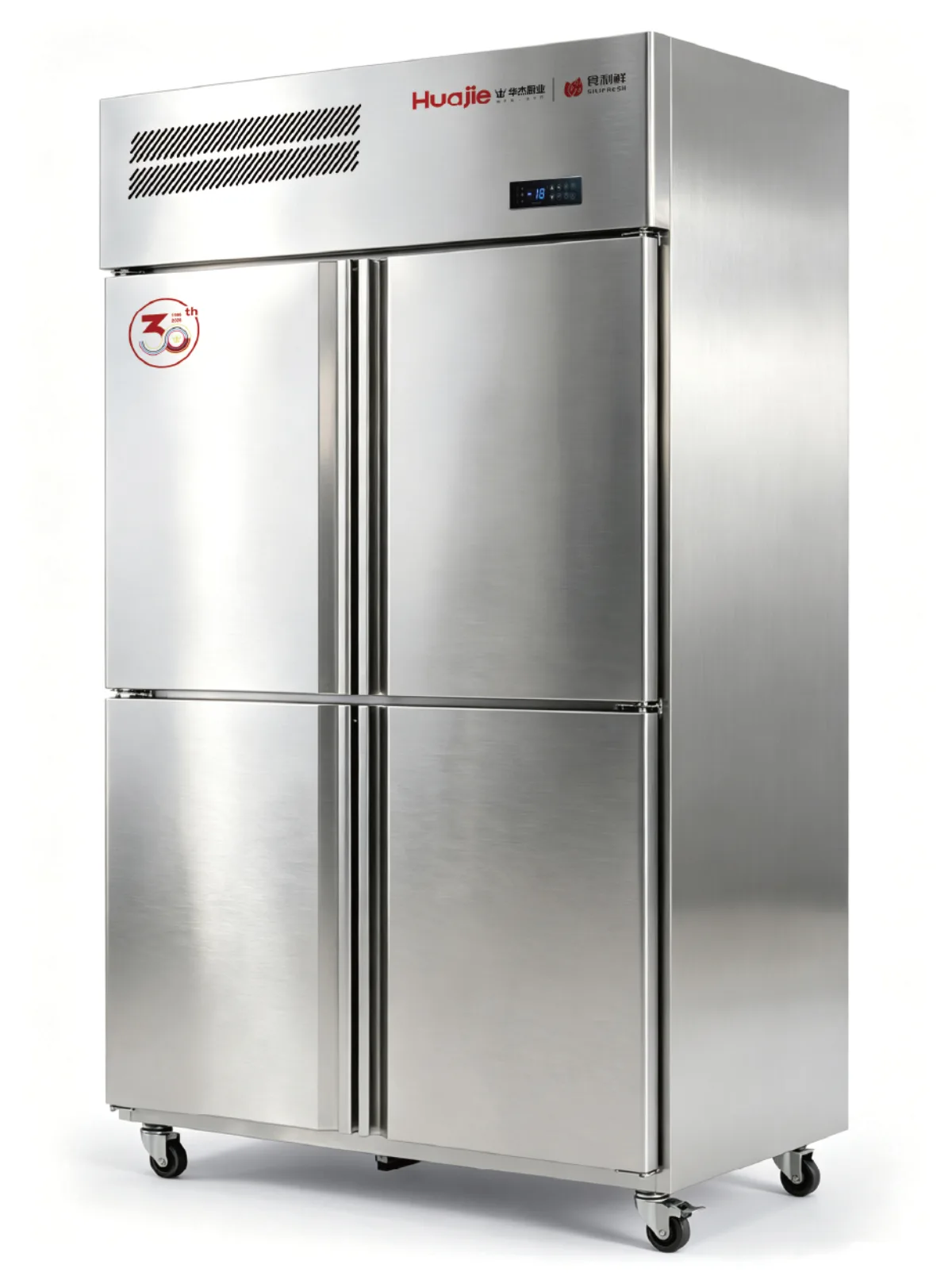
The A family cabinet is 1220 x 810 x 2050 mm. That is 0.99 m² of floor and two metres of height, and the height is where projects fail quietly. A 2050 mm cabinet with casters does not go through a 2000 mm service door, does not fit under a 2100 mm duct run once the top grille needs air, and cannot be stood upright in a goods lift rated for 2200 mm. Measure the route from the loading dock to the final position before you compare models, not after.
Floor area is the second filter. Divide published litres by footprint and the series sorts itself out: the A4C chiller delivers about 960 L per m², the A4D about 760 L per m², and the BWC worktop counter about 330 L per m². The worktop is not inefficient — it is buying you a 1800 x 800 mm stainless prep surface, and the storage is what fits underneath it. If your constraint is floor area, the upright wins on every count. If your constraint is a bench you do not have, the worktop earns its place.
Air is the third filter. These cabinets reject heat through a top-mounted condensing unit, so the grille needs clear space above and behind it, and the room needs somewhere for that heat to go. Two metres from a frying range, in a corner with no extract, is the worst position in the building. Most installers leave around 100 mm behind the cabinet and keep the top clear; confirm the figure with the supplier for the model you order, because the number moves with the condenser layout.
Match the Dual-Temperature Refrigerator Zones to Real Menu Traffic
Put the chilled zone where hands go most often. In a central kitchen that is the prep bench side, because portioned protein and blanched vegetables come in and out twenty times a shift. Put the frozen zone on the side that faces the batch cooking area or the loading route, where a full tray leaves once or twice a day. Get that backwards and the frozen side takes the door traffic, the defrost cycle fights the openings, and the compressor never settles.
Door count matters more than people expect. The A4D carries four independent doors on a 1220 mm width, so a cook opening the top-left door disturbs roughly a quarter of the cabinet. A two-door 1015 L upright on the same width loses half its cold air every time it opens. For a station with high opening frequency, four doors beat two even when the two-door model lists more litres.
Usable space is the number to agree with your supplier in writing. Shelving, air gaps, the divider wall and the evaporator housing all take volume, and a planning allowance of about two-thirds of the published figure is realistic for boxed and trayed product. Ask for the shelving drawing with clear internal dimensions, then measure one of your own crates against it. That single step prevents most of the "it looked bigger in the photo" arguments.
Core Specifications Buyers Should Compare
| Specification | Why It Matters | What Buyers Should Check |
|---|---|---|
| Published volume (L) | Sets the storage plan and the number of cabinets per room. | Compare litres on the same footprint, then convert to boxed-product space with the shelving drawing. |
| Zone configuration | A dual-temperature cabinet trades volume for flexibility. | A4D 750 L against A4C 950 L on the same cabinet — decide whether the second zone is worth roughly 200 L. |
| Temperature band | The band decides which products may legally and safely be stored. | Chilled 0 to 8°C, frozen -5 to -22°C on the A family, -5 to -20°C on the C family; hanging chillers are listed 0 to -8°C. |
| Cooling power | Indicates pull-down ability and continuous running load. | A4D 740 W, A4C 540 W, C4D 650 W, BWC 450 W; match to the ambient temperature of the room, not to a showroom. |
| Defrost power | This is the peak figure the circuit must carry, and it is usually the higher one. | A4D 980 W, A4F 980 W, C4D 820 W, HF 1300 W, BWC 300 W; the HC publishes no defrost figure. |
| Compressor make | Determines the spare-part route and local service familiarity. | A family Embraco, C family Kubing; ask which one your market can service in 48 hours. |
| Footprint and height | Decides whether the unit reaches the room and how many fit along a wall. | 1220 x 810 x 2050 mm (A family), 1200 x 750 x 1950 mm (C family), 1800 x 800 x 800 mm (worktop). |
| Door configuration | Four doors lose less cold air per opening than two. | Count openings per shift at the station, then choose door count before brand. |
Use the table as a filter, not as a specification sheet. None of these figures replace the supplier's datasheet for the exact model and voltage you order. Final specifications should be confirmed according to the selected model and supplier documentation.
Size the Electrical Circuit on Defrost Power
Defrost is where refrigeration quotations go wrong. The A4D is rated 740 W for cooling and 980 W for defrost; the HF horizontal freezer is rated 550 W cooling against 1300 W defrost; the C4D is 650 W against 820 W. Wire the circuit on the cooling figure and the breaker trips every six hours, on a schedule that looks random until someone reads the datasheet.
The arithmetic is simple enough to do at the quotation stage. At 230 V, 980 W is about 4.3 A. Four A4D cabinets on one circuit, all defrosting at the same moment, pull roughly 17 A — past a 16 A breaker. Two fixes exist and both are cheap before installation: give each cabinet its own radial circuit, or set the defrost timers to stagger across the day so no two units peak together. Ask the supplier whether the controller allows a defrost start-time offset; most do, and it is the difference between a 16 A and a 32 A supply to the cold room.
Voltage is the other item to settle early. The listing does not publish a voltage for the series, so put 220-240 V / 50-60 Hz on the RFQ and ask for confirmation per model, plus the plug or terminal arrangement. A 60 Hz market that receives a 50 Hz-specified unit, or a 110 V site that receives a 230 V cabinet, is a customs problem and an electrical problem at the same time.
Compare the HY-MWCR Family Model by Model
| Model | Type | Volume | Temperature | Cooling / defrost | Compressor |
|---|---|---|---|---|---|
| HY-MWCR-A4C | Four-door chiller | 950 L | 0 to 8°C | 540 W / 750 W | Embraco |
| HY-MWCR-A4F | Four-door freezer | 950 L | -5 to -22°C | 740 W / 980 W | Embraco |
| HY-MWCR-A4D | Four-door dual-temperature | 750 L | 0 to 8°C and -5 to -22°C | 740 W / 980 W | Embraco |
| HY-MWCR-C4D | Four-door dual-temperature | 600 L | 0 to 8°C and -5 to -20°C | 650 W / 820 W | Kubing |
| HY-MWCR-A2M | Double-door hanging chiller | 950 L | 0 to -8°C | 540 W / 750 W | Embraco |
| HY-MWCR-BWC | Refrigerated worktop counter | 480 L | 0 to 8°C | 450 W / 300 W | Embraco |
| HY-MWCR-HC | Horizontal chiller cabinet | 280 L | 2 to -2°C | 700 W / not published | Embraco |
| HY-MWCR-HF | Horizontal freezer cabinet | 600 L | -22°C | 550 W / 1300 W | Embraco |
Two patterns show up once the series is laid out side by side. First, the C family is the narrower cabinet — 1200 x 750 x 1950 mm against 1220 x 810 x 2050 mm — and it pays for that with volume and with a Kubing compressor instead of Embraco. Second, the worktop chillers run defrost power below cooling power (450 W against 300 W, 350 W against 300 W) while every upright and the HF freezer run it above. That is not an inconsistency; it is what happens when a small forced-air evaporator sits close to the product and needs an aggressive heater to clear it.
How to Choose the Right Model
Production Capacity
Litres do not tell you how many kilograms you can hold, so build the number yourself. Weigh one full tray of the product you actually store, count how many trays fit on one shelf level in the shelving drawing, multiply by the number of levels on the side you are sizing, and you have a realistic capacity in kilograms for that zone. Do it separately for the chilled and frozen sides — a 750 L dual cabinet is not 750 L of anything, it is two zones with different depths of shelving.
Then compare that number with daily throughput. A central kitchen that issues 120 kg of portioned protein a day against a 300 kg chilled holding capacity is running a 2.5-day buffer, which is comfortable. The same cabinet against 250 kg a day is a 1.2-day buffer, which means the door opens constantly and the defrost cycle never gets a quiet window. Capacity is not how much fits; it is how much fits divided by how fast it moves.
Food Contact Materials
The listing does not publish the steel grade, and that is normal at this stage of a project — but it is not something to leave open. Put the requirement in the RFQ: 304 stainless steel for the interior liner, shelf frames and any surface that touches unwrapped food, with the material certificate supplied at shipment. For buyers selling into China, GB 4806.9-2016 is the standard that governs food-contact metal materials and articles; for EU and US markets, ask for the declaration of compliance that goes with it.
Gaskets and lubricants are part of the same question and are often forgotten. Door gaskets should be a food-contact grade that survives daily wiping with a chlorinated sanitiser without going hard, and any lubricant with incidental food contact should sit under FDA 21 CFR 178.3570. Neither is expensive. Both are hard to change once the cabinets are on site.
Cleaning and Maintenance
A cold room cabinet is cleaned far more often than it is serviced, so design for the cleaner. Removable, tool-free door gaskets save fifteen minutes per cabinet per week and are the single most common after-sales complaint on upright chillers. The condensate drain has to be reachable without pulling the unit out, and the drain pan has to be deep enough for a full defrost cycle — the A4D sheds 980 W of defrost heat into that pan, and a shallow pan in a humid kitchen overflows onto the floor.
Condenser cleaning sets the service interval. In a kitchen with frying or wok cooking, the coil loads with grease in weeks; in a clean prep room it lasts months. Agree a written interval with the operator — monthly in greasy environments, quarterly otherwise — and check that the grille can be removed without tools. On the maintenance side, ask for the controller fault codes and the defrost termination sensor part number before you sign, not after the first winter.
One more item belongs here: the Microseismic Fresh function. Huayi Equipment describes it as a physical micro-vibration approach that acts on water molecules in the stored product, without additives, to slow visible quality loss such as yellowing, surface drying and drip loss. If fresh-keeping performance is the reason you are choosing this series over a plain upright, ask for the test method and the measured weight-loss figures behind that description, and validate them against your own product in a trial. Treat the claim as something to verify, not as a substitute for temperature control.
Plan the Cold Room Layout Around Door Swing and Airflow
Four doors need four swing arcs, and a 1220 mm cabinet standing in a 1400 mm aisle is a cabinet nobody can open fully. Plan on roughly 900 mm of clear working space in front of the doors for a person with a tray, more where a trolley turns. Hinged doors on this series open outward, so the cabinet cannot be placed in a corner with a wall on the hinge side and still be serviced.
Airflow is the second layout rule. Do not butt two cabinets tightly against each other with the condenser grilles facing a shared dead corner; leave a gap and keep the top clear. And keep the cabinet out of the discharge stream of a steamer or a combi oven — 40°C air entering the condenser turns a 740 W cooling load into a compressor that runs at full duty all day.
Buyer Checklist
- Measure the delivery route: door widths, lift height, turn radii, and whether a 2050 mm cabinet arrives upright.
- Confirm the zone split and the temperature band each zone must hold, in writing, against the products you actually store.
- Convert published litres into boxed-product space using the shelving drawing, and check one of your own crates against it.
- Add up cooling and defrost power per circuit, and confirm whether defrost start times can be staggered.
- Specify 220-240 V / 50-60 Hz and the plug or terminal arrangement per model, and ask for confirmation in the quotation.
- Put the steel grade (304) and the material certificate in the RFQ, plus the gasket and lubricant declarations.
- Ask for the condenser cleaning procedure, the controller fault-code list, and the defrost sensor part number.
- Confirm the warranty terms, the spare-parts list with lead times, and who services the compressor in your market.
Common Mistakes to Avoid
The first mistake is buying the dual-temperature cabinet as a volume purchase. On the same 1220 x 810 x 2050 mm frame, the A4D gives 750 L where the A4C gives 950 L. If both zones will hold the same chilled product 90% of the time, that 200 L is being spent on flexibility nobody uses.
The second is treating the frozen side as a blast freezer. It is a storage zone, not a freezing step. Product going in has to be already at temperature, or the compressor runs continuous duty and the chilled side drifts up while it does.
The third is circuit sizing on the cooling figure. The defrost heater is the peak load on nearly every model in this series — 980 W on the A4D, 1300 W on the HF — and a breaker sized on 740 W will nuisance-trip.
The fourth is ignoring the height. A 2050 mm cabinet with casters is 2050 mm plus the casters, and a 2000 mm door frame does not negotiate. Measure before you order; the alternative is removing a door frame at your own cost.
The fifth is putting the cabinet next to the cooking line. Every degree of ambient temperature above the design condition comes straight off the cooling margin, and grease on the condenser coil takes the rest.
The sixth is agreeing to capacity in litres. Litres are a manufacturing figure. Agree on kilograms of your product, in the shelving drawing, per zone — that is the only number that survives contact with a real shift.
FAQ
Q:What is the difference between the HY-MWCR-A4D and the A4C?
A:Zone count and volume. Both sit in a 1220 x 810 x 2050 mm cabinet. The A4C is a chiller at 0 to 8°C with 950 L and 540 W cooling; the A4D splits the same frame into 0 to 8°C and -5 to -22°C, publishing 750 L with 740 W cooling and 980 W defrost.
Q:How many kilograms will a 750 L dual-temperature refrigerator actually hold?
A:Between 60% and 70% of the published figure is a realistic allowance for boxed and trayed product once shelving, the divider and air gaps are counted. Convert it with your own tray weight and the shelving drawing rather than a generic litres-to-kilograms ratio.
Q:What temperature band should the chilled zone be set to?
A:The A4D chilled zone is listed at 0 to 8°C. Most central kitchens set 2 to 5°C for protein and 4 to 8°C for vegetables and dairy, leaving margin below the 8°C limit for door openings and defrost recovery. Confirm the setpoint policy with your food safety officer.
Q:Does the cabinet need its own electrical circuit?
A:Plan for it. At 230 V the A4D draws about 4.3 A in defrost. Two units on one 16 A circuit is workable if defrost times are staggered; four units on one circuit is not. Confirm the supply voltage and the defrost timing option per model.
Q:What material should the interior be?
A:Specify 304 stainless steel for liners, shelf frames and food-contact surfaces, and ask for the material certificate. For China-market compliance the reference is GB 4806.9-2016; for other markets ask for the declaration of compliance covering the same surfaces.
Q:How often does the condenser need cleaning?
A:Monthly in a kitchen with frying or wok stations, quarterly in a clean prep room, and always before the summer peak. Grease-loaded coils raise condensing temperature, which lengthens running time and shortens compressor life.
Q:Can the frozen side be used to freeze fresh product?
A:No. It is a holding zone at -5 to -22°C, not a blast freezer. Product should enter already at storage temperature. If you need freezing capacity, plan a separate blast freezer and size the cabinet as storage only.
Q:What is the Microseismic Fresh function?
A:Huayi Equipment describes it as a physical micro-vibration approach that acts on water molecules in stored food without additives, intended to slow quality loss such as yellowing, surface drying and drip loss. Ask the supplier for the test method and measured weight-loss data before treating it as a selection criterion.
Sources
- Codex Alimentarius CXC 1-1969, General Principles of Food Hygiene (revised 2020), FAO/WHO — time and temperature control principles for chilled and frozen storage.
- EN ISO 23953-1:2015, Refrigerated display cabinets — vocabulary, classification and temperature classes.
- IEC 60335-2-89:2019, Household and similar electrical appliances — particular requirements for commercial refrigerating appliances with an incorporated or remote refrigerant condensing unit.
- GB 4806.9-2016, National Food Safety Standard — food contact metal materials and articles.
- Regulation (EU) No 517/2014 on fluorinated greenhouse gases — refrigerant charge limits, leak checks and the F-gas phase-down schedule.
- US FDA 21 CFR Part 178, Indirect Food Additives: Adjuvants, Production Aids and Sanitizers — lubricants with incidental food contact.
- Huayi Equipment product listings for the HY-MWCR Microseismic Fresh series, accessed 30 October 2026 — dimensions, volumes, temperature bands, cooling and defrost power, compressor make.
Related Examples
- HY-MWCR-A4D four-door dual-temperature refrigerator — 750 L, 0 to 8°C and -5 to -22°C, Embraco.
- HY-MWCR-A4C four-door chiller — 950 L on the same 1220 x 810 x 2050 mm cabinet.
- HY-MWCR-C4D four-door dual-temperature refrigerator — 600 L, narrower 1200 x 750 x 1950 mm frame, Kubing compressor.
- HY-MWCR-A2M double-door meat hanging chiller — 950 L, 0 to -8°C, hanging rails.
- HY-MWCR-BWC refrigerated worktop counter — 1800 x 800 x 800 mm, 480 L, 0 to 8°C.
- Commercial refrigerator category and commercial freezer category — the full cabinet range the cold room is built from.
- Commercial dough mixer sizing: ZMH-15 to ZMH-100 and steam jacketed kettle sizing for central kitchens — the upstream and downstream stations that share the same cold room.
Sizing a dual-temperature refrigerator comes down to a short sequence. Measure the route and the wall before anything else, because 2050 mm is not negotiable with a 2000 mm door. Decide whether the second zone earns its 200 L against a chiller-only cabinet at the same footprint. Convert published litres into kilograms of your own product using the shelving drawing. Size the circuit on defrost power rather than cooling power, and stagger the defrost timers. Then agree the material, gasket and cleaning requirements in writing, and only then compare prices.
Final specifications should be confirmed according to the selected model and supplier documentation. The HY-MWCR-A4D figures quoted here are the published listing values for this series; a project quotation should rest on the datasheet for the exact model, voltage and option set you order. Send your room dimensions, product list, daily throughput in kilograms and target market to Huayi Equipment, and ask for the shelving drawing with the quotation — that is the document the cold room gets built from.
苏涛;舜翔央厨、华艺智能
Published 30 October 2026