
How to size a gas steam generator for a central kitchen: compare 40-80 kW SZQT models on evaporation capacity, steam pressure, gas draw, feed water and connections.
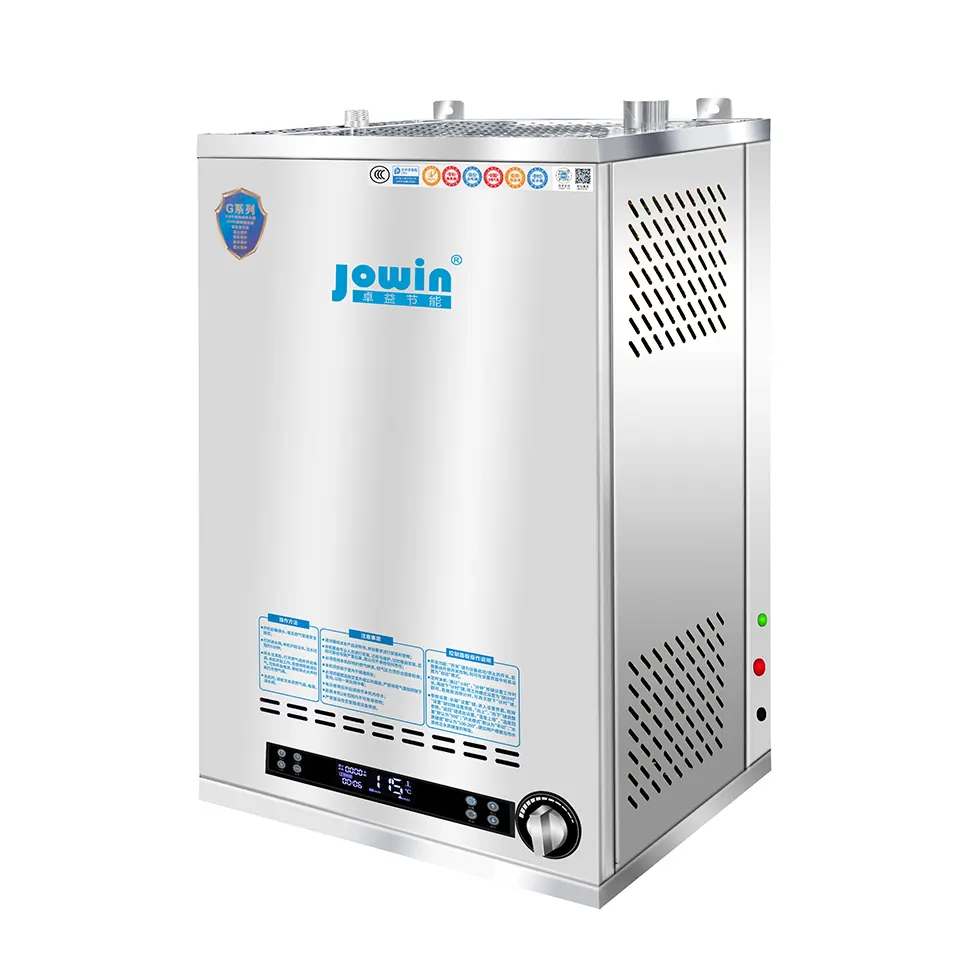
A gas steam generator only earns its place when it can hold rated output through a full service day: the SZQT series from Huayi Equipment runs 40 kW to 80 kW heat input at 55 kg/h to 125 kg/h evaporation, produces steam at 100–125 °C through a DN25 outlet, and holds working pressure in the 0–0.08 MPa atmospheric band. The 60 kW SZQT60-G is the mid-series unit many central kitchens land on, drawing 5 m³/h LPG or 6 m³/h natural gas and weighing 69 kg at 640 × 540 × 900 mm. This guide walks through how importers and central kitchen engineers size one of these steam generators, what changes between models, and which site conditions decide the final model.
Key Takeaways
- Treat the rated evaporation figure — 55, 70, 80, 90 or 125 kg/h — as a selection limit, not a marketing number. It is measured at specific feed water conditions.
- Match heat input to the steam header, not to the tank size of whatever equipment you want to fill. A 28 kW steam cooker still needs the header to hold pressure while four units run together.
- Atmospheric units like the SZQT series deliver 100–125 °C steam at 0–0.08 MPa. If your process needs 1.25 MPa and above, you are looking at a pressured generator, not this series.
- Confirm available gas type and pressure before ordering. The series runs on LPG or natural gas (12T), and consumption moves from 3.2 m³/h to 9 m³/h across the range.
- Size feed water supply at 0.15–0.6 MPa. Below that, the burner cycle stalls under load and you lose output precisely when the kitchen is busiest.
- The series is built to GB 35848-2024 with 304 stainless steel bodies and ion-type flame failure devices on every unit.
What This Equipment Is Used For
A gas steam generator produces saturated steam on demand and feeds a header that several machines draw from at once. In a central kitchen the header usually runs above the steam cookers, the sterilization kettle and the proofing cabinet. In a bakery it feeds deck ovens and the proofer. In a hospital canteen it feeds utensil sterilization, where the standard requirement is different again and much less about volume.
Huayi Equipment builds the SZQT atmospheric series and also manufactures the MZQT modular gas steam generator (167 kg/h, 250 kg/h and 500 kg/h variants) plus the LSS1.2-1.25-Q fully premixed vertical unit rated 1.2 t/h at 1.25 MPa. That range matters when you plan a site: the atmospheric SZQT units sit at one end, the premixed vertical at the other, and they are not interchangeable without changing the header design.
The category page for steam equipment carries the wider family — steam cookers, steam sterilization kettles and the LSS vertical generators — so treat a steam generator purchase as a header study before it is a machine purchase.
Core Specifications Buyers Should Compare
| Specification | Why It Matters | What Buyers Should Check |
|---|---|---|
| Rated heat input | Sets the ceiling on steam output and gas consumption. | Compare 40, 50, 60, 70 and 80 kW against the connected load, not against the largest unit available. |
| Evaporation capacity | Determines how fast the header recovers after a peak draw. | Confirm 55 / 70 / 80 / 90 / 125 kg/h against your duty cycle and simultaneous draw. |
| Steam temperature | Decides which downstream equipment can run on this steam. | Atmospheric series delivers 100–125 °C at 0–0.08 MPa working pressure. |
| Gas consumption | The main operating cost driver and often the site constraint. | LPG runs 3.2–6.4 m³/h; natural gas runs 4–9 m³/h. Match to your supply and meter size. |
| Feed water pressure | Insufficient pressure cuts burner output under load. | Applicable water pressure must hold 0.15–0.6 MPa at the inlet. |
| Dimensions and weight | Determines plinth size, doorway clearance and floor loading. | SZQT units run 570 × 470 × 900 mm to 680 × 580 × 900 mm, 54–88 kg net. |
| Standard compliance | Needed for export documentation and local approval. | Confirm the build standard — the SZQT series is GB 35848-2024. |
How to Choose the Right Model
1. Start With the Connected Steam Load
A steam generator serves other machines, so the load is the sum of what runs at once, not what runs across a shift. If two 28 kW steam cookers and a sterilization kettle share one header, add their simultaneous draw and then add margin for recovery. The 60 kW SZQT60-G producing 80 kg/h covers that class of load; the 40 kW SZQT40-G at 55 kg/h does not.
That margin also dictates clearance. That capacity demands room on the return side for condensate, because a generator sized to peak draw without condensate space will trip its own safety cut-outs under continuous duty.
2. Match the Pressure Band to the Process
Atmospheric generators like the SZQT series hold 0–0.08 MPa and deliver 100–125 °C. That is correct for steaming, boiling, sterilization of loose utensils and proofing injection. Processes such as retort sterilization or pressure cooking require substantially higher pressure, and for those the SZQT series is the wrong category. Huayi Equipment's vertical SUS304 steam pressure cookers and the LSS1.2-1.25-Q premixed generator cover that side.
Buyers should check the working pressure of every downstream machine before selecting. A unit that produces excellent steam at 0.08 MPa cannot lift a 1.25 MPa vessel.
3. Confirm Gas Type and Supply Capacity
The series is dual fuel — LPG or natural gas (12T) — with pulse ignition and ion-type flame failure protection on every model. Consumption scales with output: the SZQT40-G uses 3.2 m³/h LPG, the SZQT80-G uses 6.4 m³/h LPG or 8 m³/h natural gas. Confirm the local supply, the meter rating and the run time available before ordering, because gas infrastructure is usually the longest lead item on the schedule.
4. Coordinate Feed Water and Drainage
Applicable water pressure is 0.15–0.6 MPa. Provide a dedicated supply with isolation valve and strainer, and a DN25 drain. The series uses a DN25 steam outlet, DN15 water inlet and DN15 gas inlet, with a φ50 exhaust pipe. Exhaust runs hot and wet — plan the termination point before the unit is delivered, not after.
5. Compare Series Against Series
Atmospheric SZQT covers 40–80 kW. Modular MZQT starts where a single cabinet stops: the MZQT60-07X2 delivers 167 kg/h, the 07X3 reaches 250 kg/h, and the 07X6 reaches 500 kg/h with a 360 kW rated heat load and a 2060 × 990 × 1740 mm footprint. The LSS1.2-1.25-Q premixed vertical reaches 1.2 t/h at 1.25 MPa with 98–101% thermal efficiency. Treat steam capacity as a selection limit and match the series to the duty.
Buyer Checklist
- Confirm total connected steam load in kW and required kg/h.
- Confirm the steam pressure band your downstream equipment actually needs.
- Confirm gas type, gas pressure and meter capacity.
- Confirm feed water pressure holds 0.15–0.6 MPa at the inlet.
- Confirm plinth size, doorway clearance and floor loading from the dimension sheet.
- Ask for equipment photos, videos, and test details where applicable.
- Confirm spare parts availability, burner parts and ignition electrode stock.
- Check voltage — the series runs AC220/50Hz with a 120W control load.
- Ask how the quotation treats the exhaust route and condensate drainage scope.
- Ask how the quotation treats site survey terms, installation and commissioning.
Common Mistakes to Avoid
The most common error is sizing on peak steam demand and ignoring how long the header has to recover. The second is treating rated evaporation as a guaranteed hourly figure when it assumes a specific feed water condition and a specific duty cycle. The third is ordering an atmospheric unit for a pressure process because the two units cost similar amounts.
Another recurring problem arrives after delivery: the exhaust pipe was never planned, so a φ50 run has nowhere safe to go. Gas infrastructure is quoted by others and installed late, and it delays commissioning more often than the machine itself does.
FAQ
Q:What is the difference between an atmospheric and a pressurized gas steam generator?
A:An atmospheric unit such as the SZQT series holds 0–0.08 MPa and delivers 100–125 °C saturated steam, which suits steaming, boiling, utensil sterilization and proofing. A pressurized generator reaches 1.25 MPa and above, which retort sterilization and pressure cooking require. The correct choice depends on the working pressure of the connected equipment.
Q:How much steam do I need for a central kitchen?
A:Add the simultaneous demand of every machine drawing from the header, then allow recovery margin. A load of two steam cookers plus a sterilization kettle generally fits the 60 kW SZQT60-G at 80 kg/h, while a 40 kW SZQT40-G at 55 kg/h covers lighter duty. Confirm the figure against your own duty cycle.
Q:Which gas can these steam generators run on?
A:The SZQT series is dual fuel and runs on LPG or natural gas (12T) with pulse ignition and ion-type flame failure protection. Consumption runs from 3.2 m³/h LPG on the 40 kW model to 6.4 m³/h LPG or 8 m³/h natural gas on the 80 kW model. Confirm local gas supply before ordering.
Q:What water pressure does the generator need?
A:Applicable water pressure is 0.15–0.6 MPa. Provide a dedicated supply with isolation valve and strainer. Below this range the burner cycle stalls under load and rated output is lost precisely when the kitchen is running at peak.
Q:Can an SZQT unit replace a pressurized steam boiler?
A:No. An SZQT unit produces 100–125 °C steam at 0–0.08 MPa and cannot lift a vessel requiring 1.25 MPa. If your process needs higher pressure, specify a pressurized generator such as the LSS1.2-1.25-Q premixed vertical unit rated 1.2 t/h at 1.25 MPa.
Q:What maintenance does a gas steam generator need?
A:Daily checks cover the gas valve, the flame failure device and the drain. Periodic work covers the ignition electrode, the burner nozzle and the strainer. Keep spare parts for the ignition electrode, the burner and the water level sensor on hand, because a generator that trips on ignition at peak service is the one that costs the most.
Conclusion
The selection order is the same on every project: confirm the connected steam load, confirm the pressure band, confirm gas and water supply, then confirm the physical installation. On those four checks the SZQT series is straightforward — 40 kW to 80 kW, 55 kg/h to 125 kg/h, GB 35848-2024, 304 stainless steel. Price, MOQ, lead time, warranty, project scope, site survey terms, installation and commissioning are quote items, and the final model should be confirmed against your product type, capacity, site conditions and the supplier's technical documentation.
Send your throughput targets, site conditions, and target market to start that conversation.
Sources and References
- GB 35848-2024 — Chinese national standard for food processing steam generating equipment.
- GB 4806.9-2023 — Chinese national food safety standard for metal materials in food contact.
- GB 31654-2021 — General hygienic practice for food production.
- HSE — UK Health and Safety Executive, commercial kitchen and steam plant guidance.
- FAO — Food and Agriculture Organization, food hygiene and processing guidance.
Related Products
- 40kW SZQT40-G LPG/Natural Gas Steam Boiler 55kg/h Output for Food Processing — 40 kW heat input, 3.2 m³/h LPG, 570 × 470 × 900 mm.
- 50kW SZQT50-G LPG/Natural Gas Steam Boiler 70kg/h Output for Food Processing — 50 kW heat input, 4.1 m³/h LPG, 57 kg net.
- 60kW SZQT60-G LPG/Natural Gas Steam Boiler 80kg/h for Food Processing — 60 kW heat input, 80 kg/h evaporation, 304 stainless steel.
- SZQT80-G Commercial Gas Steam Generator 80kW for Kitchens and Food Processing — 110 kg/h, max 125 kg/h, 680 × 580 × 900 mm.
- XKE-RQZL-900 Commercial Steam Cooker 28 kW Stainless Steel High Capacity — steam cooker for central kitchen service lines.
- Heavy-Duty SUS304 Stainless Steel Steam Sterilization Kettle 50–900 kg Capacity — sterilization vessel for canteen-scale service.
- 32-Tray Dual-Door Cold Proofing and Freezing Proofer for Commercial Bakery — proofing cabinet that draws from the same steam header.
- LSS1.2-1.25-Q Fully Premixed Vertical Steam Generator Food Grade 1.2t/h — 1.25 MPa pressurized option when atmospheric output is insufficient.
Published: 22 October 2026 · Author: 苏涛;舜翔央厨、华艺智能