
Three numbers decide a commercial meat grinder: output in kg per hour, plate diameter in mm and site voltage. How the HC-30, BB-332 and TY-20L differ.
Introduction: A commercial meat grinder for a butcher shop, a supermarket counter or a food plant is chosen by three numbers before any brand name enters the conversation: output in kg per hour, plate or orifice diameter in millimetres, and the electricity available at the wall. Huayi Equipment, a food processing machinery manufacturer in China, builds three machines in this class, and each one answers that set of numbers differently. Two are screw grinders that reduce meat to particles through a perforated plate. One is a bowl cutter that emulsifies by rotating product against a knife inside a 20 L bowl. Treating them as one category is the most expensive mistake in this range.
Key Takeaways
- Fix output, plate diameter and site power before comparing suppliers. Everything else on a spec sheet follows from those three.
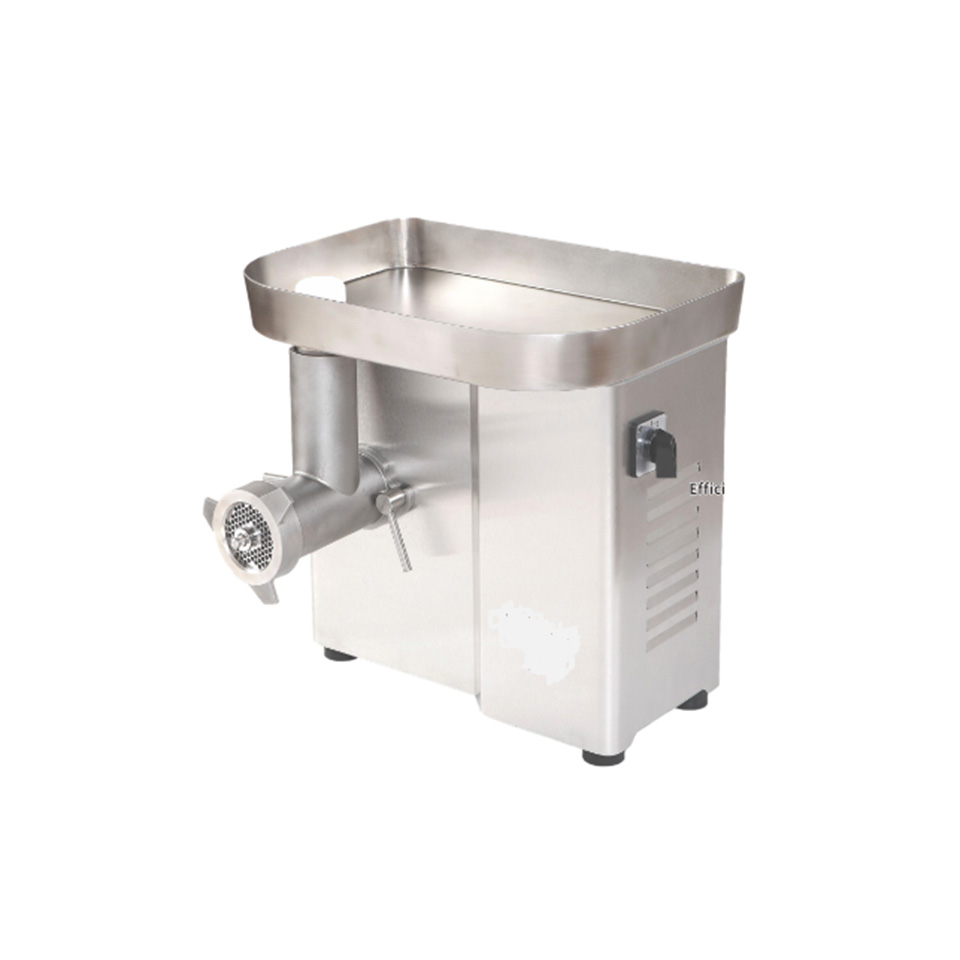
- The HC-30 tabletop screw grinder runs 100-300 kg/h on 1100 W at 220 V and ships with 3, 4.5, 6 and 8 mm plates. It fits a single counter, not a plant line.
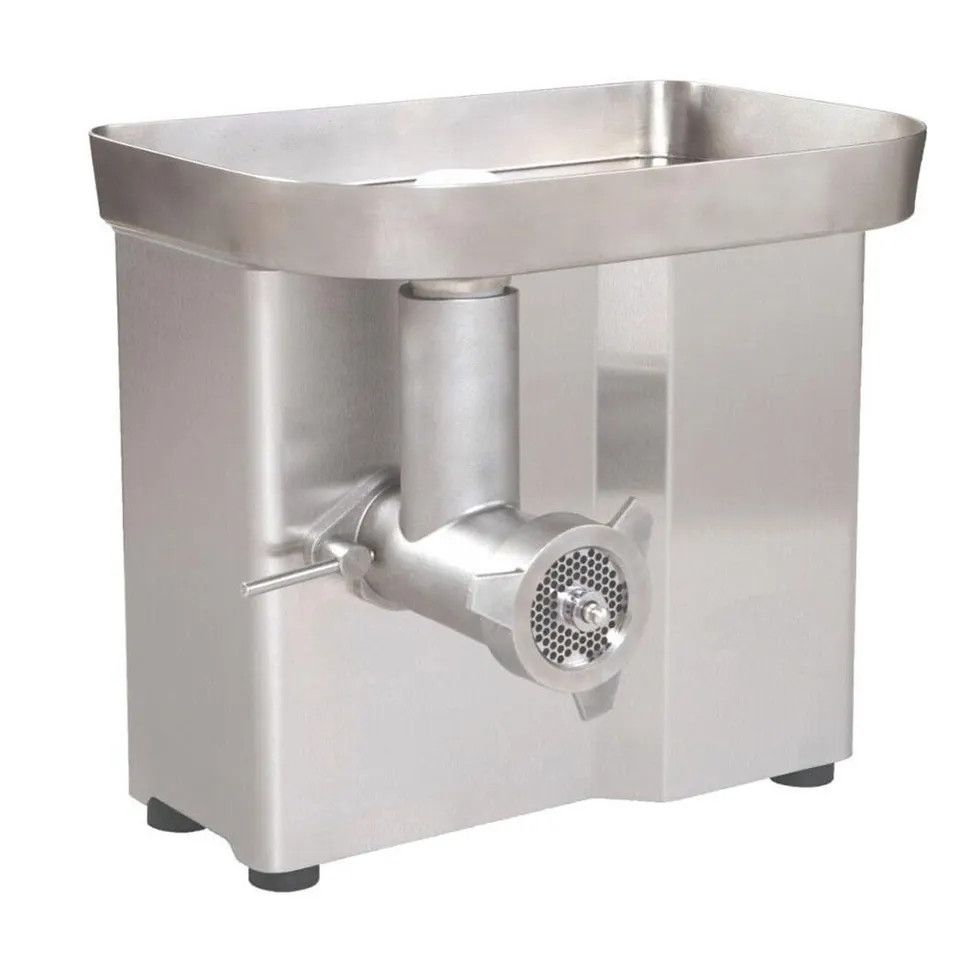
- The BB-332 floor grinder holds 300 kg/h on 3 kW at 380 V/50 Hz, weighs 85 kg and has a 100 mm feed orifice in 304 stainless steel.
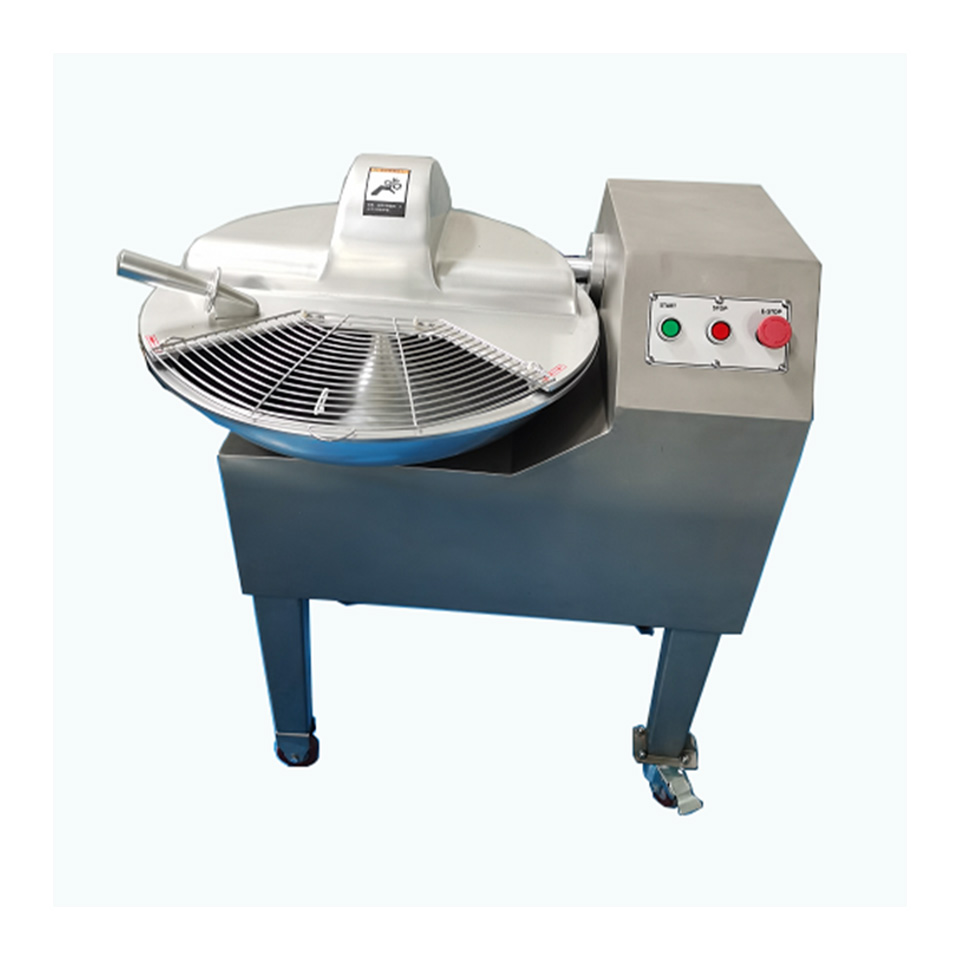
- The TY-20L bowl cutter works a 20 L bowl at 1440 r/min cutter speed and 12 r/min bowl speed on 1.5 kW at 220 V. It is for emulsifying and charcuterie, not for producing mince.
- A published capacity is a range or a batch size, not a guarantee. A trial on your own product is the only way to confirm the figure you quote to a customer.
- Price, MOQ, lead time, warranty, project scope and site survey terms are quote items with a China manufacturer. A specification sheet settles machine capability, not commercial terms.
What a Commercial Meat Grinder Is Actually Used For
A screw grinder does one thing well. Meat is loaded into the hopper, the feed throat and auger pull it forward, and a knife against a perforated plate reduces it to a particle size set by that plate. That is the machine behind mince for burgers, sausage filling and retail packs, and it is the machine behind a butcher counter that handles 150 kg of beef a day without a second operator.
A bowl cutter works a different way. Product sits in a rotating bowl while a high-speed knife cuts against the bowl wall and the bowl itself. The action emulsifies: it binds water and fat into a mixture that holds together when it is cooked. Sausage, pâté, forcemeat and cured products need that binding, and a grinder plate will not give it to them.
The grinder versus bowl cutter decision comes down to one question: does the product need to be minced, or does it need to be bound. The distinction matters commercially because the two machines sit in different parts of the line. The grinder is a reduction step, usually upstream of a mixer, filler or packing machine. The bowl cutter is a forming and emulsifying step, usually upstream of a stuffing or portioning machine. Buying a grinder for sausage emulsification is a common mistake, and the machine will run, and the product will still be wrong.
Compare the Three Machine Classes Before You Read a Price
Before comparing wattage, decide which class of work the machine belongs to. The table below sets the three classes against the job each one actually does, using the published figures for the Huayi models in this range.
| Machine class | What it does to the product | Published output | Typical buyer |
|---|---|---|---|
| Tabletop screw grinder (HC-30) | Cuts meat against a perforated plate into particles from 3 mm to 8 mm | 100-300 kg/h | Butcher shop, supermarket counter, small prep room |
| Floor screw grinder (BB-332) | Cuts against a replaceable plate, particle size adjustable across 3 mm to 30 mm | 300 kg/h | Meat processing plant, production line |
| Bowl cutter (TY-20L) | Emulsifies by high-speed knife against a rotating 20 L bowl | 20 L batch; no hourly rate published | Sausage and charcuterie maker, R&D kitchen |
That table is the shortest useful answer to a first enquiry. A buyer asking for a meat grinder is often actually asking two different questions: how do I make mince, and how do I make a stable emulsion. Those need different machines, different cleaning routines and different operators.
Compare the Huayi Commercial Meat Grinder Range
The three models below are the ones Huayi Equipment currently publishes in this class, taken from the product specification tables. The published output for the HC-30 is a range, not a point, which is itself informative: output depends on the product and the plate fitted, and a supplier who quotes the top of that range without conditions is quoting a number you cannot plan a shift around.
| Model | Output | Power and voltage | Particle or plate range | Size (mm) and weight | Typical fit |
|---|---|---|---|---|---|
| HC-30 tabletop meat grinder | 100-300 kg/h | 1100 W, 220 V | 3 / 4.5 / 6 / 8 mm plates | 525 × 417 × 525 mm, 43 kg net | Single counter or shop floor |
| BB-332 commercial meat grinder | 300 kg/h | 3 kW, 380 V/50 Hz | 3-30 mm via interchangeable plates | 460 × 610 × 820 mm, 85 kg net | Plant production line |
| TY-20L bowl cutter | 20 L bowl, batch operation | 1.5 kW, 220 V | Set by blade and variable frequency drive | 920 × 720 × 1030 mm, 135 kg net | Sausage, emulsified meat, R&D |
Three further figures are worth keeping in view. The BB-332 has a 100 mm feed orifice, which is the opening the meat passes through on its way to the screw; a larger orifice takes larger pieces at the throat, which matters when the raw material arrives bone-in or in primal cuts. The HC-30 has a 43 kg net weight and a 55 kg gross weight, and its packaging dimension is 565 × 480 × 640 mm, which is the number that matters when you are checking whether it fits through a service door or into a freight container position. The TY-20L carries a 135 kg net weight, the heaviest of the three, and sits on casters, so its floor position and its cleaning route need to be planned together.
Match Output to the Shift You Actually Run
Capacity planning for a grinder is arithmetic, and it is worth doing before the supplier quotes. Start with daily volume, divide by available minutes, and then add the margin your operation really needs. The two examples below use published outputs against realistic shift patterns; both are estimates based on the figures above and should be confirmed by a trial on your own product.
For example, take a supermarket meat counter. The counter grinds 150 kg of beef per day in a single 8 hour shift, so 480 minutes are available. The required rate works out at 150 kg ÷ 480 min ≈ 0.31 kg per minute, which is about 19 kg/h. The HC-30 at the bottom of its published range, 100 kg/h, gives more than five times that. The BB-332 at 300 kg/h would be over-specified for this shop, and over-specification has a cost: a larger cabinet, a heavier machine to lift for cleaning, and a higher electrical connection for output the counter will never use.
For a second example, take a meat processing plant. The plant runs two 8 hour shifts, so 960 minutes, and moves 1,200 kg of product a day through the grinding step. That works out at 1,200 kg ÷ 960 min = 1.25 kg per minute, or 75 kg/h required. The HC-30 at 100 kg/h would sit at roughly 75 percent utilisation before anyone counts cleaning, changeover or a breakdown, which is too thin a margin for a production line. The BB-332 at 300 kg/h gives about 25 percent utilisation, and that headroom is what absorbs the shift changeover and the wash-down that a food plant runs inside the working day. On these assumptions the plant-scale machine is the correct one, and the reason is not the peak rate, it is the downtime.
The TY-20L works on a different calculation entirely. Its published figure is a 20 L bowl, which is a batch volume rather than an hourly rate. How many batches you clear per hour depends on the load, the blade and the discharge arrangement, and no hourly output is published for this model. Anyone who wants a bowls-per-hour number for the TY-20L has to get it from a trial.
Choose Between Screw Grinding and Bowl Cutting
Once the class is settled, the next decision is which of the two mechanisms the product actually needs. The comparison below is written for a buyer who has both a mince line and a sausage line to equip.
| Aspect | Screw grinder (HC-30, BB-332) | Bowl cutter (TY-20L) |
|---|---|---|
| Primary action | Reduction: meat is cut against a perforated plate | Emulsification: product is cut against the rotating bowl wall |
| Particle control | Set by plate hole size, from 3 mm to 30 mm depending on model | Set by blade fit and cutter speed, adjusted by VFD |
| Published speed figures | Not published for either model | 1440 r/min cutter, 12 r/min bowl |
| Batch behaviour | Continuous flow, fed from the hopper | Batch, 20 L bowl, lid raised for loading |
| Heat behaviour | BB-332 published as a low heat design that limits heat build-up | Published as minimal heat rise from a controlled blade-to-bowl clearance |
| Contact parts | BB-332: screw, chamber, blades and funnel in 304 stainless steel | 304 stainless steel with a seamless bowl |
| Typical output of the line | Mince, burger patties, retail packs | Sausage emulsion, pâté, forcemeat, cured product |
One practical point about the bowl cutter deserves emphasis, because it is the number a buyer cannot get from a catalogue. Cutter speed and bowl speed are published separately for the TY-20L, 1440 r/min and 12 r/min, and they are not interchangeable. A slow bowl with a fast knife gives a different cut from a fast bowl with a slow knife, and the variable frequency drive is what lets the operator trade one against the other when the product changes. Ask the supplier to demonstrate the machine on your product and to explain which speeds they would run for it.
Check Power, Voltage and Site Conditions Before the Order
The specification table above is where projects get caught. A machine that fits the process but not the room is a machine that gets installed, then gets moved, then gets used badly. The table below sets the three models against the conditions that decide whether they can run where you intend to put them. Where a figure is not published, it says so, and that is a line to confirm with the supplier before the order, not a gap to guess at.
| Site condition | HC-30 | BB-332 | TY-20L |
|---|---|---|---|
| Supply | 220 V | 380 V/50 Hz, three phase | 220 V |
| Installed size (mm) | 525 × 417 × 525, bench top | 460 × 610 × 820, floor standing | 920 × 720 × 1030, floor standing on casters |
| Weight | 43 kg net, 55 kg gross | 85 kg net | 135 kg net |
| Loading arrangement | Open hopper, plate head detaches for cleaning | Hopper with feed plate and plunger | 20 L bowl with hinged lid, needs overhead clearance to open |
| Cleaning access | Stainless steel body; contact-part list not published | 304 contact parts, quick disassembly published | Seamless bowl, removable blade, casters to move the machine |
| Ventilation and extraction | Not published | Not published | Not published |
| Shipping dimension (mm) | 565 × 480 × 640 | Not published | Not published |
Two items in that table drive hard decisions. The BB-332 needs 380 V three phase, which in most export markets means a different supply arrangement, a different distribution board and, in some cases, a step-down or step-up transformer that has to be costed into the project rather than discovered on site. The TY-20L needs enough vertical room to open the bowl lid and enough floor space to roll the machine out for cleaning. Neither is difficult to solve. Both are expensive to solve after the machine is on the truck.
Run the Buyer Checklist Before You Order
- Confirm the raw material: primal cuts, boneless, chilled, frozen or a mix, and the piece size arriving at the machine.
- Confirm the required rate in kg/h from your own daily volume and shift pattern, and treat it as a rate to verify rather than a figure to inherit.
- Confirm the plate or particle range you need, and whether you need one plate or an interchangeable set.
- Confirm voltage, phase, and the supply arrangement at the machine position, including any transformer.
- Confirm the installed footprint, the loading route, and where the machine will be cleaned.
- Ask for the contact-part material list for the specific model, and for the documents that cover it.
- Ask what wear parts the supplier recommends you hold on the shelf, and how fast they can supply them.
- Ask for a trial on your own product, and get the output you measure written into the order confirmation.
Avoid the Mistakes That Cost a Reorder
The most common error is buying on peak output. A supplier quoting 300 kg/h when the line runs at 75 kg/h sounds like a good machine and behaves like an oversized one: it is harder to clean, it costs more to connect, and it gives the operator a large drum that is uncomfortable to work with in small batches. The second error is skipping the trial. Capacity figures on a specification sheet are produced under conditions the supplier chose, on product the supplier had. Your product is different, and the only measurement that counts comes from your own raw material on the machine you are about to buy.
The third error is buying the wrong mechanism, and it is the one that is hardest to see because the machine works. A grinder running at 300 kg/h will happily make mince that fails to emulsify, and the failure shows up three weeks later in the cooking yield of the finished sausage. If the product is emulsified rather than minced, the machine is a bowl cutter, and no plate change will fix it.
Conclusion
Choose a commercial meat grinder by fixing the three numbers first: output in kg per hour, the plate or particle range you need, and the electricity at the wall. Then place the machine in the right class. The HC-30 at 1100 W and 220 V covers a counter that moves roughly 150 kg a day. The BB-332 at 3 kW and 380 V/50 Hz covers a plant line that runs two shifts and needs headroom for cleaning inside the working day. The TY-20L at 1.5 kW and 220 V with its 20 L bowl covers emulsifying and charcuterie, and it is not a mince machine. Send your throughput targets, product state, site conditions and target market to a supplier, and ask for the trial and the contact-part documentation with the quotation.
FAQ
Q: How much power does a commercial meat grinder actually need at the wall?
A: It depends on the model and it is worth checking before anything else. The HC-30 is published at 1100 W on 220 V, which suits a standard single-phase supply in most export markets. The BB-332 is published at 3 kW on 380 V/50 Hz three phase, which in many countries needs its own supply arrangement and sometimes a transformer. The TY-20L sits at 1.5 kW on 220 V. Confirm the supply at the machine position rather than at the distribution board.
Q: Is a 300 kg/h grinder oversized for a butcher shop?
A: In most cases yes, and it is a common way to spend more than the job needs. Working from published outputs, a counter moving 150 kg a day across one 8 hour shift needs roughly 19 kg/h, which the HC-30 at 100 kg/h covers with room to spare. Over-specification costs a larger cabinet, a heavier machine to strip for cleaning, and an electrical connection sized for output the shop never reaches.
Q: What is the difference between a screw meat grinder and a bowl cutter?
A: The screw grinder reduces meat by cutting it against a perforated plate, and the plate hole size sets the particle size. The bowl cutter emulsifies by cutting product against the wall of a rotating bowl, and the TY-20L runs its cutter at 1440 r/min and the bowl at 12 r/min. A grinder makes mince; a bowl cutter makes a bound mixture for sausage and pâté. They solve different problems.
Q: Which plate size should I fit for mince, and does it change the output?
A: The HC-30 ships with 3, 4.5, 6 and 8 mm plates, so you can move between fine mince and coarse mince on one machine, and the BB-332 covers a wider 3-30 mm particle range. Plate size does affect output, because smaller holes put more resistance through the screw. That is why the HC-30 capacity is published as a range of 100-300 kg/h rather than a single figure. Ask for the rate you need at the plate size you plan to run most.
Q: Can these machines be washed down in place?
A: The published cleaning claims differ by model and should be read carefully. The BB-332 is described with quick disassembly and 304 stainless steel contact parts including the screw, chamber, blades and funnel. The TY-20L has a seamless bowl with a removable blade and sits on casters so it can be moved for cleaning. The HC-30 has a detachable plate head, but its full contact-part list is not published. Ask for the cleaning procedure in writing for the model you are buying.
Q: Does the 380 V model work in a 220 V country?
A: Not directly. The BB-332 is published at 380 V/50 Hz three phase, so in a 220 V single-phase market it needs a transformer and a distribution arrangement that suits three phase. That cost belongs in the project budget, decided before the order, not discovered when the machine arrives. If your site is single phase, the HC-30 and the TY-20L are both published at 220 V.
Q: Which wear parts do I need to keep on the shelf for a grinder?
A: On a screw grinder the items that wear in service are the knife and the perforated plate, and the supplier's published plate sets for the HC-30 are 3, 4.5, 6 and 8 mm, which are the parts most often reordered. On the bowl cutter the consumable is the blade and its seal. Published spare part lists for these models are not on the product pages, so ask the supplier for a recommended spare parts list for the specific model and for the lead time on each part.
Sources and Standards
Regulation (EC) No 852/2004 on the hygiene of foodstuffs | Regulation (EC) No 853/2004, Annex II | EN 1672-1:2009, stainless steel and stainless steel-covered sheet metal in the food industry | EN ISO 12100:2010, safety of machinery, general principles for design | Directive 2006/42/EC, machinery safety | 21 CFR Part 110, FDA good manufacturing practice | FDA Food Code 2022, food establishment equipment and food-contact surfaces
These references describe the general regulatory framework that a grinder and its installation sit inside. They are not a statement of what any particular model is certified to. Ask the supplier which documents exist for the exact model, who issued them and which parts they cover, and request the food-contact material declaration for the parts that touch product.
Related Examples
- HC-30 Tabletop Meat Grinder, 100-300 kg/h, 1100 W, 220 V - the bench-top option for counters and small prep rooms.
- BB-332 Commercial Meat Grinder, 300 kg/h, 3 kW, 380 V/50 Hz - the plant-line screw grinder in 304 stainless steel.
- TY-20L Bowl Cutter, 20 L, 1440 r/min, 1.5 kW - the emulsifying machine for sausage, pâté and R&D kitchens.
- Meat Grinders collection - the full grinder and cutter range in one place.
- Butchery Equipment collection - saws, cutters and preparation machines for a butcher counter.
- Meat Slicers collection - where slicing sits next to grinding on the same line.
- Commercial Meat Slicer Buying Guide - choosing the slicing step that feeds the grinder.
- Stainless Steel Surfaces on Commercial Meat Bone Saws - how to separate surface claims from full-machine material claims.
Further Reading
Meat Processing Technology for Small- to Medium-Scale Producers
Final specifications should be confirmed according to the selected model and supplier documentation.
Author: 苏涛;舜翔央厨、华艺智能