
How to choose a commercial meat slicer for butcher shops and food plants: thickness ranges, hourly capacity, blade types, materials, and checks before you buy.
A commercial meat slicer is a powered cutting machine that turns fresh, chilled, or semi-frozen meat into slices of repeatable thickness. Production models typically cover a 1–32 mm range and run on 380 V three-phase power. Take the DQP-17K meat cutting machine: 1700 × 750 × 1250 mm, a 400 kg frame, 3.4 kW motor, and up to 155 slices per minute, with food-contact parts in 304 stainless steel. Conveyor models reach 300–500 kg/h; heavy industrial versions approach 1500 kg/h. This guide covers what decides whether a commercial meat slicer still holds tolerance after six months of daily production.
Key Takeaways
- For butcher shops and delis, a 1–20 mm thickness range and a 140–150 mm feed opening usually cover the work; high-volume plants use conveyor slicers at 300–500 kg/h.
- Thickness range is the first filter: 1–32 mm covers lamb rolls, jerky, and dicing; 60–260 pieces per minute suits chilled meat lines.
- Product temperature drives the choice — chilled meat at -2 to -3 °C slices cleanly, while hard-frozen blocks need a different cutting approach.
- Food-contact parts should be SUS 304 or better; ask for material certificates, not catalogue claims.
- Industrial slicers commonly run 380 V / 50 Hz three-phase at 1.25–3.4 kW — confirm the supply before ordering.
- Machines in this class weigh 123–400 kg; check floor loading, door width, and cleaning access.
What a Commercial Meat Slicer Is Used For
The visible job is retail slicing — a butcher shop cutting cooked deli meat, a hot pot kitchen preparing 1.5–2 mm lamb rolls. Most capacity, however, sits in larger operations: central kitchens slicing cooked protein for portion control before a meal-assembly line. Ready-meal plants cut beef, pork, and poultry to a fixed thickness so every tray cooks and cools on the same validated time-temperature profile. Frozen meat plants work from tempered blocks, where the slicer has to cut without smearing or shattering product. Each job pushes a different specification forward — a butcher shop cares about accuracy and fast cleaning; a plant about hourly output and blade life.
The Main Types of Commercial Meat Slicers
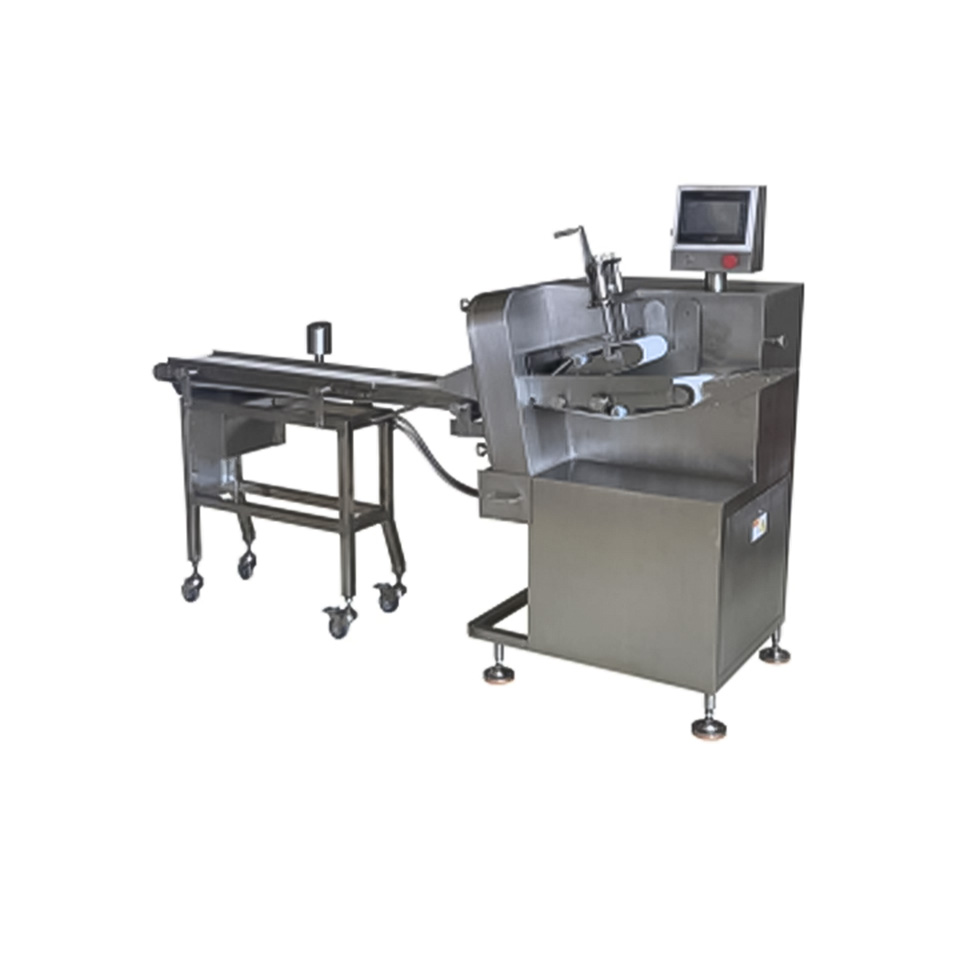
Gravity-feed slicers are the small manual machines behind a retail counter. Automatic cutter-slicers hold product in a feed chamber and slice continuously: the DQP-17K accepts product up to 170 × 170 × 640 mm, adjusts 1–32 mm, and runs 155 slices per minute on a 3.4 kW motor.
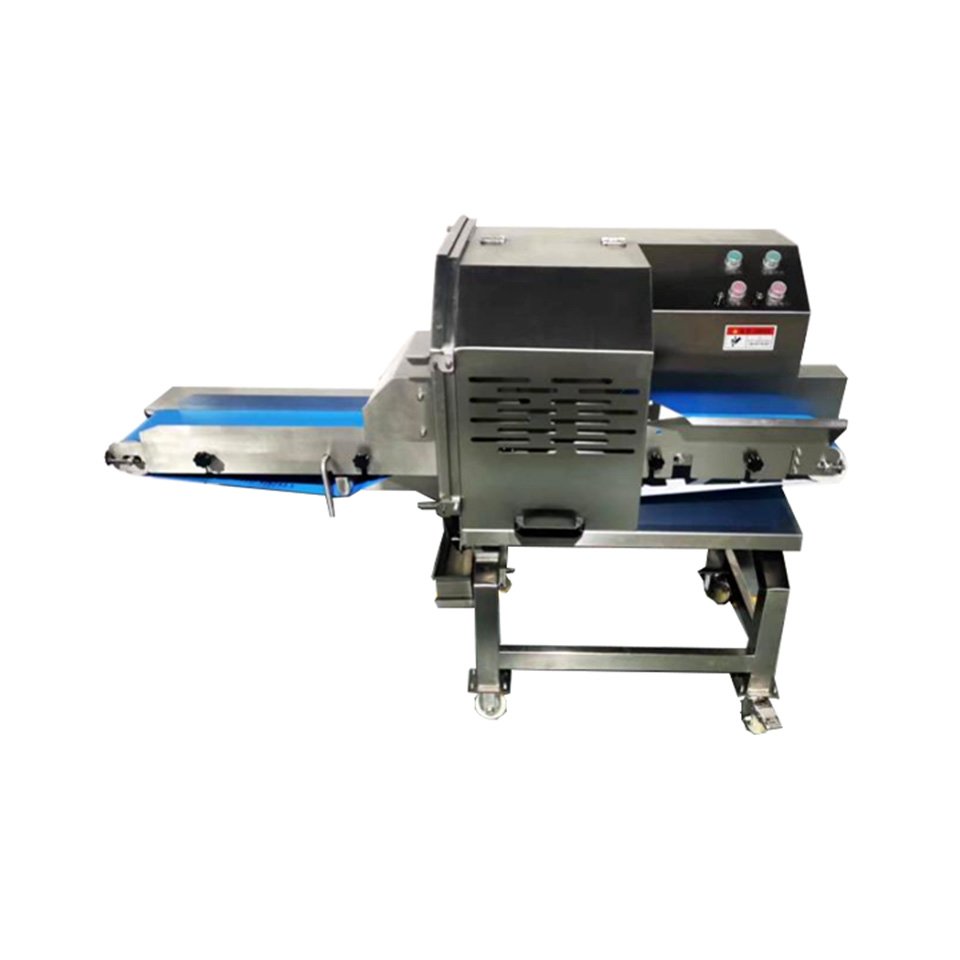
Conveyor slicers feed product on a belt; the TY-120 uses a 120 mm belt, adjusts 0–20 mm, and processes 300–500 kg/h on 1.5 kW — the format for putting a slicer inside an existing line. For chilled and tempered product, purpose-built cutters such as the TY-160 use a 600 × 160 × 100 mm chamber, 1–30 mm adjustment, and 60–260 pieces per minute, with a design point of -2 to -3 °C.
Core Specifications Buyers Should Compare
| Specification | Why It Matters | What Buyers Should Check |
|---|---|---|
| Slice thickness range | It decides which products the machine can serve, from 1.5 mm lamb rolls to 32 mm diced product. | Compare your thinnest and thickest cut; typical values run 1–32 mm (DQP-17K) and 1–20 mm (TY-140). |
| Hourly capacity | It sets the line speed and labor the machine can support. | Examples: 155 slices/min (DQP-17K), 300–500 kg/h (TY-120), up to 1500 kg/h (dual-blade industrial unit). |
| Motor power | Undersized motors stall on chilled or dense product. | Typical values: 1.25 kW (TY-160), 1.5 kW (TY-120, TY-140), 3.4 kW (DQP-17K), dual 1.5 kW + 1.5 kW (industrial). |
| Voltage and phase | Wrong supply means a rewire or a new machine. | Most industrial slicers run 380 V / 50 Hz three-phase; confirm your site supply first. |
| Feed opening / chamber | It limits the largest piece you can process. | Examples: up to 170 × 170 × 640 mm (DQP-17K), 140 mm inlet and 150 mm outlet (TY-140), 600 × 160 × 100 mm chamber (TY-160). |
| Machine dimensions | Footprint has to fit the room and the line layout. | Examples: 1700 × 750 × 1250 mm (DQP-17K), 1500 × 625 × 1050 mm (TY-120/TY-140), 2300 × 650 × 1400 mm (TY-160). |
| Weight | Heavier frames damp vibration and hold slicing tolerance. | Expect 123–400 kg in this class; check floor loading and the moving path before delivery. |
| Food-contact material | It decides hygiene compliance and cleaning life. | Stainless 304 is the baseline; request material certificates with the order. |
| Product temperature | Cut quality collapses outside the designed range. | Chilled meat slices best at -2 to -3 °C on machines designed for it; frozen blocks need a different cutting principle. |
How to Choose the Right Model
Production Capacity and Slice Thickness
Start from the peak hour, not the daily average. A kitchen plating 4000 meals with a 40 g slice of cooked beef is slicing 160 kg in the peak window — a bench machine will not hold that pace; the DQP-17K at 155 slices per minute will. Thickness accuracy matters just as much: a ready-meal line validated on a fixed time-temperature profile needs every slice inside the same millimetre band.
Product Temperature: Chilled, Fresh or Frozen
The most common selection error is buying for fresh meat and then running chilled product. Chilled meat at -2 to -3 °C gives the cleanest slices on a heavy-duty cutter such as the TY-160 — firm but not brittle. Hard-frozen blocks at -18 °C behave differently: they shatter, load the motor, and dull blades unless the machine is built for frozen product. Tell the supplier the temperature you will run.
Blade, Motor and Drive System
Blade geometry and torque decide cut quality more than headline power. Dual-blade arrangements raise output at the same thickness — the industrial 1500 kg/h model carries two 1.5 kW motors rather than one large one. Ask about blade material, how the blade gap is locked, and expected blade life on your product. On site, machines fail first where the blade gap drifts because the lock is light for the duty.
Food-Contact Materials and Cleaning Design
Cutting chamber, hopper, belt, and guards should be stainless or certified food-grade, and the machine should strip for cleaning with simple fasteners. Buyers under HACCP or ISO 22000 programs should be able to point to where each surface is cleaned, how the blade is guarded during cleaning, and where water can pool. Ask for the cleaning procedure in writing.
Voltage, Power and Installation
Confirm the supply before you buy: 380 V / 50 Hz three-phase is standard in this class, but site wiring, breakers, and cable runs are the buyer's side. Put weight and dimensions into the floor plan early — the TY-160 is 2300 mm long, and a machine that will not fit through the door is an expensive mistake.
Buyer Checklist
- Confirm raw material type, size, and the product temperature you will run.
- Confirm peak-hour output, not the daily average.
- Check the slice thickness range against your thinnest and thickest cut.
- Verify voltage, phase, breaker capacity, and cable route on site.
- Check dimensions and weight against the room, door, and floor loading.
- Ask for material certificates for food-contact parts.
- Ask for the cleaning procedure in writing, including blade guarding.
- Request a factory acceptance test with your own product sample where possible.
- Confirm spare parts availability — blades, belts, and seals wear first.
- Confirm after-sales response time and technical documentation in your language.
Common Mistakes to Avoid
Three mistakes repeat across projects. First, buying on unit price instead of cost per slice: a machine 20% cheaper but 30% slower and needing blades twice as often is the more expensive machine. Second, treating slice thickness as a marketing number — a spec line that says "1–32 mm" tells you nothing until you confirm accuracy at the thin end with your own product. Third, ignoring the cleaning routine during selection; a machine that takes 40 minutes to strip down will not be cleaned to HACCP standard on a busy Friday.
FAQ
What slice thickness range do I need in a commercial meat slicer?
It depends on the product mix: lamb rolls slice at 1.5–2 mm, deli meat at 2–4 mm, and diced product at 20–32 mm. If your range spans that spread, choose a wide band such as 1–32 mm (DQP-17K) or 1–30 mm (TY-160), and confirm accuracy at the thin end.
How much meat can a commercial meat slicer process per hour?
Bench machines handle tens of kilograms per hour; the DQP-17K runs 155 slices per minute; conveyor models process 300–500 kg/h; industrial dual-blade machines reach 1500 kg/h. Match your peak hour, then add margin.
Can a commercial meat slicer cut frozen meat?
Chilled meat at -2 to -3 °C is the sweet spot for clean slicing. Hard-frozen blocks at -18 °C need a machine designed for frozen product, or you risk blade damage and motor overload. Tell the supplier the real temperature.
What material should the food-contact parts be?
Stainless 304 is the baseline for food-contact parts; belts and guides may use food-grade polymers. Ask for material certificates and confirm exactly which surfaces touch product — a stainless body does not guarantee every contact part is stainless.
What power supply does a commercial meat slicer need?
Industrial slicers commonly run 380 V / 50 Hz three-phase at 1.25–3.4 kW. Confirm supply, breaker capacity, and plug configuration before ordering, and ask for the full-load current draw, not just the motor rating.
How do I maintain a commercial meat slicer?
Daily: strip and clean food-contact surfaces and check the blade for nicks. Weekly: check blade gap and locking, inspect belts and guards. Keep a spare blade and seals at line side. Machines fail early when the blade gap drifts or cleaning skips the cutting chamber.
Related Products and Guides
- Commercial Meat Slicers — TY and DQP series slicers with adjustable thickness for butcher shops and food plants.
- Meat Dicing Machines — dicing and cutting machines for ready meals and meat processing lines.
- Meat Grinders — grinders sized for butcher shops and industrial meat plants.
- Meat Bone Saws — bone saws for frozen meat, fish, and poultry processing.
- Refrigeration and Freezing Equipment — chillers and freezers that keep product in the slicing temperature window.
- Meat Processing Equipment — the full meat processing range from cutting to packaging.
- DQP-17K Meat Cutting Machine — 1–32 mm adjustable, 155 slices per minute, 304 stainless food-contact parts.
Choosing a commercial meat slicer comes down to matching the machine to your product, your temperature, and your peak-hour output — then confirming the details that only show up in service: blade life, spare parts, and documentation. Final specifications should be confirmed according to the selected model and supplier documentation.
Last updated: October 2026
苏涛;舜翔央厨、华艺智能