
Commercial gas griddle sizing from the E-RQP-36A to the E-RQP-1500: plate thickness, kW per plate length, frame choice, gas type, and batch capacity checks.
A commercial gas griddle is sized by plate area and plate thickness first, and by burner count only afterwards. The two ends of the Huayi Equipment range show why. The E-RQP-36A carries a 25 mm plate at 26.4 kW, weighs 120 kg, and sits on a 914 × 734 mm footprint. The E-RQP-1500 runs a 1496 × 540 × 16 mm plate at 20 kW, uses four burners, and weighs 150 kg. Both are gas flat tops. They are not interchangeable, and the price gap between them says almost nothing about which one belongs in your kitchen. What separates them is stored heat, recovery after a cold load, and the frame that has to stand on your floor. This guide is for overseas buyers, chain kitchen planners, and catering equipment importers comparing commercial gas griddle models before a quote.
Key Takeaways
- Plate thickness sets the working behaviour: 10 mm plates react fast, 16 mm plates hold a batch, 20–25 mm plates carry heat through a rush.
- Normalise power before comparing prices. The E-DP-900S runs 6 kW across a 590 mm plate (10.2 W per mm of plate length); the E-RQP-36A runs 26.4 kW across 914 mm (28.9 W per mm).
- Frame type is a site decision, not a styling choice. Tabletop models sit at 420 mm body height (E-RQP-600X, E-RQP-720B-A); floor-standing models stand at 850 mm with legs and a lower shelf (E-RQP-1000 to E-RQP-1500).
- A 728 × 396 mm plate (E-RQP-720B-A) holds about 10 patties of 100 mm diameter per load once margins are taken off.
- Confirm gas family before ordering: the E-RQP-1200 and E-RQP-1500 are listed for LP/NG and NG/LPG respectively, and the jetting is not interchangeable on site.
- Ask for a recovery curve, not a maximum temperature. Maximum plate temperature is easy to print; time back to searing heat after a frozen load is what the line actually lives on.
What This Equipment Is Used For
A gas flat top is a direct-contact cooking surface. Food sits on a heated steel plate, so heat arrives by conduction rather than by air, and the surface that touches the plate browns first. That single characteristic decides where the machine belongs in a kitchen.
In a burger operation the griddle is the sear station. Patties go down cold, come off with a crust, and the plate has to return to temperature between loads. In a breakfast or catering kitchen the same plate runs eggs, bacon, pancakes, and toast in sequence, often with different set points across the width. In a central kitchen it becomes a batch station for patties, sliced vegetables, and pre-cooked proteins that are then chilled or packed.
The plate also does work that a range cannot. A griddle gives full contact across the whole surface, so a 1200 mm plate can run eight to twelve portions at once with the same result at each position. A burner ring gives one hot spot and a gradient around it. For anything cooked in flat batches at volume — patties, eggs, tortillas, sandwiches, teppanyaki-style vegetables — the griddle is the correct station. For stock pots, noodles, and wok work it is the wrong one, and buyers who try to use it that way usually complain about recovery rather than about the machine.
Typical buyers are chain restaurants standardising a menu across sites, catering companies running event kitchens, food truck builders working to a 600 mm module, and central kitchens that need a repeatable sear before chilling.
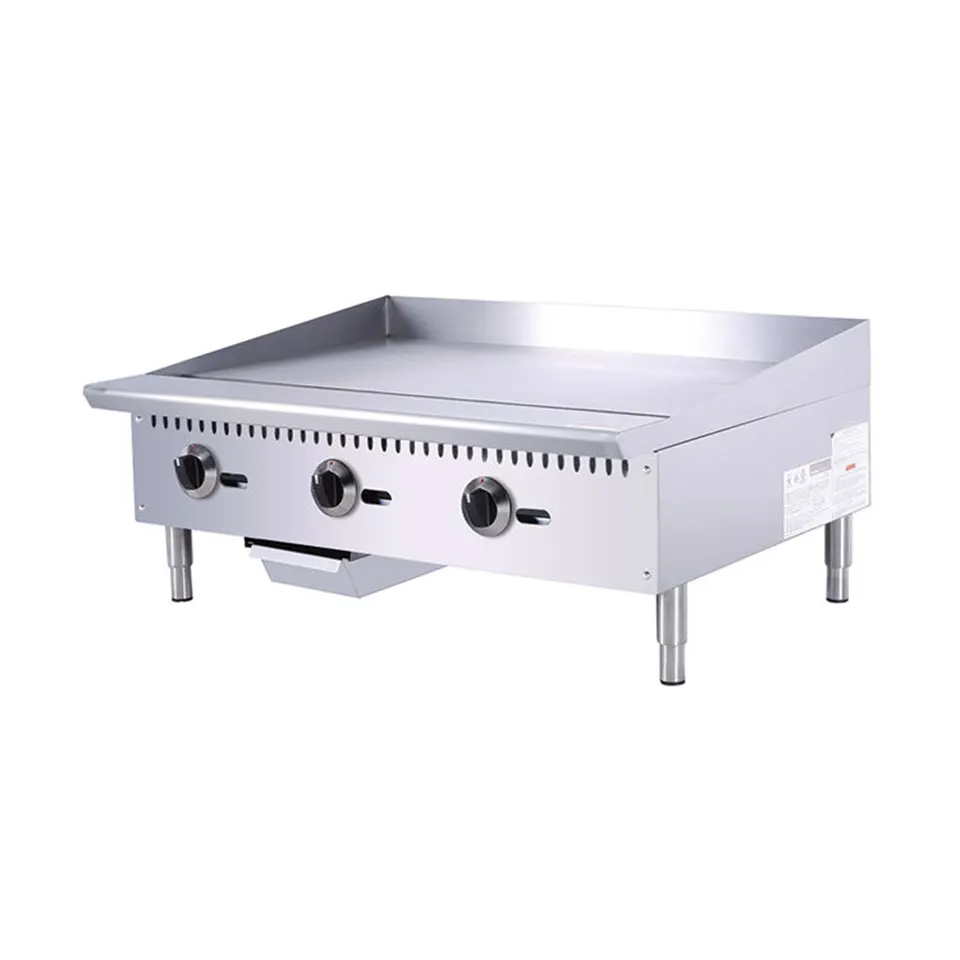
Core Specifications Buyers Should Compare
| Specification | Why It Matters | What Buyers Should Check |
|---|---|---|
| Plate thickness | Thick plates store heat and recover slowly; thin plates react fast and drop fast. | Ask for the plate dimension in mm. The range spans 10 mm (E-RQP-720B-A), 16 mm (E-DP-900S, E-RQP-1000 to E-RQP-1500), and 20–25 mm (E-RQP-36 / E-RQP-36A). |
| Plate length and width | Usable surface sets batch size and how many portions can be worked at once. | Take the plate, not the body: 996 × 540 mm on the E-RQP-1000, 1496 × 540 mm on the E-RQP-1500, 728 × 396 mm on the E-RQP-720B-A. |
| Gas input in kW | Power decides recovery speed and the gas line and hood you must provide. | Divide kW by plate length and compare like with like: 10.2 W/mm on the E-DP-900S against 28.9 W/mm on the E-RQP-36A. |
| Burner quantity and layout | Independent burners give zones; one long burner gives a single gradient. | Confirm 3 burners (E-RQP-1200) or 4 burners (E-RQP-1500) and whether each has its own control valve. |
| Gas type | LP and NG need different jets and air settings; a mismatch is a commissioning failure. | State the gas family on the purchase order and ask for the jet size in the manual. |
| Frame and height | Decides whether the unit drops into a counter line or stands alone with a shelf. | Tabletop bodies sit at 420 mm (E-RQP-600X, E-RQP-720B-A); floor units stand at 850 mm with legs (E-RQP-1000 to E-RQP-1500). |
| Weight and footprint | Sets floor loading, delivery handling, and clearance for service access. | 23 kg (E-DP-400X) through 42 kg (E-RQP-600X) to 150 kg (E-RQP-1500); check the door width on site. |
| Grease management | Grease trough and drawer size decide how often someone stops cooking. | Look at trough depth, drawer volume, and whether the drawer pulls out without moving the unit. |
| Plate material and finish | Steel grade, plate flatness, and coating decide cleaning method and lifespan. | Confirm SUS304 or 201 body steel, plate flatness, and whether the surface is plain steel or PTFE-coated. |
Start With the Plate, Not the Burner Count
Burner count is the easiest number to put on a spec sheet and the least useful one to buy on. Three knobs on a 728 mm plate and three knobs on a 1200 mm plate describe two different machines.
Plate thickness drives behaviour more than anything else on the sheet. A 10 mm plate — the E-RQP-720B-A is listed at 728 × 396 × 10 mm — heats quickly and responds to the valve within seconds. It also sheds heat into a cold load quickly, so the surface drops and the next patty goes down on a cooler plate. That is acceptable in a food truck running twelve covers at a time. It is not acceptable on a burger line pushing 200 units an hour.
A 16 mm plate, used across the E-DP-900S (306 × 590 × 16 mm) and the floor-standing E-RQP-1000, E-RQP-1200, and E-RQP-1500 (996, 1196, and 1496 × 540 × 16 mm), is the working compromise. It stores enough heat to hold through a batch and still recovers in a workable time. Most catering kitchens and central kitchens settle here.
The 20 mm and 25 mm plates on the E-RQP-36 and E-RQP-36A are a different class. At 914 × 734 mm and 26.4 kW, the 36A is carrying 28.9 W per mm of plate length — roughly 2.8 times the density of the E-DP-900S. That power is not there for a higher maximum temperature. It is there to push heat back into 25 mm of steel after a cold load. Buy it when the menu is long, the rush is short, and the plate is never allowed to cool between orders. Skip it when the station runs forty covers a service, because you will pay for gas you do not use.
Compare Commercial Gas Griddle Frames: Tabletop and Floor-Standing
The second decision is the frame, and it is usually settled by the counter, not by the cooking.
Tabletop bodies are 420 mm tall. The E-RQP-600X measures 600 × 600 × 420 mm and weighs 42 kg; the E-RQP-720B-A measures 730 × 550 × 420 mm and weighs 45 kg. These drop onto an existing stainless counter, a food truck bench, or a serving line, and they leave the space underneath free for refrigeration or storage. The trade-off is that everything below the plate is unusable, and the grease drawer has to be short.
Floor-standing units stand at 850 mm and bring their own frame. The E-RQP-1000 is 1000 × 670 × 850 mm at 65 kg; the E-RQP-1500 is 1500 × 670 × 850 mm at 150 kg. Legs and a lower shelf mean the unit can stand alone in a cooking island, and the shelf takes gastronorm pans within reach of the cook. Weight is the price: 150 kg is not a two-person lift, and it needs a route into the building before it needs a gas connection.
One detail worth asking about: the E-DP-900S is listed as 400 × 900 × 850 + 120 mm. That trailing 120 mm is the splash guard above the plate. It matters when the unit sits against a wall or under a low hood, because it adds height that the drawing does not always show.

Match kW to Plate Length Before You Compare Prices
A 20 kW griddle and a 20 kW griddle can be two different machines. Divide the gas input by the plate length and the difference appears immediately.
- E-DP-900S: 6 kW across a 590 mm plate — 10.2 W per mm.
- E-RQP-1200: 15 kW across a 1196 mm plate — 12.5 W per mm.
- E-RQP-1500: 20 kW across a 1496 mm plate — 13.4 W per mm.
- E-RQP-720B-A: 10 kW across a 728 mm plate — 13.7 W per mm.
- E-RQP-1000: 20 kW across a 996 mm plate — 20.1 W per mm.
- E-RQP-36A: 26.4 kW across a 914 mm plate — 28.9 W per mm.
Read the ladder as a heating intent, not a quality ranking. The two low-density units at the top of that list are long, thin-plate machines built to cover a wide menu at moderate load. The E-RQP-36A at the bottom is a heavy-plate machine built to absorb cold product without stalling. A buyer who orders on kW alone will overpay for a wide plate in one kitchen and under-order recovery in another.
Ask the supplier for the calculation in writing, using the plate dimensions from the drawing. If the answer is a maximum temperature only, the question has not been answered.
How to Choose the Right Model
Production Capacity
Work backwards from the worst hour, not the average day. Take the plate area, remove a 40 mm margin from each side for the splashes and the scraper, then divide by the footprint of one portion plus its turning gap.
Worked example on the E-RQP-720B-A. The plate is 728 × 396 mm. After margins the usable area is 648 × 316 mm. A 100 mm patty needs about 110 mm of pitch to turn with a spatula, so the load is 5 across by 2 deep — 10 patties. At a four-minute cycle that is 15 loads, or about 150 patties an hour. If the target is 300 an hour, this plate is the wrong plate, and no amount of knob-twisting fixes it.
Run the same arithmetic on the E-RQP-1500: 1496 × 540 mm becomes 1416 × 460 mm usable, which is 12 across by 4 deep at the same pitch — 48 patties per load, or roughly 720 an hour at a four-minute cycle. That is the number to put against labour and against the hood size.
These figures are planning arithmetic on published plate dimensions, not tested output. Confirm them against the supplier's capacity statement and your own product thickness, because a 150 g patty and a 200 g patty do not share a cycle time.
Food Contact Materials
The plate is a food contact surface and should be specified as one. Body steel is listed as SUS304 or SUS201 at 0.8–1.2 mm on the E-RQP-1200 and E-RQP-1500, and 304 is the grade to insist on where the unit sees daily washdown and acidic marinades. The plate itself is usually a carbon steel or a specialised alloy chosen for heat transfer and seasoning behaviour, not for corrosion resistance, which is why a griddle plate is scraped and oiled rather than soaked.
Where a coating is offered, read what it is. The E-DP-900S is listed with a PTFE non-stick surface. PTFE reduces sticking on eggs and delicate items and changes the cleaning method: no metal scrapers, no abrasive pads, no caustic soak. Buyers who run a heavy scraper routine should take a plain plate and season it instead.
For export markets, ask for the food contact declaration against the destination rule set — GB 4806.9-2016 for stainless steel in China, FDA 21 CFR Part 177 for the United States, and the EU framework regulation 1935/2004 with its national implementing rules. A supplier who cannot produce a declaration for the plate alloy should not be shortlisted for a chain account.
Cleaning and Maintenance
A griddle is cleaned hot and often. Build the routine around three parts: the plate, the trough, and the drawer.
The plate is scraped while warm, wiped with oil, and left with a thin film. Deep cleaning with water on a hot plate warps it and strips the seasoning, and a warped plate shows up later as uneven browning at one end of the batch. The trough behind the plate carries grease to the drawer and is the part that blocks first; on a busy line it is cleared every service. The drawer is the capacity limit — a short drawer on a 420 mm tabletop body fills faster than the same plate on a floor-standing frame, which is one reason a 20 kW tabletop can feel busier than a 20 kW floor unit.
Weekly checks that catch most failures: plate flatness with a straight edge, burner flame colour at each zone, gas hose condition, and drawer seal. Plate flatness matters most. A 0.5 mm bow across a 700 mm plate is enough to leave oil pooling at one end and burning at the other.
Specify Gas Type, Clearance, and Ventilation
Gas family comes first. The E-RQP-1200 is listed for LP/NG and the E-RQP-1500 for NG/LPG, which means the same model number can arrive jetted two ways. Put the family and the supply pressure on the purchase order, and ask for the jet table in the manual so the commissioning engineer can verify it rather than guess.
Clearance comes second. A gas flat top needs air at the burner and a path for combustion products. Minimum side clearance to combustible surfaces is normally set by the listing standard rather than by the supplier, so check the unit against EN 203-1:2014 in Europe or ANSI Z83.11 in North America, and against local gas regulations in the destination market. A unit pushed tight against a wall will run, and it will also discolour the wall and trip the hood's thermal cut-out on a long service.
Ventilation comes third and is usually underestimated. A 26.4 kW griddle releases a large heat load into the hood, and the hood has to be sized for the total of every appliance under it, not for the griddle alone. Where the griddle sits in an island, an overhead hood with side skirts works better than a wall hood at the same extraction rate, because the capture velocity at the plate edge is what decides whether smoke is caught.
Plan the Grease Path and the Service Access
Grease is the maintenance cost of a griddle, and the path it takes should be drawn before the unit is ordered. Plate to trough, trough to drawer, drawer to waste. Every joint in that path is a place where grease cools and sets.
Service access is the second drawing. The gas valve, the thermocouple, and the pilot need to be reachable without lifting the plate. On a tabletop body that usually means pulling the unit forward on its counter; on a floor-standing frame it means a front panel that comes off with the unit in place. Ask which panel comes off and how many fasteners hold it. If the answer involves removing the plate, plan for a longer downtime and a spare unit.
One practical note on weight: at 150 kg, the E-RQP-1500 needs a route that a pallet truck can take. Measure the door, the lift, and the turn into the kitchen before the shipping date, not after.
Check Power Density, Recovery, and the Demo Batch
Three checks separate a griddle that suits the menu from one that only suits the drawing.
First, power density. Ask for kW and plate dimensions, then calculate W per mm of plate length yourself. Anything under 13 W/mm on a 16 mm plate is a light-duty machine; anything over 25 W/mm is a heavy-plate machine built for a rush.
Second, recovery. Put six frozen patties on a preheated plate at the set point, leave them for three minutes, then measure the plate temperature at the centre of the load and the time back to set point after removal. A supplier who has run this test will have numbers. A supplier who has only a maximum temperature has not run it.
Third, the demo batch. Cook the actual product — the real patty weight, the real egg, the real tortilla — and count how many portions come off before the surface colour changes between the first and the last. That count, not the spec sheet, is the capacity of the machine in your kitchen.
Buyer Checklist
- Confirm the product: patty weight, egg, tortilla, or vegetable, and the thickness of each.
- Confirm the worst-hour output and convert it to portions per load using the plate dimensions.
- Ask for plate length, width, and thickness in mm, separately from the body dimensions.
- Calculate W per mm of plate length and compare models on that number, not on kW alone.
- State the gas family and supply pressure on the order, and request the jet table.
- Confirm the frame: 420 mm tabletop body or 850 mm floor-standing with legs and shelf.
- Check the route: door width, lift capacity, and turning space for 42 kg to 150 kg.
- Ask for the food contact declaration for the plate alloy and the body steel grade.
- Ask for the cleaning method in writing, especially where a PTFE coating is involved.
- Confirm spare parts: thermocouple, gas valve, pilot assembly, knobs, and drawer seal.
- Request a recovery test result and a demo video with the actual product.
Common Mistakes to Avoid
Buying on burner count. Three burners on a 728 mm plate and three on a 1200 mm plate are not the same machine. The plate decides the batch; the burners only decide how the heat is distributed across it.
Comparing kW without normalising. A 15 kW unit over 1196 mm runs cooler per millimetre than a 10 kW unit over 728 mm. Without the division, the larger number looks stronger and is not.
Putting a tabletop body where a floor frame belongs. A 420 mm body on a counter loses the space below and shortens the grease drawer. Kitchens that run long services regret it within a month.
Ordering LP gas into an NG building. The unit will light, run yellow, and soot the plate. Jets and air settings are not field-adjustable on most models, and the fix is a parts order and a second commissioning visit.
Skipping the recovery test. Maximum plate temperature is printed on every sheet and tells you nothing about the fourth load. Ask for the recovery curve, then verify it on your own product.
Forgetting the hood. A 26.4 kW griddle is a large heat source. If the hood was sized before the griddle was chosen, the extraction will be short and the kitchen will run hot.
FAQ
Q: What is a commercial gas griddle used for?
A: It is a flat, direct-contact cooking surface for batch items — patties, eggs, bacon, tortillas, sandwiches, and sliced vegetables. Heat reaches the food by conduction through the plate, so the surface that touches the steel browns first. It is the right station for flat batches at volume and the wrong one for stock pots, noodles, or wok work.
Q: How thick should a griddle plate be?
A: It depends on the load pattern. A 10 mm plate such as the one on the E-RQP-720B-A reacts in seconds and suits short, light services. A 16 mm plate on the E-RQP-1000 to E-RQP-1500 holds a batch and recovers in a workable time, which fits most catering and central kitchens. A 20–25 mm plate on the E-RQP-36A carries heat through a rush and needs the 26.4 kW behind it.
Q: How many patties per hour can a 728 mm plate handle?
A: On the E-RQP-720B-A, with a 40 mm margin and a 110 mm pitch for a 100 mm patty, the plate takes 10 patties per load. At a four-minute cycle that is about 150 per hour. Confirm the cycle time against your own patty weight before committing to a target.
Q: Should I choose gas or electric?
A: Gas gives faster recovery per kW and does not need a high-current supply; electric gives finer zone control and a cleaner plate edge. The E-DP-400X at 4.05 kW on 380–415 V and the E-DP-900S at 6 kW show the electric end of the range; the E-RQP series covers 8.5 kW to 26.4 kW on gas. Where the building has no gas line, electric is the decision that has already been made for you.
Q: What gas pressure and clearance do I need?
A: Pressure comes from the jet table and the local gas rules, not from the brochure; put the family and pressure on the purchase order. Clearance follows the listing standard — EN 203-1:2014 in Europe, ANSI Z83.11 in North America — plus local rules, and it is usually larger to combustibles than to stainless steel.
Q: How do I clean a griddle with a PTFE plate?
A: Scrape with a plastic or soft-metal scraper while warm, wipe with oil, and avoid abrasive pads, wire brushes, and caustic soak. A plain steel plate takes a metal scraper and a re-seasoning film; a coated plate does not. Confirm the method in writing so the night shift follows the same routine as the day shift.
Q: Can I change the gas type after delivery?
A: Usually not in the field. Jets, air shutters, and sometimes the valve are matched to the gas family at build. Order the correct family, and keep the jet table with the manual so a later conversion can be quoted properly.
Sources
- FAO, Codex Alimentarius: General Principles of Food Hygiene (CXC 1-1969, revised) — separation of raw and cooked surfaces, cleaning frequency.
- HSE (UK), Safety in commercial kitchens: gas appliances and ventilation — clearance, flueing, and hood requirements.
- FDA, 21 CFR Part 177 — indirect food additives: polymers and adjuvants for food contact surfaces.
- EN 203-1:2014 — gas-heated catering equipment, safety and rational use of energy.
- GB 4806.9-2016 — food contact stainless steel and alloys, migration limits.
- ANSI Z83.11 / CSA 1.8 — food service equipment, gas-fired ranges and griddles.
- EU Regulation (EC) No 1935/2004 — materials and articles intended to come into contact with food.
Related Examples
Model pages for the units referenced above, with the full specification tables:
- E-RQP-36A 36-inch commercial gas griddle, 25 mm plate, 26.4 kW
- E-RQP-1000, E-RQP-1200, and E-RQP-1500 floor-standing gas griddles, 16 mm plate
- E-RQP-720B-A commercial gas griddle, 728 × 396 × 10 mm plate, 10 kW
- E-RQP-600X compact gas griddle, 600 × 600 mm, 8.5 kW
- E-DP-900S gas griddle with PTFE plate, 306 × 590 × 16 mm, 6 kW
- E-DP-400X countertop electric griddle, 4.05 kW on 380–415 V
- Griddles and charbroilers collection
- Related guide: commercial deep fryer buying guide
- Related guide: combi steam oven selection for central kitchens
- Send throughput targets and site conditions for a model recommendation
Choosing a commercial gas griddle comes down to three moves in order: the plate for the product, the kW for the plate, and the frame for the room. Model numbers follow from those three answers, not from the price list. Final specifications should be confirmed according to the selected model and supplier documentation.
Published on 2026-11-01. Author: 苏涛;舜翔央厨、华艺智能