
A practical guide to choosing commercial deep fryers for restaurants, central kitchens, and food processing. Compare gas vs electric, oil capacity, recovery rate, filtration, and safety specs.
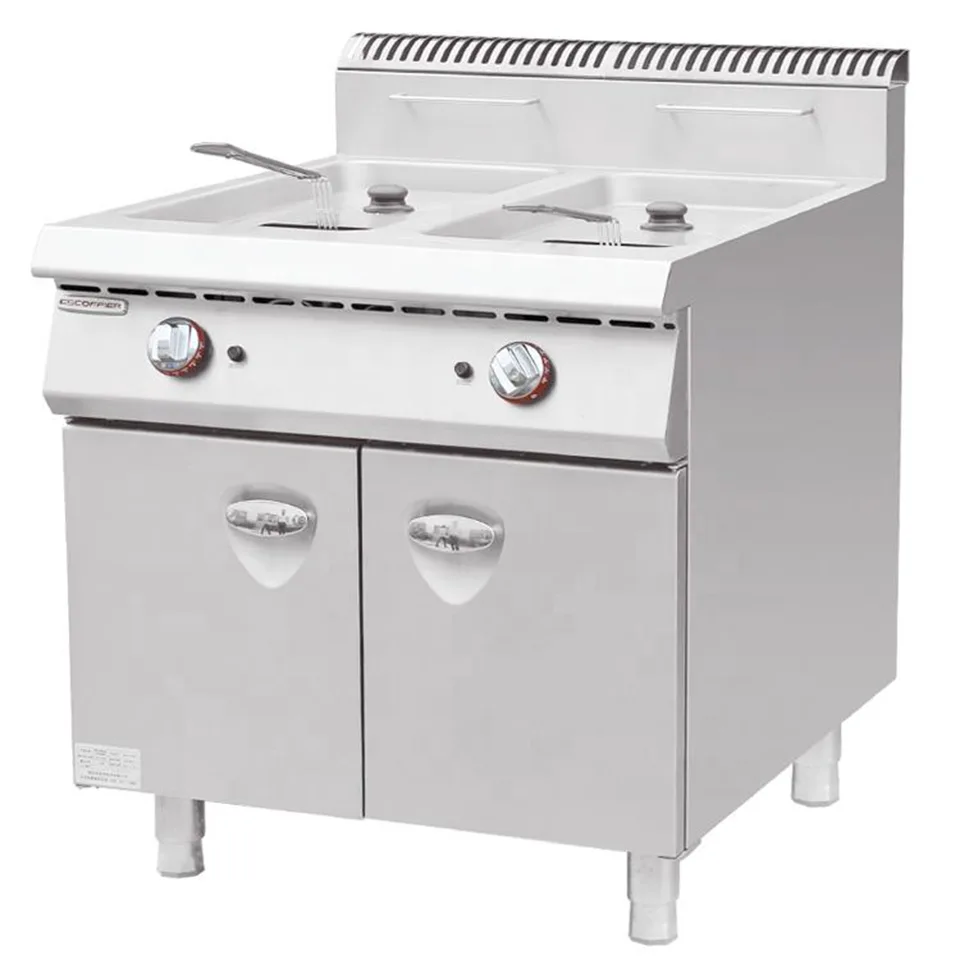
Commercial deep fryers are loud, hungry equipment: they demand 40–54 kW of heat input, require a gas supply line or a 380 V three-phase circuit, and consume 150–200 L of cooking oil per week in a busy operation. That combination makes fryer selection an engineering problem, not a marketing decision. This guide covers what B2B buyers actually need to compare — oil capacity, heating power, recovery rate, filtration, and certification — so the fryer pays back in three months instead of six.
Types of Commercial Deep Fryers
Gas Floor Fryers
Gas fryers dominate high-output kitchens because they recover temperature faster after a cold basket load. A 54 kW gas fryer with 50–75 L oil capacity brings 20 L of fresh oil from 160°C back to 177°C within 60–90 seconds after a full basket drop. That recovery rate is the spec that matters in à la carte or buffet service. Gas connection requires a certified gas plumber and a 28–35 mbar supply line for natural gas. Electronic ignition saves gas on pilot-only days and is worth specifying at order time.
Electric Floor Fryers
Electric fryers are the default in facilities without gas infrastructure — upper-floor production kitchens, modular catering units, or export shipments to markets with 208–240 V single-phase or 380–415 V three-phase grids. A 36 kW electric fryer draws 52 A at 380 V three-phase, so the electrical panel must be confirmed before ordering. The advantage: no combustion gases, easier hood exhaust calculations, and PID temperature control that holds 177°C within ±1°C during peak production.
Pressure Fryers
Pressure fryers seal the lid during cooking, raising internal pressure to cut cook time by 30–40 percent and delivering what quick-service chains call "juicyfried" — oil penetration without surface drying. Pressure fryers operate at 0.5–0.8 bar above atmospheric pressure, which means the vessel requires ASME or PED pressure vessel certification and annual inspection of the pressure relief valve. A 40–60 L pressure fryer at 54 kW gas input is the standard spec for bone-in chicken lines.
Continuous Fryers
Continuous fryers pass product through oil on a conveyor belt at preset speed, delivering consistent color, moisture content, and oil uptake per kilogram. They are the choice for sweet potato chip lines, extruded snacks, and frozen food pre-frying. A 300 kg/h continuous fryer requires 120–180 kW of thermal input and 3–5 m of floor length. Fryer height can reach 2.2 m including the exhaust stack.
Core Specifications Buyers Should Compare
| Specification | Why It Matters | What Buyers Should Check |
|---|---|---|
| Oil Capacity (L) | Determines thermal mass and recovery rate. Small oil volume drops temperature faster under load. | Confirm usable oil volume, not tank nominal volume. Dead volume at tank bottom can be 3–5 L. |
| Heating Power (kW) | Higher kW = faster recovery and higher throughput. Gas: 40–54 kW. Electric: 18–36 kW. | Check whether kW is input (gas) or usable value. Gas efficiency 80–85%; electric 95–98%. |
| Recovery Time (seconds) | Time to return to setpoint after full basket drop. Faster = higher hourly output. | Request manufacturer test data or run a FAT basket-drop test. Typical: 90–120 seconds for 50 L gas. |
| Temperature Control | Frying range is 150–190°C. Low-end precision matters for doughnuts and tempura at 150–160°C. | Confirm whether controller allows ±1°C vs ±5°C increments. |
| Oil Life (hours) | Oil is 60–70% of fryer lifetime cost. Filtration extends life from 8 hours to 24+ hours. | Ask for the test protocol. "Extended oil life" without a defined product profile is marketing copy. |
| Gas Type | Natural gas 25 mbar vs LPG 37 mbar require different jets. Wrong jetting causes CO hazard. | State the site gas type before ordering. Confirm jetting matches at commissioning. |
| Electrical Spec | Electric fryers: 208 V / 1-phase or 380–415 V / 3-phase. Amp draw determines circuit size. | Confirm voltage, phase, and available amp capacity with facilities before ordering. |
Gas vs Electric: How to Decide
If the site has an existing natural gas riser — a central kitchen or hotel kitchen already running a combi oven on gas — adding a 54 kW gas fryer requires one additional 35 mbar supply line. Installation cost is typically USD 200–600 depending on distance from the gas main. Gas fryers cost 15–20 percent less per kilogram of finished product in markets where gas pricing is lower than electricity on a per-kWh thermal basis.
If the site is electric-only, a 36 kW electric fryer at 380 V / 3-phase draws 52 A and needs a dedicated circuit. Operating cost per kilogram is higher, but there is no combustion gas, no open flame, and some facilities qualify for reduced exhaust hood airflow configurations.
Pressure fryers earn their premium on bone-in chicken and products where surface moisture retention is a quality spec — but require pressure vessel certification and annual inspection.
Sizing to Throughput
The sizing mistake most buyers make is selecting by oil volume rather than recovery rate. A 30 L fryer with 36 kW recovers faster than a 50 L fryer with 27 kW. The correct question: not "how many liters" but "how many kilograms per hour at my product's dwell time?" A 50 L gas fryer at 54 kW processes 80–120 kg/h of finished product in typical restaurant use. A slaughterhouse cutting 30 tonnes per day needs three or more fryer stations, not one oversized tank.
Oil Management and Filtration
Built-in filtration adds USD 800–2,500 to the purchase price but typically pays back within 6–12 months through extended oil life and reduced waste. If the fryer ships without built-in filtration, add a floor-model fryer filter (USD 400–900) to the same purchase order. A fryer without filtration burns oil 2–3x faster and produces lower-quality product in the second half of the oil's life cycle. Monitor oil quality with a refractometer: above 25 percent total polar compounds, change the oil regardless of hours elapsed.
Safety and Compliance Checklist
- Gas fryers: AGA / UL / CE gas certification for the stated gas type (NG or LPG).
- Electric fryers: UL / CE electrical certification matching the site's voltage and frequency.
- Pressure fryers: ASME Code Section IV or PED 2014/68/EU vessel registration number.
- Confirm 380 V / 50 Hz vs 415 V / 50 Hz compatibility before ordering — they are not interchangeable on the same wiring config.
- Fryers over 100 kg operating weight need structural engineer confirmation for upper-floor installations.
Buyer Checklist
- Confirm product type and hourly throughput target in kg/h before comparing models.
- Confirm gas type (NG 25 mbar / LPG 37 mbar) or electrical voltage and phase on site.
- Request basket-drop recovery time test data or run a FAT test with the target product.
- Ask for oil life test protocol: hours of production, product load, temperature, and filtration frequency.
- Confirm basket dimensions and quantity. Most fryers ship with full-size baskets; half baskets cost extra on some brands.
- Add built-in filtration to the purchase order — aftermarket accessory pricing is always higher.
- Request warranty, local service response time, and spare parts availability for the target market before signing.
FAQ
Q: What size commercial deep fryer do I need for a restaurant with 80 covers?
A: A single 50–75 L gas floor fryer at 54 kW handles 80–120 kg/h of finished product for most à la carte volumes. If fried proteins are 40 percent or more of the menu, add a second fryer or move to a twin-vat configuration to avoid colour switching delays between fish and chicken.
Q: How often should I change the oil in a commercial deep fryer?
A: High-starch products like potato chips reduce oil life to 8–12 hours of production. Meat and chicken products typically allow 16–24 hours with daily filtration. Measure with a refractometer: above 25 percent total polar compounds, change the oil regardless of hours.
Q: What is the difference between gas and electric commercial fryers?
A: Gas fryers have faster recovery and lower operating cost per kilogram, but require gas infrastructure and produce combustion gases. Electric fryers install easily in sites without gas and offer more precise temperature control, but have higher per-kilowatt-hour energy cost and require adequate electrical panel capacity.
Q: Do I need a pressure fryer?
A: Pressure fryers are for bone-in chicken and products where surface moisture retention is a quality spec. For general-purpose restaurant frying — chips, vegetables, fish — a standard open fryer produces equal quality at lower equipment and maintenance cost.
Q: Can I install a 54 kW gas fryer on an upper floor?
A: A 54 kW gas fryer needs a dedicated gas supply, produces significant flue gases, and weighs over 200 kg with oil. Upper-floor installations require structural load confirmation, gas line pressure verification at the floor level, and usually a dedicated make-up air unit.
Conclusion
Fryer selection comes down to four decisions: the product, the heat source available on site, the hourly throughput target, and the oil management commitment. A 50–75 L gas fryer at 54 kW covers most restaurant and central kitchen needs. A 36 kW electric unit at 380 V / 3-phase serves facilities without gas. Pressure fryers earn their premium on bone-in chicken and similar products. Final selection should always be confirmed against the supplier's FAT data sheet and a site survey before signing.
Related Examples
- Deep Fryers — Browse all commercial fryer models
- Commercial Gas Fryer XKE Double Tank — 31 kW gas, double tank configuration
- Dual Tank Electric Deep Fryer 24 kW — twin-vat electric fryer
- XKE-DZ-900 Dual Basket Electric Fryer — 24 kW dual basket
- Kingbetter Electric Pressure Fryer KEPMF-24NFS — 24 L sealed pressure fryer
- Commercial Electric Fryer E-DZ-800GF-4 — 68 L with built-in filtration