
A practical B2B buying guide to commercial meat bone saws for frozen meat, fish, and poultry. Covers blade length, throat width, motor power, cutting speed, and stainless steel construction.
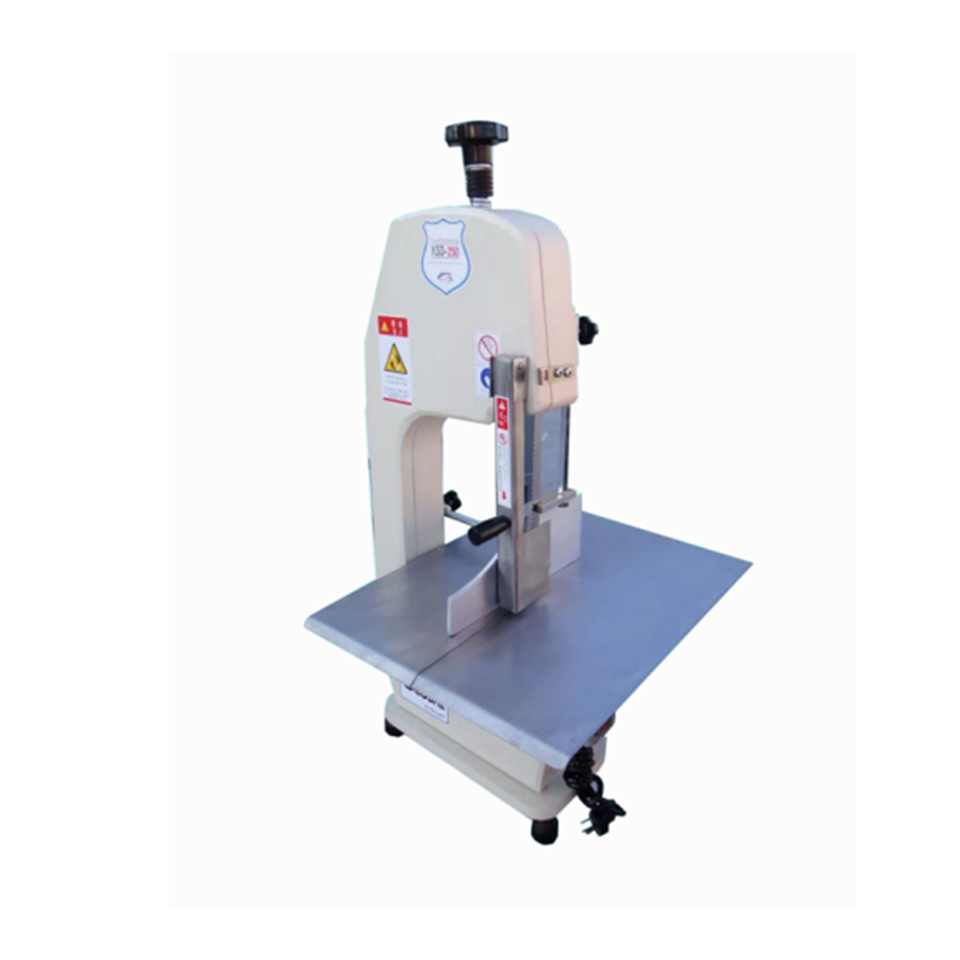
A meat bone saw is a band-saw machine built to cut through frozen bone, cartilage, and dense muscle that an ordinary slicer cannot handle. It is used in butcher shops, meat processing plants, seafood facilities, poultry lines, and central kitchens where portions have to be cut cleanly at production speed. Buyers looking for a meat bone saw for frozen meat, fish, and poultry should compare the machine on cutting speed, blade length, motor power, throat height, construction material, and safety design before looking at price.
Key Takeaways
- A meat bone saw is a band-saw with a continuous loop blade sized for frozen bone, not a slicer with a circular blade.
- Cutting speed for a commercial unit typically ranges from 11 m/min on light-duty tabletop models up to 25 m/min on heavy-duty floor-standing models.
- Throat width (the distance between the blade and the upright column) determines the maximum piece size; 175 mm, 230 mm, and 290 mm are common.
- Stainless steel 304 construction on every product-contact surface is the baseline expectation for food-grade compliance.
- Buyers should match motor power (1.1 kW to 2.2 kW), blade length (1550 mm to 1980 mm), and cleaning access to the actual product mix before selecting a model.
What This Equipment Is Used For
A meat bone saw cuts frozen or fresh bone-in portions into retail or further-processing sizes. In a beef plant it splits rib racks, vertebrae, and shanks. In a poultry plant it sections frozen blocks of leg quarters or backs. In a fish plant it cuts through frozen fish blocks, heads, and frames. In a butcher shop or central kitchen it portions frozen pork ribs, lamb racks, and whole frozen chicken.
The defining characteristic of a meat bone saw is a continuous band blade running on two wheels at a controlled speed. The blade has hardened teeth spaced roughly 4 to 10 mm apart depending on the application. The operator pushes the product through the blade against a fixed work table, often with a pusher block for safety on smaller pieces.
Core Specifications Buyers Should Compare
| Specification | Why It Matters | What Buyers Should Check |
|---|---|---|
| Blade length | Determines maximum cutting height and the size of replacement blades stocked on site. | Confirm blade length in mm (typically 1550 mm, 1750 mm, or 1980 mm) and order matching spare blades with the machine. |
| Throat width | Sets the largest product cross-section that can pass the blade. | Choose 175 mm for portioning beef and pork, 230 mm for whole poultry or fish blocks, 290 mm for large primal cuts. |
| Cutting speed | Affects throughput and cut finish. Slower speeds give cleaner cuts; faster speeds raise output. | For frozen bone, 11-18 m/min is typical. Confirm the speed is adjustable on the inverter-driven models. |
| Motor power | Determines whether the saw can maintain blade speed through dense bone without bogging. | 1.1 kW suits light-duty butcher use; 1.5 kW suits most central kitchens; 2.2 kW suits heavy-duty plants. |
| Work table height | Ergonomics and operator fatigue over an 8-hour shift. | Tabletop units sit at 850-900 mm; floor-standing units usually align with conveyor lines at 800-850 mm. |
| Material | Food contact surfaces must resist corrosion from blood, brine, and cleaning chemicals. | All product-contact surfaces should be stainless steel 304 (AISI 304) at minimum; 316 is better for saline fish applications. |
| Safety features | Band saws have moving blades and pinching points; guards are mandatory in most jurisdictions. | Look for a blade guard, pusher block for small pieces, emergency stop, door interlock, and low-voltage controls (24 V). |
How to Choose the Right Model
Match the Machine to the Product Mix
Before talking to a supplier, list the products the saw will cut in order of frequency: pork ribs, frozen beef shanks, whole frozen chicken, fish blocks, and so on. The product with the largest cross-section sets the minimum throat width. The product with the hardest bone sets the minimum motor power. A buyer who cuts mostly pork and poultry can run on a 1.5 kW machine; a buyer who splits frozen beef vertebrae all day needs a 2.2 kW unit with a heavy-duty gearbox.
Confirm Cutting Speed and Adjustability
Cutting speed is the linear speed at which the band blade travels. For most frozen bone applications, 11 to 18 m/min is the working range. Some plants run slower (8-10 m/min) to reduce chipping on rib bones, and faster (20-25 m/min) on softer poultry bones. An inverter-driven motor with a speed dial is the most flexible option; a fixed-speed single-phase motor is the budget option for shops that always cut the same product.
Look at Cleaning and Maintenance Access
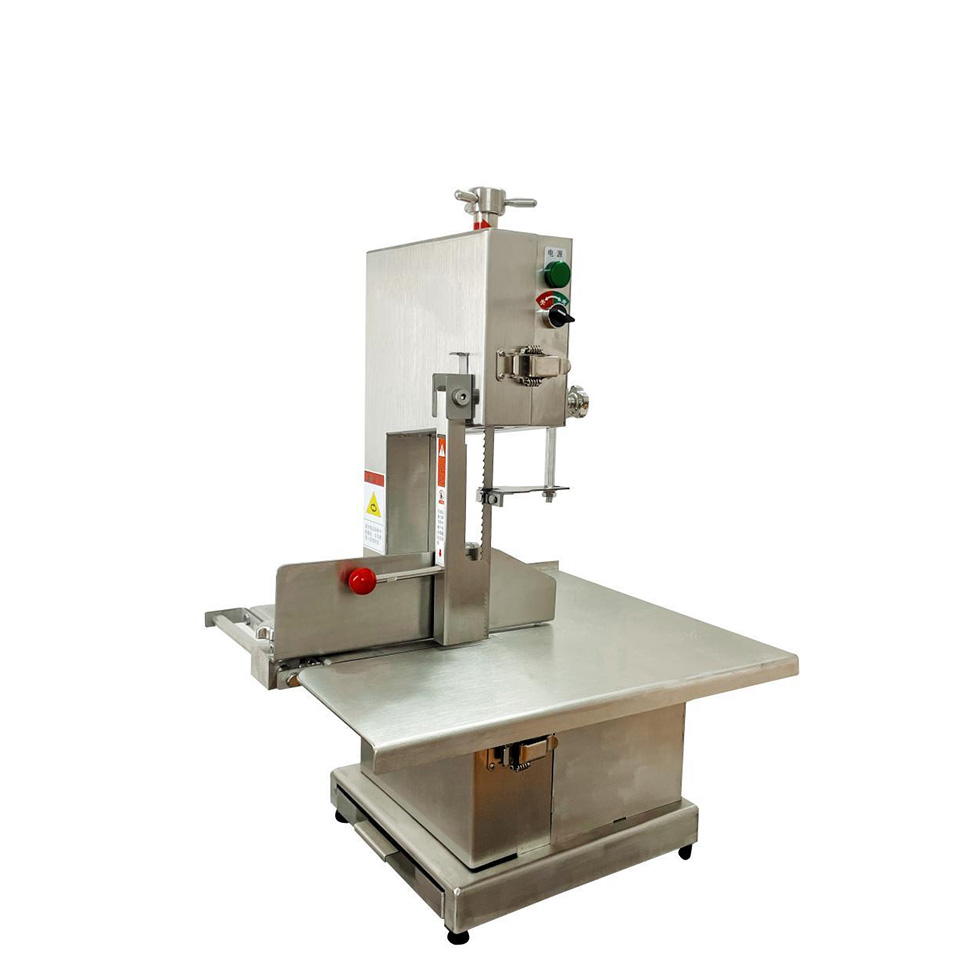
Bone dust, blood, and fat accumulate on the wheels, the blade guides, and the work table. A saw that cannot be cleaned in 10 minutes will be cleaned less often, and that is how bacteria find their way into the product. Look for a removable blade, accessible wheel housings, and a work table that can be hosed down. Stainless steel surfaces with brushed finish are easier to wipe than painted steel.
Daily cleaning should take one operator 5 to 10 minutes. Weekly deep cleaning (blade removal, wheel housing wash, guide inspection) should take 20 to 30 minutes. If a supplier says cleaning takes longer than this, ask why.
Plan for Spare Blades and Service
Bone saw blades wear out. For most plants, a blade lasts 1 to 4 weeks depending on the product and how often the blade is sharpened. Order at least four spare blades with the machine: one in use, one sharpened, one spare, one being sharpened. Confirm the blade spec with the supplier (length in mm, teeth per inch, blade width) and keep one full set on hand.
Motor, gearbox, and bearing replacement parts are not common failures but should be available. Ask the supplier which bearings, which contactor, and which blade guides fit the model, and keep a small stock. A 24- to 48-hour response on parts is the working baseline for any plant that runs a saw every day.
Buyer Checklist
- Confirm the product mix and largest cross-section before specifying throat width.
- Confirm voltage and phase available on site (220 V single-phase for small shops; 380 V three-phase for plants).
- Confirm motor power: 1.1 kW light-duty, 1.5 kW standard, 2.2 kW heavy-duty frozen bone.
- Confirm blade length and order matching spare blades with the machine.
- Ask for the food-contact material certificate (stainless steel 304 or 316).
- Confirm cutting speed and whether it is adjustable.
- Check safety features: blade guard, pusher block, emergency stop, door interlock, low-voltage controls.
- Ask for cleaning time estimate and confirm removable blade, accessible wheel housings, and hose-down work table.
- Confirm warranty terms, response time for service, and whether on-site training is included.
Common Mistakes to Avoid
Buying a slicer instead of a bone saw. A meat slicer with a circular blade cannot cut through frozen bone. The motor, the blade, and the safety system are all built for thin slices of fresh muscle. A buyer who tries to push a frozen pork shank through a slicer will destroy the blade and possibly the machine.
Undersizing throat width. A 175 mm throat saw cannot accept a whole lamb carcass or a large primal. Buyers sometimes save money on a smaller throat and then find they have to pre-section the product by hand, which defeats the purpose of the machine.
Ignoring blade speed control. A single-speed motor at one fixed RPM works for one product. Plants that switch between frozen poultry and frozen beef benefit from an inverter-driven speed adjustment. The cost difference is usually recovered within a year through reduced blade wear.
Skipping the pusher block. Cutting small pieces by hand against a moving band blade is the most common cause of serious injury in butcher shops. A pusher block is a low-cost accessory and should be standard. Some jurisdictions require it by regulation.
FAQ
What is the difference between a meat bone saw and a meat band saw?
The terms are often used interchangeably. A meat bone saw is a band-saw built specifically for frozen bone and dense muscle. A general-purpose meat band saw may have a finer blade for fresh muscle and seafood without bone. For frozen bone at production speed, specify a heavy-duty meat bone saw with the right blade pitch.
Can one meat bone saw cut both frozen meat and fresh fish?
Yes, with the right blade. Frozen bone needs a coarse-tooth blade (3-4 teeth per inch); fresh fish benefits from a fine-tooth blade (6-8 teeth per inch) to reduce tearing. Most plants keep two blade sets and swap them based on the day's product. Cleaning between product changes is also important to avoid cross-contamination.
What throat width do I need for whole frozen chicken?
A 230 mm throat is the practical minimum for cutting whole frozen chicken without pre-sectioning. Plants that also process larger poultry (turkey, goose) or primal beef cuts usually step up to 290 mm. Anything below 200 mm will require the operator to split the bird before sawing.
How often does the blade need sharpening?
For a typical frozen-meat plant running one shift, blade sharpening every 1 to 2 weeks is normal. High-volume plants running two or three shifts on dense bone may sharpen every 3 to 5 days. Keeping a spare blade in rotation reduces downtime while the working blade is being sharpened.
What safety certification should a commercial meat bone saw have?
Look for CE marking for the European market, UL/ETL for North America, and confirmation that the machine meets EN 1972 (food processing machinery safety) or the equivalent local standard. The saw should have a guarded blade, an emergency stop within reach of the operator, low-voltage controls (24 V), and a door interlock that stops the blade when the wheel housing is opened.
Summary
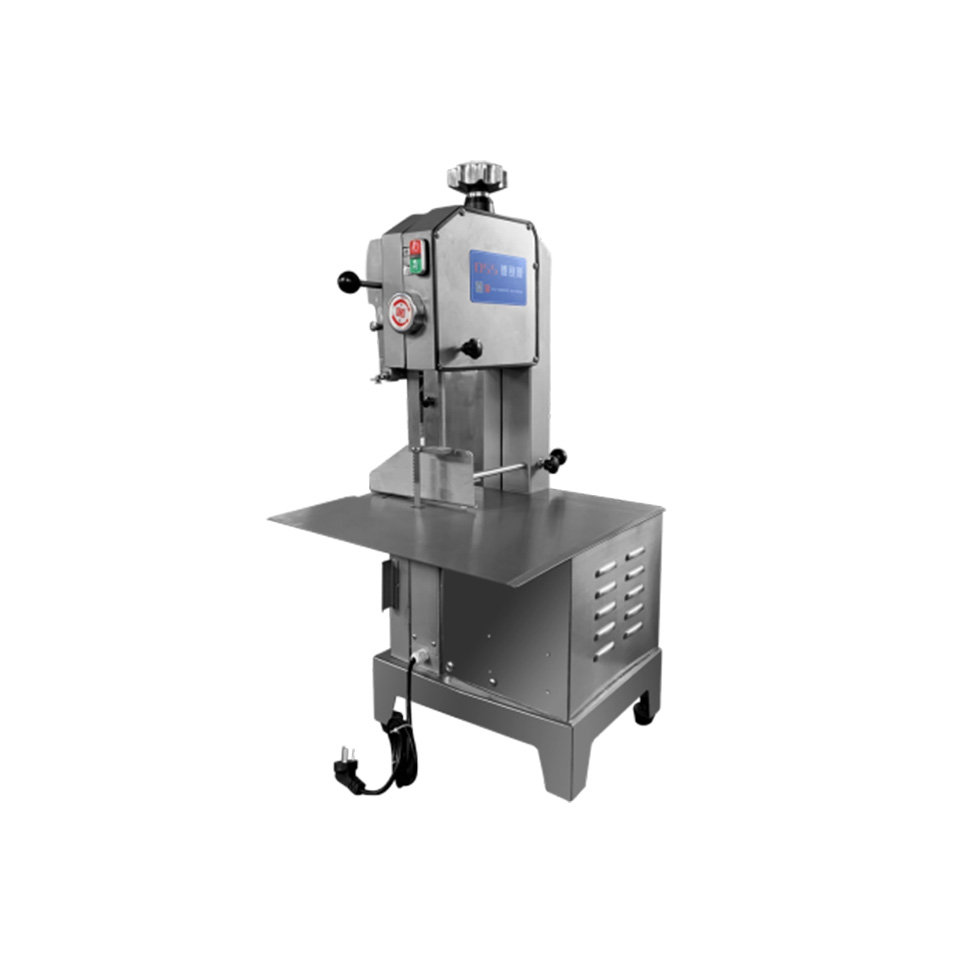
The right meat bone saw for frozen meat, fish, and poultry depends on the product mix, the largest cross-section, and the daily volume. Buyers should compare throat width, motor power, blade length, cutting speed, and stainless steel construction before looking at price. A heavy-duty floor-standing saw with 2.2 kW motor, 1980 mm blade, and 290 mm throat fits a beef or pork plant running two shifts; a 1.5 kW compact unit with 1750 mm blade and 230 mm throat fits a butcher shop or central kitchen. Confirm food-contact material, safety features, spare blade availability, and cleaning access with the supplier before ordering. Final specifications should be confirmed according to the selected model and supplier documentation.