
External vacuum sealer vs chamber sealer compared on bag size, pump rate, 0.85 MPa compressed air and cycle time, with band and foil sealing on the same packing line.
External vacuum sealers pull air from a pre-made bag through a suction nozzle and heat-seal the mouth on an open table. The HB-172 does that on a 700×380×430 mm bench at 36 kg with a 6.5 m³/h pump and an 8 mm bar; the HB-180 vertical does it up to a 1000 mm bar at 150 kg with a 20 m³/h pump. Huayi Equipment, a China manufacturer of food packaging machinery, builds five sealing families for export buyers — external vacuum, chamber, compression, band and induction foil — and the choice starts with the pack in front of you, not with the kilowatt rating.
Key Takeaways
- Pick the seal first. A mouth seal on a pre-made bag means an external vacuum sealer; a platen seal on a thick pouch means a compression heat sealer; a continuous seal on a film tube means a band sealer; a cap seal on a bottle means an induction foil sealer.
- Compressed air is the most-missed service on the drawings. Every external vacuum sealer in this range asks for 0.85 MPa.
- Pump rate sets cycle time. A 6.5 m³/h desktop pump and a 20 m³/h floor pump clear very different bag volumes in the same minute.
- Bag size sets the sealing bar, not product weight. A 1000 mm vertical body with an 8 mm bar is a different job from a 600 mm desktop unit with an 8 mm bar.
- Vertical bodies save floor space and cost more floor area. The HB-180 runs from 700×680×1400 mm to 1096×840×1865 mm and 85 kg to 150 kg, against 700×380×430 mm and 36 kg for the desktop HB-172.
- Chamber machines hold the vacuum over the whole bag; nozzle machines work on one mouth at a time. That single difference decides liquid products and meat with drip.
Compare the Five Sealing Technologies
Five sealing families sit in the same catalogue and they are not competitors. They do different jobs, and most lines finish with two of them: one machine for the product pack, one for the secondary pouch or the carton.
| Technology | How the seal is made | Vacuum level | Typical product | Weak point |
|---|---|---|---|---|
| External vacuum sealer | Suction nozzle on the bag mouth, then a heated bar | -0.8 kPa on the 600 mm HB-235 | Pre-made bags: meat, rice, snacks, small portions | Liquid or drip products can draw air back through the mouth |
| Chamber vacuum sealer | Whole bag drawn into a vacuum well, lid and bar seal it | Set on the machine, chamber wide | Dripping meat, soups, liquid sachets, marinated products | Fixed chamber size, longer changeover between bag sizes |
| Compression heat sealer | Pneumatic press plate squeezes film against a heated bed | No vacuum step | Thick pouches, laminated film, medical and industrial packs | Cycle counted in pieces per minute, not bags per minute |
| Continuous band sealer | Heated band runs along the film while a conveyor carries the bag | No vacuum step | Long film tubes, pillow packs, carton overwrapping | Seals film only, so a vacuum step is still needed for air removal |
| Induction foil sealer | Electromagnetic field welds foil to the container mouth | No vacuum step | Glass and plastic bottles, seasoning, juice, condiments | Needs the right foil, cap diameter and line height |
Size an External Vacuum Sealer by the Bag
Start from the bag, not the product weight. The sealing bar has to be longer than the mouth of the bag, and the machine has to take the bag depth without folding the mouth. The desktop HB-172 handles a 600 mm seal on an 8 mm bar in a 700×380×430 mm body at 36 kg; the horizontal HB-173 and HB-175 use the same 600 mm bar and the same 6.5 m³/h pump but stand 930 mm tall because the bag hangs down from the bar, and they weigh 43 kg.
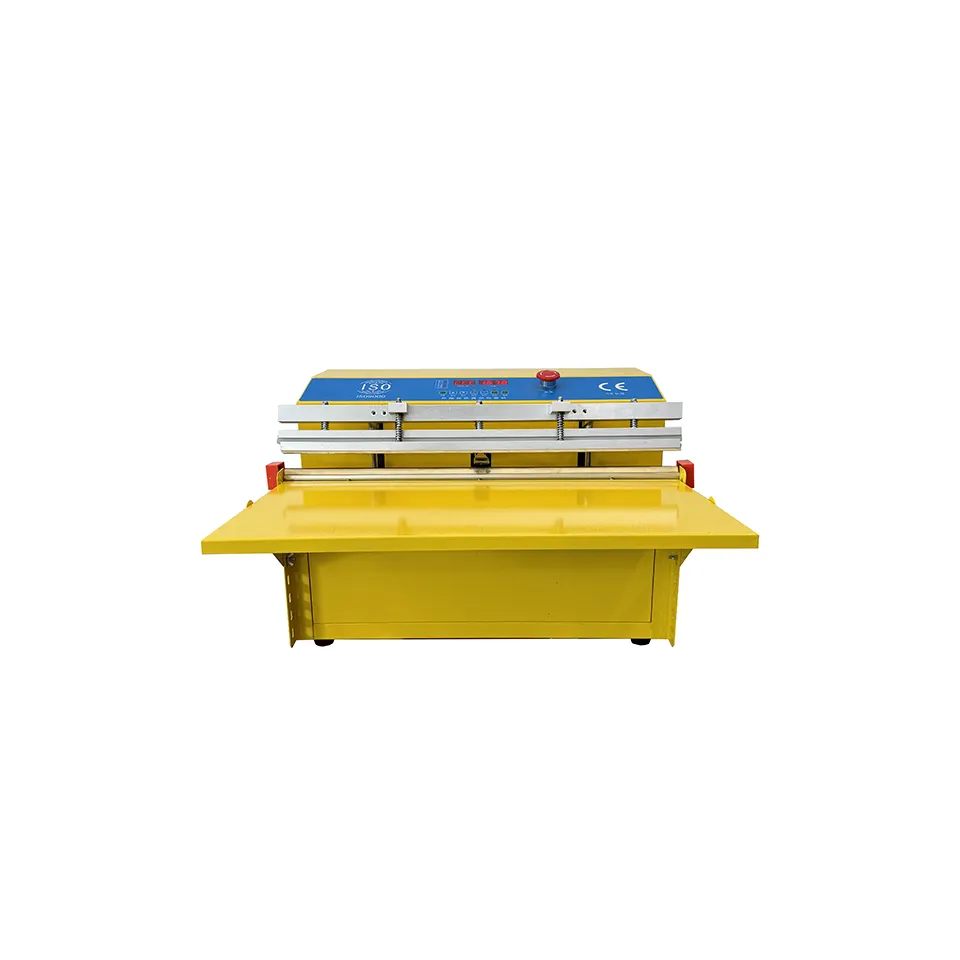
Once the bag gets deep enough to stand on its own, the vertical body takes over. The HB-180 comes in 600, 800 and 1000 mm sealing lengths with a height adjustment of 300-900 mm on the 600 and 800 models and 900-1370 mm on the 1000 model, so the same machine can seal a flat 400 mm bag on the bench and a 900 mm bag standing on the floor. Power stays at 220 V/50 Hz with a 1 kW motor and 0.95 kW of heating on all three sizes.
| Model | Seal length × width | Pump / power | Service | Body and weight |
|---|---|---|---|---|
| HB-172 desktop | 600 mm × 8 mm | 6.5 m³/h, 0.36 kW motor, 0.95 kW machine | 0.85 MPa compressed air, 220 V/50 Hz | 700×380×430 mm, 36 kg |
| HB-173 / HB-175 horizontal | 600 mm × 8 mm | 6.5 m³/h, 0.36 kW motor, 0.95 kW machine | 0.85 MPa compressed air, 220 V/50 Hz | 700×380×930 mm, 43 kg |
| HB-176 horizontal 600 / 800 | 600 / 800 mm × 10 mm | 20 m³/h, 1 kW motor, 0.95 kW heating | 0.85 MPa compressed air, 220 V/50 Hz, 201 stainless steel | 640×500×930 / 840×500×930 mm, 54 / 56 kg |
| HB-180 vertical 600 / 800 | 600 / 800 mm × 10 mm | 20 m³/h, 1 kW motor, 0.95 kW heating | 0.85 MPa compressed air, 220 V/50 Hz | 700×680×1400 / 900×680×1400 mm, 85 kg |
| HB-180 vertical 1000 | 1000 mm × 8 mm | 20 m³/h, 1 kW motor, 0.95 kW heating | 0.85 MPa compressed air, 220 V/50 Hz, 304 stainless steel, PLC and touchscreen | 1096×840×1865 mm, 150 kg |
| HB-235 floor external | 600 mm × 12 mm, -0.8 kPa | 20 m³/h, 900 W pump, 750 W heating | 220 V/50 Hz, stainless steel cabinet | 520×670×1030 mm, 75 kg |
Work Out the Cycle Before You Compare Prices
Two machines with the same sealing length can differ by a full bag per minute, because the vacuum step dominates the cycle. Air has to be removed from the bag, the bag has to hold that vacuum while the bar heats, and then there is loading and unloading. The pump rate is the number that tells you how long the first part takes: a 20 m³/h pump moves roughly ten times the air per minute that a 6.5 m³/h pump does.
| Cycle step | What sets it | Example on a 600 × 400 mm bag with 1 kg of product |
|---|---|---|
| Load and position | Operator, table height, bag depth | 4-8 s on a flat table, longer on a vertical body |
| Vacuum draw | Pump rate and bag volume | 6.5 m³/h gives a noticeably longer draw than 20 m³/h on the same bag |
| Heat seal | Bar width and film thickness | 1-3 s for an 8-12 mm bar on thin PE or laminate |
| Open, cut, unload | Chamber vs nozzle, cutter fitted or not | 2-5 s, and a cutter adds one more action per cycle |
Worked example, treated as an estimate rather than a factory figure: a 600×400 mm bag holding about 6 litres of air draws a noticeably longer vacuum step on the 6.5 m³/h HB-172 than on the 20 m³/h HB-176, and a buyer planning 20 bags a minute on a single station should ask the supplier to state the measured cycle on that bag size before accepting the number. Price, MOQ, lead time, warranty, project scope and site survey terms are quote items, so the number that has to be right before the quote is the cycle time.
Compare the Other Three Machines
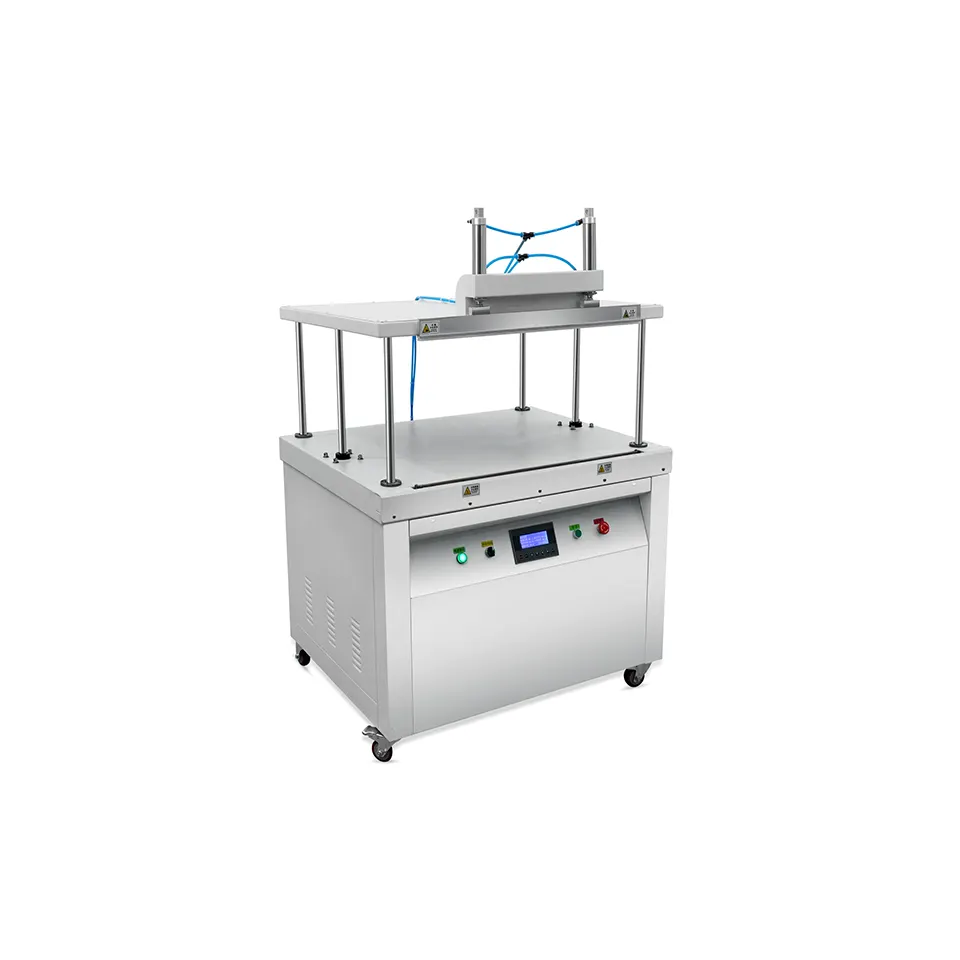
When the bag is not the problem, the seal is. A compression sealer presses film against a heated bed at 0.6-0.8 MPa with a 300 mm stroke on the 600YS and 800YS models, and rates itself in pieces per minute: 3-6 pcs/min with a 600×600 mm or 800×800 mm compression plate and 180 kg to 210 kg of machine weight. That is the right machine for thick laminates, medical pouches and industrial packs, and the wrong machine for a 500-piece-per-hour food bag line.
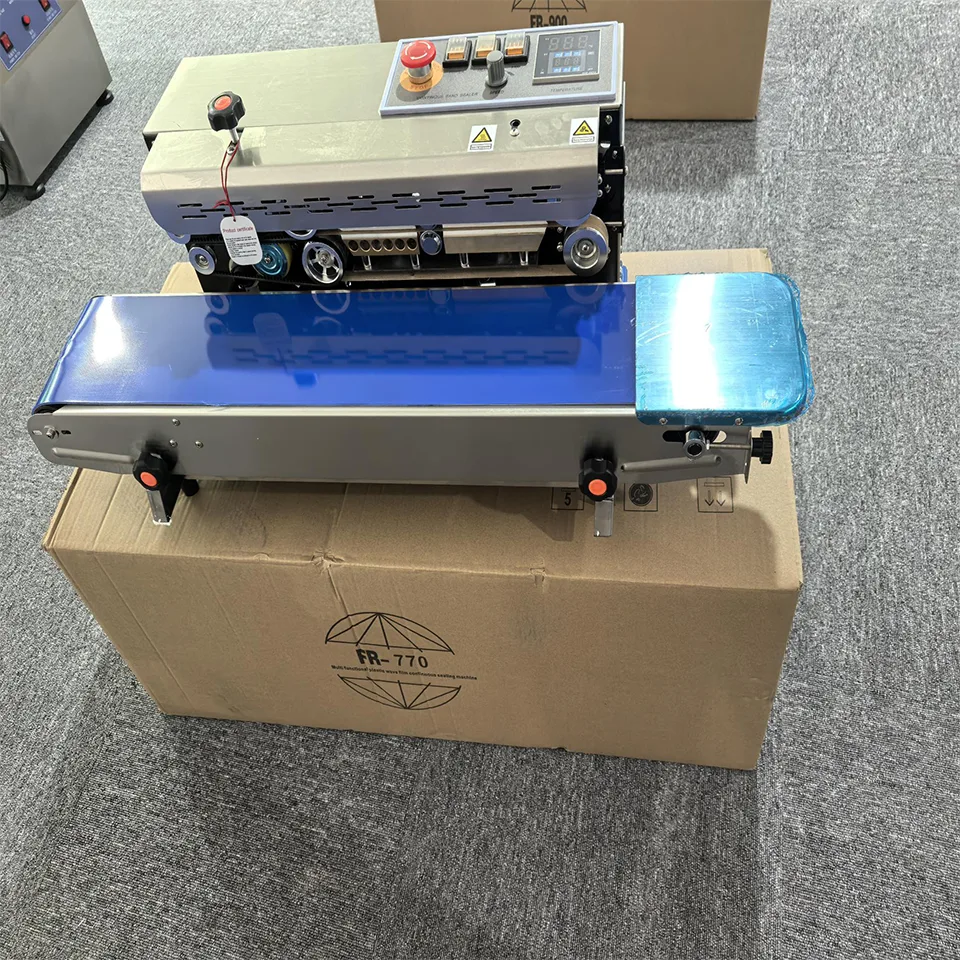
The continuous band sealer does the opposite job: it seals film, fast, without touching the product. The FR-770, FR-900 and FRD-1000 run a 12 mm sealing width at 0-17 m/min with a temperature range of 0-300 °C on the first two and 0-400 °C on the FRD-1000, handle single-layer film up to 0.4 mm, and carry up to 2 kg per item on the conveyor. It is the finishing station after a filling machine, not a vacuum step.
The induction foil sealer closes the last hole in the chain. The LTF-1800, 2100, 3600 and 4200 seal foil onto plastic and glass containers without touching the product, and the published figures reach 200 bottles per minute and 60,000 units a day. The supplier will ask for bottle material, cap diameter, foil specification, target speed, line height and voltage, because a wrong foil choice does not seal at all.
| Machine | Seal produced | Power | Throughput unit | Line-up logic |
|---|---|---|---|---|
| External vacuum sealer | Bag mouth, air removed | 0.36-1 kW plus 0.85 MPa air | Bags per minute | Final pack station |
| Compression heat sealer | Platen seal on thick film | 0.8-1 kW, 0.6-0.8 MPa | Pieces per minute, 3-6 | Standalone, after portioning |
| Continuous band sealer | Continuous film seal | 750-1350 W, 220 V/50 Hz or 110 V/60 Hz | Metres per minute, 0-17 | After a filler or before an overwrapper |
| Induction foil sealer | Foil weld on a container mouth | Model-dependent, confirm in writing | Bottles per minute, up to 200 | On a bottle filling line |
Run the Buyer Checklist Before You Order
- Fix the pack first: bag material, bag width, bag depth, product weight per bag, and whether the product is solid, drippy or liquid. That single answer removes half the machine list.
- Check the electrical service: 220 V/50 Hz for every external vacuum sealer in this range, and confirm whether the site runs 110 V/60 Hz for the band sealer alternative.
- Check the compressed air: 0.85 MPa at the machine, with a dryer if the local humidity is high. Air quality shows up in seal consistency first and in pump life second.
- Measure the footprint against the line: the HB-180 1000 model needs 1096×840×1865 mm and a 150 kg floor load, and it needs a loading side clear of the bag swing.
- Ask for the cycle time on your bag size, not the rated capacity, and ask which of the 20 m³/h pumps and nozzles reach the stated -0.8 kPa.
- Confirm the food-contact material grade for the sealing bar, the nozzle and the table, since some bodies in this range list 201 stainless steel and the 1000 vertical lists 304.
- Order the consumables with the machine: sealing strip, film roll and cutter blade are not accessories, they are production stops.
- Get the acceptance test written into the order: seal strength on your film, vacuum holding on your bag, and the measured cycle under load.
Avoid the Mistakes That Cost a Reorder
The most expensive mistake is treating a chamber machine and a nozzle machine as the same purchase. A buyer who only compares kilowatt ratings ends up with a machine that pulls a good vacuum on dry rice and cannot hold it on a marinated meat pack with liquid in the bottom corner, and the fix is not a service call but a different machine.
The second mistake is forgetting the 0.85 MPa compressed air line. The machine arrives, it is connected to 220 V, and it will not cycle because there is no air. Put that line on the drawings before the machine is delivered, not after.
The third mistake is buying a sealing bar length that matches the current product and not the next one. A 600 mm bar that is at its limit today is a 600 mm bar that stops the line when the customer changes the bag to 500 mm and adds a label strip. If two sizes are plausible within two years, take the longer bar.
Sources and Standards
- GB 31654-2021, National Food Safety Standard for General Hygiene Practice in Catering Services, published 18 March 2021 and effective 22 February 2022.
- GB 4806.9-2023, National Food Safety Standard for Food Contact Metal Materials and Articles, issued 6 September 2023 and effective 6 September 2024, for the sealing bar, nozzle and table grades.
- EN 12268:2014, Food machinery, production of and recommendations for stainless steel and other metal food contact surfaces.
- FDA 21 CFR Part 110, Current Good Manufacturing Practice for Food, and Codex HACCP principles CXC 1-1969 (2022 revision) for pack integrity checks in the plant.
- Export purchase documents in 2026: the model, the voltage, the air pressure and the cycle on your bag size should all appear in writing before the order is confirmed.
FAQ
Q: What is an external vacuum sealer and when does a plant use one?
A: It is a sealing machine with an open table, a suction nozzle and a heated bar. The bag mouth is placed over the nozzle, air is drawn out and the bar seals the mouth. It suits pre-made bags of rice, snacks, small meat portions and dry goods, and it works where the bag is not full of liquid, because the mouth is open to air while the vacuum is drawn.
Q: How do I choose between a desktop, a horizontal and a vertical external vacuum sealer?
A: Choose on bag depth and floor space, not on price. The HB-172 desktop unit at 700×380×430 mm and 36 kg handles flat bags on a bench, the HB-173 and HB-175 horizontals at 700×380×930 mm let a deeper bag hang from the bar, and the HB-180 verticals from 700×680×1400 mm take standing bags up to 1370 mm high with a height adjustment of 900-1370 mm on the 1000 model.
Q: What compressed air and power does an external vacuum sealer need?
A: Every external vacuum sealer in this range asks for 0.85 MPa compressed air and 220 V/50 Hz. The pump and motor load differ: the HB-172 and HB-173 run a 0.36 kW motor with 0.95 kW of heating and a 6.5 m³/h pump, while the HB-176, HB-180 and HB-235 use a 1 kW motor with 0.95 kW of heating and a 20 m³/h pump. Confirm the dryer on a humid site.
Q: How long does one bag take on an external vacuum sealer?
A: It depends on the bag volume and the pump rate. A 600×400 mm bag needs the vacuum step, the heat seal of 1-3 s for a thin film, and loading and unloading, so the cycle is dominated by the pump rather than by the bar. Ask the supplier for a measured cycle on your own bag size, because a rated output figure assumes a bag that most plants do not run.
Q: Is a compression heat sealer the same as a vacuum sealer?
A: No. The 600YS and 800YS compression machines use a pneumatic press plate at 0.6-0.8 MPa with a 300 mm stroke and rate themselves at 3-6 pcs/min, and they remove no air from the package. They seal thick pouches, laminates, medical and industrial packs, where a vacuum step would be wrong for the product.
Q: When does a continuous band sealer or an induction foil sealer belong on the line?
A: The band sealer finishes film packages after a filler, running a 12 mm seal width at 0-17 m/min over single-layer film up to 0.4 mm, and the induction foil sealer closes bottles and jars without touching the contents, with published figures up to 200 bottles per minute. Both need a separate upstream vacuum or filling step, because neither removes air from the package.
Q: How is the machine accepted before it ships?
A: Ask for a written FAT with three points: a seal on your film and bag size, a vacuum holding test on a filled bag, and a measured cycle with the operator working at normal speed. Those three results belong in the acceptance sheet, and the spare parts list, the cleaning intervals and the electrical drawing should arrive with the machine.
Related Examples
- HB-172 desktop external vacuum sealer: 600 mm bar, 8 mm seal width, 6.5 m³/h pump, 220 V/50 Hz, 36 kg
- HB-173 horizontal external vacuum sealer: 600 mm bar, 700×380×930 mm, 43 kg
- HB-176 horizontal external vacuum sealer: 600 mm and 800 mm bars, 20 m³/h pump, 1 kW motor
- HB-180 vertical external vacuum sealer: 600, 800 and 1000 mm bars, height adjustment to 1370 mm
- HB-235 floor external vacuum sealer: 600 mm bar, 12 mm seal width, -0.8 kPa, 20 m³/h
- 600YS and 800YS compression heat sealing machine: 0.6-0.8 MPa, 300 mm stroke, 3-6 pcs/min
- FR-770 / FR-900 / FRD-1000 continuous band sealer: 12 mm seal width, 0-17 m/min, 0-400 °C
- LTF-1800 to LTF-4200 induction foil sealer for glass and plastic containers
- External vacuum sealer collection: desktop, horizontal and vertical body types
- Packaging machine collection: vacuum, MAP, tray, band and foil sealing families
- Vacuum packaging efficiency in practice with the DZ-600/4SC double chamber machine
- Tray sealer buying guide for ready meals and meal kits
- Send your bag size, cycle target, air supply and voltage to start a machine recommendation
Choosing a sealing machine comes down to three moves in order: the seal you have to make from the pack, the body size from the bag depth and the floor space, and the cycle time from the pump rate and the 0.85 MPa air line. Model numbers follow from those three answers — the HB-172 and HB-174 for bench-top flat bags, the HB-173 and HB-175 for hanging bags, the HB-176 for a 600 or 800 mm bar with a 20 m³/h pump, the HB-180 for standing bags, the HB-185 for thick pouches, the FR-770 for film and the LTF series for bottles — and not from the price list. Final specifications should be confirmed according to the selected model and supplier documentation.
Published on 2026-11-24. Author: 苏涛;舜翔央厨、华艺智能