
Commercial dough proofer sizing from ZMX-32P to ZMF-36LS: tray counts, 400 × 600 mm trays, 1.69 to 9.9 kW, door layout, and cold proofing options.
Commercial dough proofer sizing starts with tray count, not cabinet litres. A 32-tray ZMX-32P holds 32 trays at 400 × 600 mm inside 1150 × 785 × 2000 mm and draws 1.69 kW. A 128-tray ZMX-128P runs 1980 × 1720 × 2100 mm at 9 kW. Between them sit the cold cabinets: ZMF-18LD at 620 × 970 × 2100 mm and 2.85 kW, ZMF-32DLS at 830 × 1230 × 2100 mm and 3.4 kW, ZMF-36LS at 1220 × 1120 × 2100 mm and 3.4 kW.
That spread is the decision. This guide is for bakery owners, central kitchen planners, and importers who have to place a fermentation cabinet on a real floor plan and defend the choice to a production manager.
Key Takeaways
- Tray count at a fixed 400 × 600 mm tray is the primary sizing figure.
- ZMX-32P and ZMX-32PT both hold 32 trays, but 1.69 kW fixed body and 1.6 kW cart body are different machines on the floor.
- Cold proofing is a refrigeration duty, not a heating one: 2.85 kW on ZMF-18LD and 3.4 kW on ZMF-36LS because compressors are in the circuit.
- Same tray count, different footprint: ZMF-36LD is 825 × 1200 mm with one door, ZMF-36LS is 1220 × 1120 mm with two.
- Above 64 trays the electrical supply stops being a detail: ZMX-64P runs 7 kW, ZMX-128P runs 9 kW.
- A proofing room host machine such as ZMX-8T at 9.9 kW controls 6–8 carts instead of holding trays itself.
What This Equipment Is Used For
A commercial dough proofer holds shaped dough at controlled temperature and humidity until the yeast has produced enough gas to fill the gluten structure. It is the last stop before the oven, after mixer, divider, rounder, intermediate proof, and moulder. This is the station where a line that has run well all morning either holds its rhythm or starts losing batches.
Three duty types get mixed up in quotation requests. Ambient spray proofers such as ZMX-16P and ZMX-32P heat and humidify only. Cold proofing cabinets such as ZMF-18LD and ZMF-36LS heat, humidify, and refrigerate, so dough can retard overnight and proof in the morning on the same racks. ZMF-32DLS adds a freezing mode for bake-off sites that hold par-baked or frozen product.
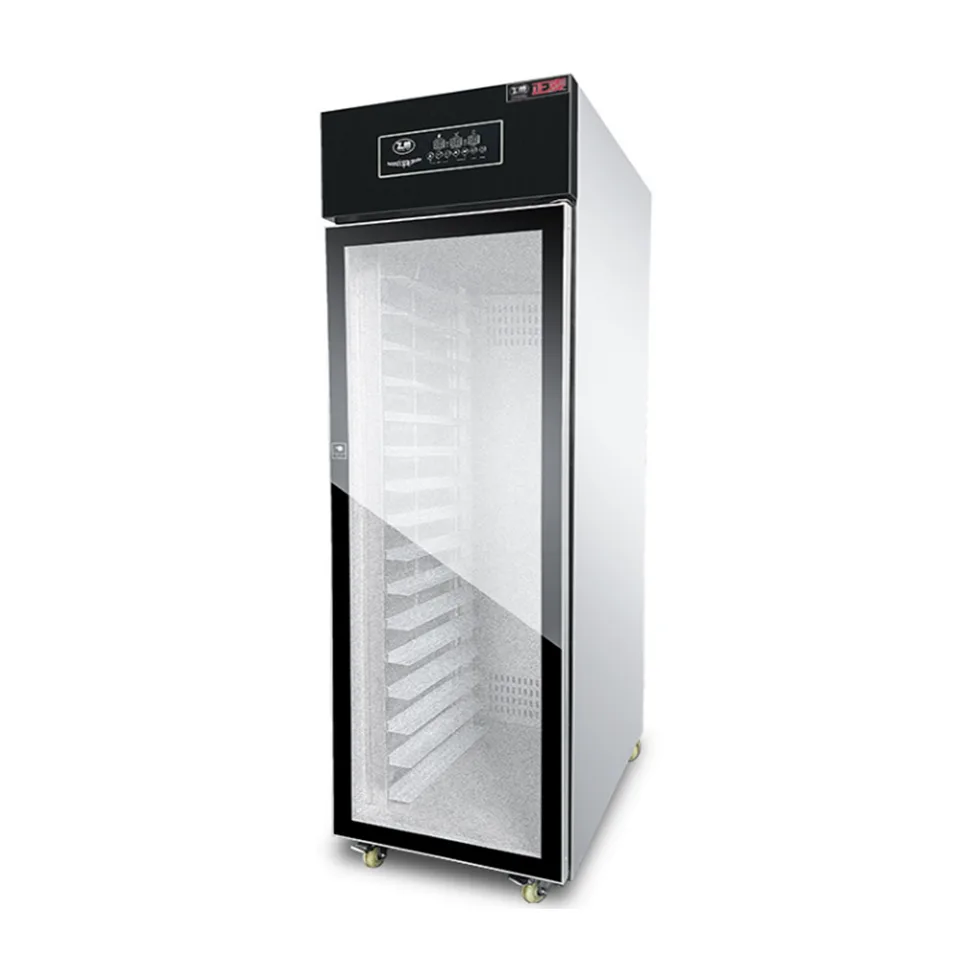
Model Range at a Glance
| Model | Capacity | External dimensions (mm) | Power | Duty |
|---|---|---|---|---|
| ZMX-16P | 16 trays, 400 × 600 mm | 950 × 585 × 2000 | 1.69 kW | Ambient spray |
| ZMX-32P | 32 trays, 400 × 600 mm | 1150 × 785 × 2000 | 1.69 kW | Ambient spray |
| ZMX-32PT | 32 trays, cart type | 1120 × 970 × 2100 | 1.6 kW | Ambient spray |
| ZMX-64P | 64 trays, cart type | 1710 × 1350 × 2100 | 7 kW | Ambient spray |
| ZMX-128P | 128 trays, dual door | 1980 × 1720 × 2100 | 9 kW | Ambient spray |
| ZMF-18LD | 18 trays, 400 × 600 mm | 620 × 970 × 2100 | 2.85 kW | Cold proof and retard |
| ZMF-32DLS | 32 trays, 400 × 600 mm | 830 × 1230 × 2100 | 3.4 kW | Cold proof and freeze |
| ZMF-36LD | 36 trays, 400 × 600 mm | 825 × 1200 × 2100 | 3.4 kW | Cold proof, single door |
| ZMF-36LS | 36 trays, 400 × 600 mm | 1220 × 1120 × 2100 | 3.4 kW | Cold proof, dual door |
| ZMX-8T | 6–8 carts | 900 × 320 × 1510 | 9.9 kW | Proofing room host |
Core Specifications Buyers Should Compare
| Specification | Why It Matters | What Buyers Should Check |
|---|---|---|
| Tray count and tray size | Sets batch size and how the proofer matches oven capacity. | Confirm 400 × 600 mm trays, or the tray actually used, before ordering racks. |
| External dimensions | Decides aisle width, door swing, and whether the unit clears the doorway. | Compare 620 × 970 mm on ZMF-18LD against 1220 × 1120 mm on ZMF-36LS. |
| Connected power | Drives cable size, breaker rating, and whether three-phase is needed. | 1.69 kW on ZMX-32P is a different supply question from 9 kW on ZMX-128P. |
| Temperature range | Proofing, retarding, and thawing need different set points. | Check the low end for retard duty and the top end for fast proof. |
| Humidity control | Dry air skins the dough surface and produces a tight, torn crust. | Confirm spray humidification and the RH ceiling in writing. |
| Door configuration | Changes loading direction and the floor space needed in front. | Single door on ZMF-36LD, dual door on ZMF-36LS for two-sided loading. |
| Body material | Washdown, corrosion, and how long the cabinet survives a wet room. | Stainless interior and exterior, 304 on the cold and cart-type cabinets. |
| Control type | Decides whether a shift can run unattended and how repeatable a batch is. | Digital temperature, humidity, and timer; ZMX-8T uses microcomputer touch control. |
Map the Proofing Step Before You Read the Tray Count
Start with where the dough stands when it reaches the proofer. A shop that moulds by hand and loads racks from one side needs a different cabinet from a plant that rolls a cart in and out. ZMX-32PT and ZMX-64P are cart-type for that reason: the loaded cart becomes the cabinet's contents, and nobody handles a tray inside the box.
Then look at the room. ZMF-36LD occupies 825 × 1200 mm with one door; ZMF-36LS holds the same 36 trays in 1220 × 1120 mm with two. The second layout is 395 mm wider and 80 mm shallower, which is the wrong trade in a narrow bakehouse and the right one where traffic passes both sides. Ceiling height gets missed more often than floor area: every rack cabinet here stands 2100 mm tall and the packaging runs to 2250 mm on ZMF-18LD and ZMF-36LS.
Compare Tray Capacity Against the Real Bake Load
Size the proofer against the oven, not the catalogue. If the rack oven takes 32 trays per bake on a 25 to 35 minute cycle, a 32-tray proofer gives no buffer: the moment one bake runs late, the next batch waits in the open. A 36-tray cabinet buys the shift its slack back.
Proof time sets the buffer. Final proof for yeasted bread usually runs roughly 45 to 90 minutes at 32–35 °C and 80–85 % RH, and it moves with dough temperature, starter activity, and shaping. A proofer holding two bakes' trays lets the bakery load the next batch while the current one bakes; a proofer holding exactly one bake turns every oven delay into over-proofed dough.
Match Power and Door Configuration to the Room
Ambient spray proofers are light electrical loads. ZMX-16P and ZMX-32P both run 1.69 kW, ZMX-32PT runs 1.6 kW. On a 220 V single-phase supply that is a normal circuit, and the cabinet can be added without a service upgrade.
Cold cabinets are not light loads even when the number looks small. ZMF-18LD draws 2.85 kW and ZMF-36LD and ZMF-36LS both draw 3.4 kW, because each circuit carries heater elements and a compressor. The compressor also dictates ambient limits: a cold proofer pushed into a 35 °C room works harder than one in a conditioned bakehouse, so tell the supplier the room temperature before the unit is specified. Above 64 trays the conversation becomes electrical: ZMX-64P at 7 kW, ZMX-128P at 9 kW, and ZMX-8T at 9.9 kW are three-phase installations in most buildings.
Decide Whether You Need Cold Proofing or Retarding
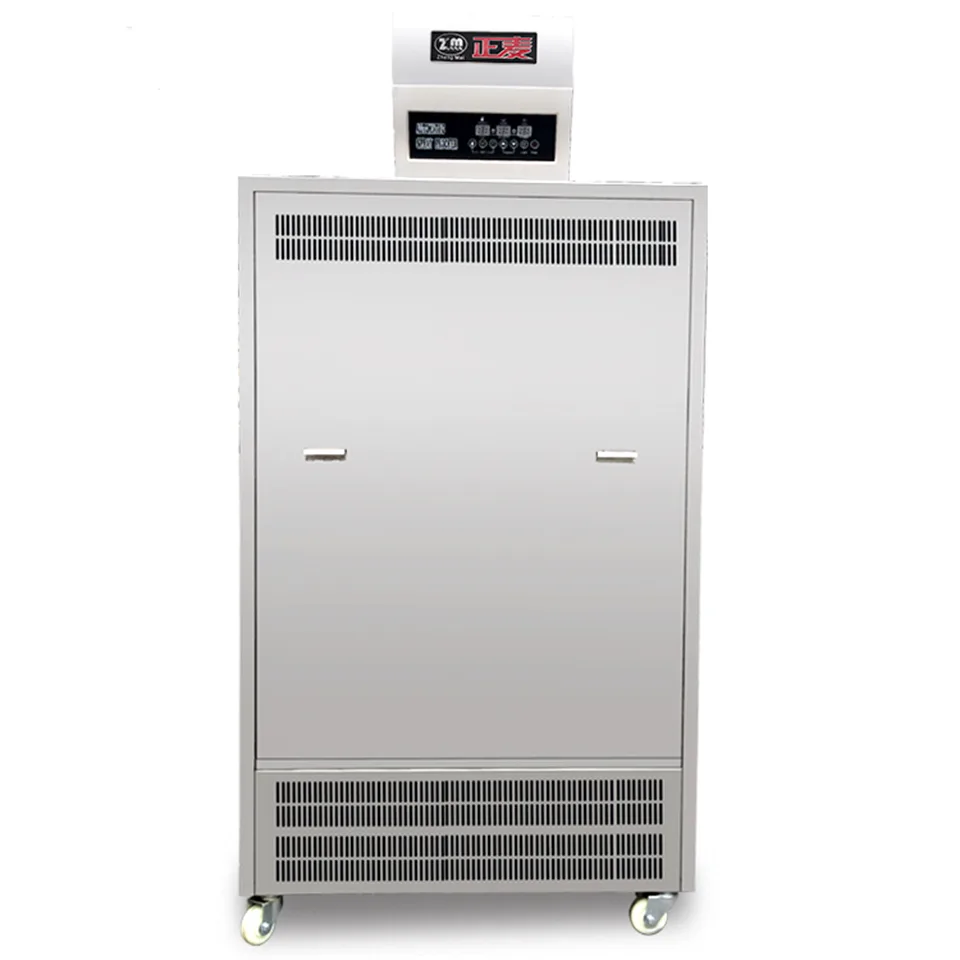
Ask one question: does dough ever sit in this cabinet overnight? If not, a ZMX ambient proofer covers the job at 1.6 to 1.69 kW with less maintenance surface. If yes, only a cold cabinet works, because ambient proofers cannot hold 2–8 °C in a warm room. Retarding is not freezing — ZMF-18LD, ZMF-36LD, and ZMF-36LS retard and proof, while ZMF-32DLS adds a freezing mode for bake-off sites holding par-baked product.
How to Choose the Right Model
Production Capacity
Count trays per bake, then add the buffer the shift actually needs. A shop baking 12 trays twice a day is served by ZMX-16P at 16 trays, 65 kg, and 950 × 585 × 2000 mm. A bakery running 32-tray bakes on one oven should look at ZMF-36LD or ZMF-36LS, not a second ZMX-32P, because four extra trays and the refrigerated option are what absorb a late bake. Above 64 trays, cart handling replaces tray handling.
Food Contact Materials
Racks, trays, and interior panels touch dough. Stainless interior and exterior is standard across the ZMX and ZMF ranges, with 304 specified on cold and cart-type cabinets. Sheet thickness, weld finish, and whether rack guides are welded or riveted decide how the cabinet behaves after two years of washdown. Ask for the grade in writing and check it against GB 4806.9-2016 or EU 1935/2004 for the destination market.
Cleaning and Maintenance
A proofer is a wet, warm box — the condition that grows biofilm fastest in a bakery. Interior corners should be coved or sealed, rack guides should lift out, and the humidifier nozzle should be reachable without dismantling the spray line. On cold cabinets the condenser coil needs a clear air path and a cleaning interval; a blocked coil shows first as a long pull-down time and then as a humidity fault. Drain and water supply belong on the drawing at specification stage, because a spray proofer without a drain becomes a mop job every shift.
Buyer Checklist
- Confirm tray size, normally 400 × 600 mm, and trays per bake.
- Measure door opening, aisle, and ceiling against the 2100 mm cabinet height and the packaging height.
- Choose single or dual door from loading direction, not from the price list.
- Confirm whether dough is retarded overnight; if yes, specify cold proofing.
- Check connected power, voltage, and phase against the building supply above 7 kW.
- Ask for the humidity range and humidification method in writing.
- Confirm drain, water supply, and floor fall at the installation point.
- Request the material grade for interior panels and rack guides.
- List spare parts: humidifier nozzle, controller, door gasket, heater element.
- Agree the commissioning procedure and the temperature and humidity verification method.
Common Mistakes to Avoid
The expensive mistake is buying cabinet volume instead of tray count. A 260-litre cabinet and a 32-tray cabinet are not alternatives; one holds trays on racks, the other holds a few trays on shelves. Litres describe the box, trays describe the batch.
The second is forgetting that a proofer has to be loaded. A dual-door ZMF-36LS in a corridor with traffic on one side wastes a door and 395 mm of floor. The third is under-sizing power: a 9 kW ZMX-128P added to a bakery with a single-phase board becomes a rewiring project discovered at commissioning. The fourth is treating humidity as a fixed setting — without independent humidity control, the top tray skins over while the bottom stays wet.
The fifth is skipping the drain. Spray humidification puts water into the box, and that water leaves through the floor or through the dough.
FAQ
Q: What is a commercial dough proofer used for?
A: It holds shaped dough at controlled temperature and humidity for final fermentation before baking, typically around 32–35 °C and 80–85 % RH with proof times of roughly 45 to 90 minutes.
Q: How many trays should I buy?
A: Match the tray count to one bake plus a buffer. If the oven takes 32 trays, a 36-tray ZMF-36LD or ZMF-36LS covers a late bake; a 16-tray ZMX-16P suits small batches through the day.
Q: What is the difference between proofing and retarding?
A: Proofing is warm fermentation before baking. Retarding is holding dough cold, typically 2–8 °C, to slow fermentation overnight. ZMF-18LD and ZMF-36LS do both; ZMX-32P does only the first.
Q: Do I need three-phase power?
A: Small cabinets do not. ZMX-16P and ZMX-32P run 1.69 kW, and F110Q runs 300 W on 220 V. ZMX-64P at 7 kW, ZMX-128P at 9 kW, and ZMX-8T at 9.9 kW usually require three-phase. Confirm against supplier documentation.
Q: What material should the interior be?
A: Stainless interior and exterior, with 304 on cold and cart-type cabinets. Verify the grade against GB 4806.9-2016 or EU 1935/2004 for the destination market.
Q: How is a proofer cleaned?
A: Rack guides and trays lift out, interior surfaces are washed with food-safe detergent, and the humidifier nozzle is descaled on a fixed interval. Condenser coils on cold cabinets need a separate schedule.
Q: Can a proofer thaw frozen dough?
A: Yes, within its temperature band. UKOEO-F260 runs from room temperature to 60 °C and to 99 % RH, which covers thaw-and-proof work; ZMF-32DLS adds a freezing mode for par-baked product.
Sources
- EN 1672-2:2005+A1:2009 — food processing machinery, hygiene requirements.
- EN 10088-1 — stainless steels, grades including 1.4301 (AISI 304).
- GB 4806.9-2016 — food contact metallic materials, migration limits.
- EU Regulation (EC) No 1935/2004 — food contact materials.
- FDA, 21 CFR Parts 175–178 — indirect food additives.
- FAO/WHO, Codex Alimentarius CXC 1-1969 — General Principles of Food Hygiene.
- EN 60335-1 — electrical safety of heated cabinets.
- ISO 22000:2018 — food safety management systems.
Related Models and Collections
- ZMF-36LS 36-tray dual-door cold proofing proofer — 1220 × 1120 × 2100 mm, 290 kg, 3.4 kW
- ZMF-32DLS cold proofing and freezing proofer — 830 × 1230 × 2100 mm, 300 kg, 3.4 kW
- ZMF-18LD 18-tray cold proofing and retarding proofer — 620 × 970 × 2100 mm, 190 kg, 2.85 kW
- ZMX-16P and ZMX-32P automatic spray proofing proofers — 1.69 kW, 65 kg and 100 kg
- ZMX-32PT, ZMX-64P, and ZMX-128P cart-type proofers — 1.6 kW to 9 kW, up to 128 trays
- ZMX-8T proofing room host machine — 6–8 carts, 9.9 kW, 900 kg
- UKOEO-F260 260-litre dough proofer — to 60 °C, to 99 % RH, 500 W, 0–480 min
- Fermentation cabinet collection — proofer range from 32 litres to 128 trays
- Bakery mixers — ZMH dough mixers from 15 kg to 100 kg
- Dough sheeters — Q50 with 0–30 mm roller and 500 mm conveyor
- Rotating baking ovens — 32-tray rotary ovens for large-scale production
- Contact Huayi Equipment — send tray counts, room dimensions, and supply details
Sizing a commercial dough proofer comes down to four moves in order: tray count from the bake load, footprint and door configuration from the room, power from the building supply, and refrigeration only if dough is retarded overnight. Model numbers follow from those answers — ZMX-16P for a pastry counter, ZMX-32P or ZMF-36LS for a single-oven bakehouse, ZMF-32DLS where retard and freeze both happen, ZMX-64P and ZMX-128P for cart-based plants.
Final specifications should be confirmed according to the selected model and supplier documentation.
Published on 2026-11-04. Author: 苏涛;舜翔央厨、华艺智能