
Batch vs continuous vegetable washing in central kitchens: 20–30 kg loads with 3–5 minute cycles against flow-based lines, and how to pick by washing rhythm.
Batch and continuous washing suit different production rhythms, floor plans, and water routines, and the better fit depends on how a central kitchen actually moves produce.
Most central kitchens do not face a single washing decision. They face a rhythm problem: produce arrives in uneven lots, the cutting room wants clean greens on a steady beat, and the floor space set aside for prep is usually the smallest room in the building. Two machines can both be described as commercial vegetable washers and still behave completely differently once the working day starts. One fills, washes, empties, and refills; the other keeps produce moving on a belt. Understanding why those two shapes exist shortens the equipment conversation, because the question stops being "which one is better" and becomes "which rhythm matches our building and our shift pattern."
| Batch washing | 20–30 kg per cycle, 3–5 minute cycle |
|---|---|
| Continuous washing | Flow-based, sized to throughput |
| TY106 footprint | 1750 × 1100 × 1100 mm |
| Power supply | 380V / 50Hz |
| Installed weight | 380 kg |
| Body material | 304 stainless steel |
Why central kitchens need a clear washing rhythm before choosing equipment shape
A central kitchen's washing station rarely runs at one speed. There is an early push when crates arrive from the market or the farm, a mid-morning lull, and a second push before the dispatch window opens. Watching a busy prep room for even an hour makes the pattern obvious: soiled crates stack up in one corner, clean produce waits in another, and the person at the sink becomes the pacing point for everything downstream. That queue is the real specification. A machine that accepts produce in fixed loads and returns it within a few minutes creates a very different queue than one that needs a steady supply of trimmed produce to keep a belt full. Cornell's Produce Safety Alliance resources describe washing as one step inside a longer flow of receiving, sorting, washing, and cooling, which is a useful way to think about equipment. The washing step only performs when the steps around it keep pace. USDA GAP audit material approaches the same reality from the compliance side, where wash water, food-contact surfaces, and handling routines all have to be managed consistently. Neither body of guidance points to a particular machine, and that is the point: the room's rhythm sets the frame, and the equipment has to fit inside it rather than the other way around.
How batch and continuous washing differ in operating logic
The difference is not mainly about size or price. It is about what the machine expects from the room around it. A batch washer expects a load, a pause, and a decision about what comes next. A continuous washer expects a steady supply of produce and somewhere for the output to go without interruption. Food processing machinery for produce prep tends to fall into these two operating shapes, and once that is clear, cycle time, footprint, and water handling stop looking like isolated numbers and start looking like consequences of the mode itself.
1. Cycle rhythm and changeover flexibility change with the operating mode
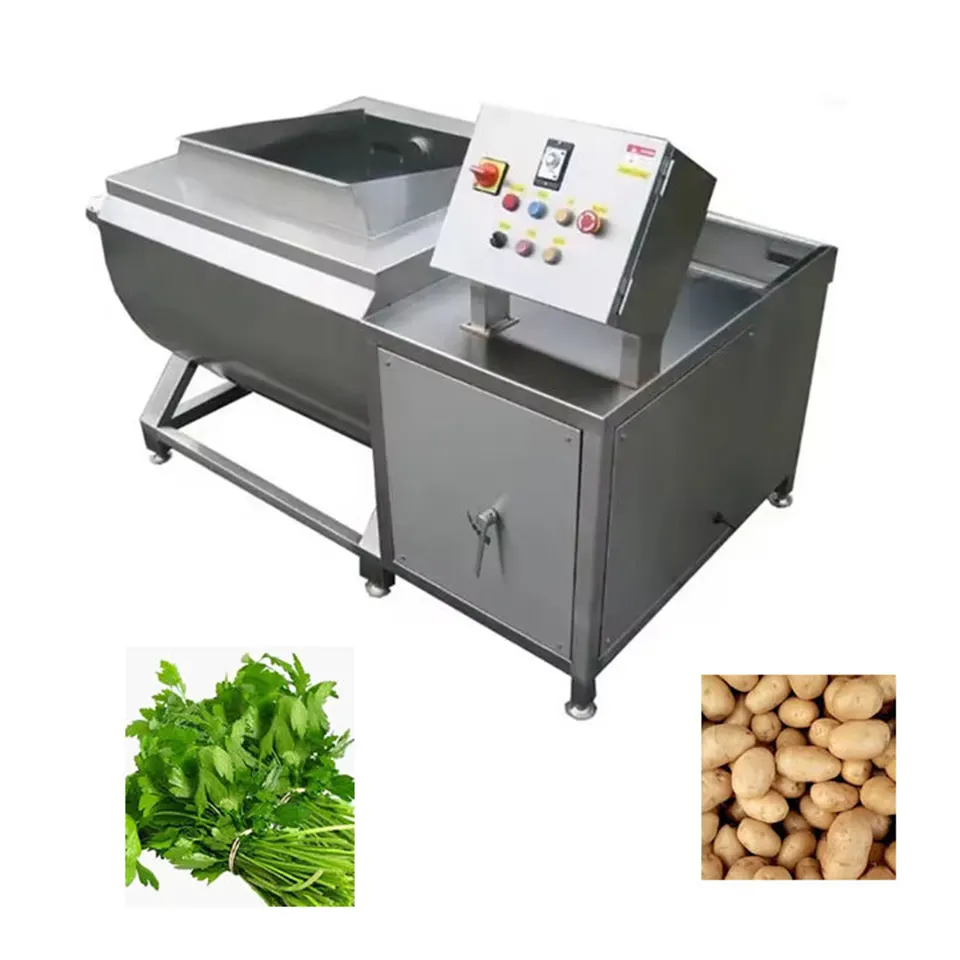
In batch mode the rhythm is set by the load. The TY106 from Huayi Equipment, for example, is rated at 20–30 kg per cycle with a 3–5 minute wash cycle, so the operator controls pace by deciding when to fill, when to stop, and when to empty. Between loads there is a natural gap for sorting the next crate, checking quality, or switching from leafy greens to root vegetables, and water can be refreshed between different produce types. A continuous line has almost no such gap. It rewards a long uninterrupted run of one product and penalises frequent stops, because every stop empties the belt while supply upstream keeps arriving.
2. Floor space and water management shape the practical comparison
A batch unit is a compact block. The same TY106 occupies 1750 × 1100 × 1100 mm and runs on 380V/50Hz power, so it can drop into a corner of an existing prep room without redesigning the room. Water thinking follows that pattern: one fill serves one load, which makes consumption easy to track and lets a kitchen treat each load as its own small, manageable event. Continuous washing spreads along a line instead, so footprint grows with throughput and water has to be managed as a moving stream through successive zones. That can be efficient at volume, but the plumbing and drainage become a building decision rather than a corner decision.
When batch washing makes more sense in a central kitchen workflow
Batch washing earns its place where the menu or the delivery schedule shifts during the day. A kitchen handling several produce types in one shift — washed lettuce for lunch service, carrots and potatoes for a stew base, then a separate run for a salad bar — gets more from a machine that can be emptied, rinsed, and refilled than from a belt that wants one long run. Small and mid-sized central kitchens also benefit, because a modest load size means one operator can manage the machine without a second person feeding it continuously. Descriptions from food processing machinery suppliers usually list capacity per load and cycle time first, which happen to be the two numbers a batch-mode kitchen actually needs. Batch mode is also forgiving about interruptions. If a delivery is late, or a quality check pulls a crate out of the flow, the machine simply waits, with no product stranded on a belt. The trade-off is operator attention and a throughput ceiling: someone has to load and unload each cycle, and output arrives as a series of loads rather than a constant stream. That is why batch washing suits central kitchens that value flexibility, lot-by-lot control, and a small footprint over maximum tonnage. Continuous washing still wins where the same product runs for hours at high volume, because steady flow is exactly what it is built to deliver.
Conclusion
The useful starting point is not a machine ranking but a rhythm check. Count how many produce types pass through the wash station in a shift, how long each run lasts, how much floor the prep room can spare, and whether one person or two are available at the sink. Batch washing answers those questions with discrete loads and quick changeovers; continuous washing answers them with steady flow and scale. The TY106 is a batch-mode example — 20–30 kg per load, 3–5 minutes per cycle, 304 stainless steel construction, compact footprint — and it makes sense for kitchens whose day looks like a series of lots. Compare those stated figures against your own shift pattern before deciding which shape belongs on your floor.
FAQ
Q: What is the main difference between batch and continuous vegetable washing?
A: Batch washing treats produce as separate loads: a fixed quantity goes in, washes for a set time, and comes out before the next load begins. Continuous washing keeps produce moving along a belt or through a tunnel so material enters and exits without a break. The difference shows up in rhythm, changeover, and floor space rather than in a simple quality ranking.
Q: Why might a central kitchen use batch washing instead of a continuous line?
A: Batch washing fits kitchens that handle several produce types in one shift, run modest volumes, or work with limited floor space. The load-by-load pattern leaves room to sort, check quality, and refresh water between different items, and one operator can usually keep the cycle going. A continuous line prefers long runs of one product at high volume.
Q: How do space and changeover needs differ between batch and continuous washing?
A: A batch washer sits in a compact block — the TY106, for instance, measures 1750 × 1100 × 1100 mm — so it can slot into an existing prep area with modest plumbing changes. A continuous line stretches along the direction of flow and needs surrounding space for infeed and outfeed. Changeover is quick on a batch unit and disruptive on a continuous line mid-run.