
Motor speed in r/min and blade speed in m/min measure different moving parts. Here is why a 1420 r/min figure cannot be used to estimate blade travel.
Introduction: A meat bone saw specification often gives a motor speed in r/min, which describes shaft rotation rather than the travel of the blade itself.
Anyone comparing meat bone saws eventually hits the same small confusion. One sheet says 1420 r/min, another lists a blade speed in metres per minute, and both numbers get filed away as "how fast this thing cuts." They are not the same measurement, and they do not even describe the same moving part. One number belongs to a spinning shaft inside the motor housing; the other belongs to a steel band running around two wheels and through a piece of meat. Understanding which object each figure measures makes specification sheets far easier to read. The practical payoff is simple. Once you know that a motor figure and a blade figure live on different sides of the drive system, you stop ranking machines by a number that was never meant to rank them. The HC-95 meat bone saw from Huayi Smart Solutions makes a clean example, because its published details give 2200 W, 380 V, 50 Hz and 1420 r/min, and that last figure is labelled as motor speed.
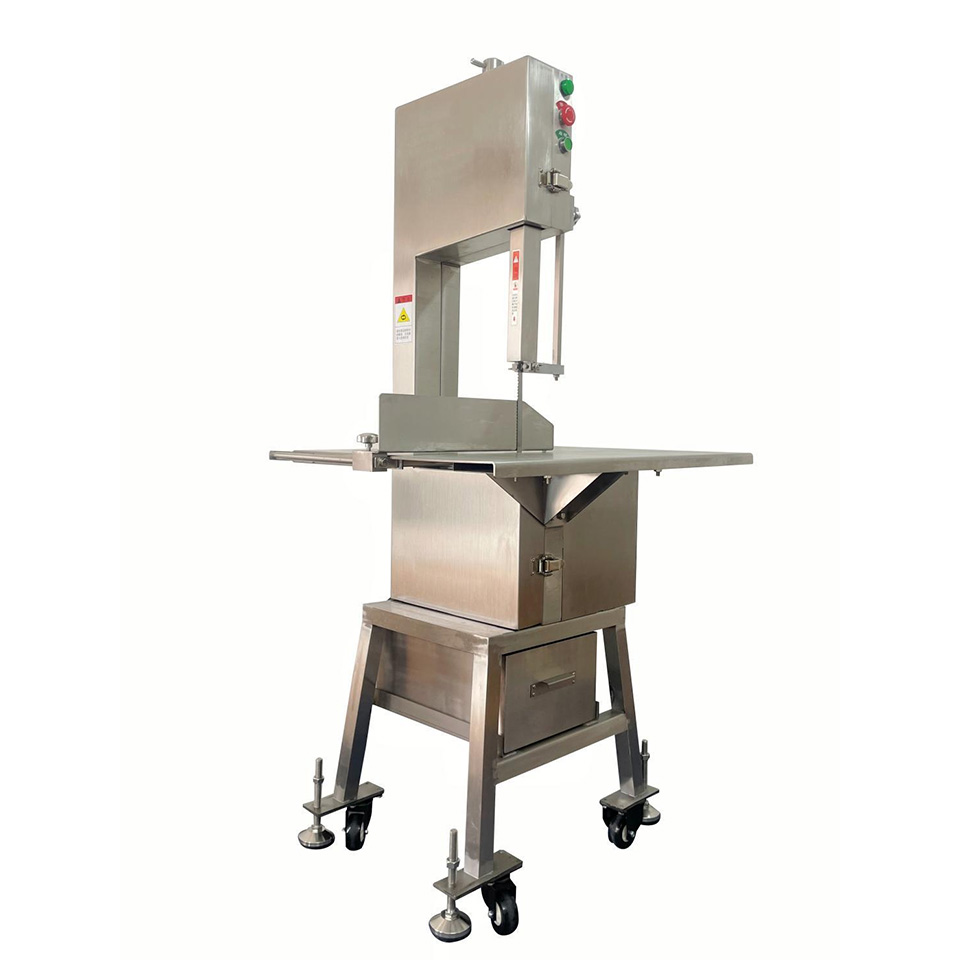
What 1420 r/min describes on a meat bone saw
The unit is the place to start. r/min stands for revolutions per minute, a count of complete turns divided by a unit of time. The SI Brochure from BIPM sets out how time, rotation and length units are written so that a reader can tell instantly what kind of quantity a value represents. A revolution is one full turn of something around its own axis, so 1420 r/min means the object completes 1420 full turns every minute. That is roughly 23.7 turns each second, which already hints that the object in question is small, fast and mechanical rather than large and slow. On the HC-95, that object is the motor. The 1420 r/min figure sits alongside 2200 W, 380 V and 50 Hz because all four numbers describe the electrical drive. Power says how much work the motor is rated to deliver, voltage and frequency describe the supply it expects, and motor speed says how quickly the shaft turns when that supply is applied. None of these values describe the blade, the wheels it rides on, or the meat passing through the cutting opening. This is where a lot of comparison goes wrong. Two saws can both publish 1420 r/min and still move their blades at noticeably different speeds, because the motor figure travels with the motor nameplate while the blade figure depends on the rest of the drive. Motor speed appears on so many spec sheets partly because a meat bone saw machine manufacturer can copy it straight from the motor plate onto the brochure, which makes it a reliable value to publish and a poor value to rank machines by.
How motor rotation differs from blade travel
The cleanest way to separate the two terms is to ask what each one measures. Motor rotation is angular motion: a shaft turning about its own centre, where the only thing that changes is the angle. Blade travel is linear motion: a point on the band moving along a path, where a length of material passes a fixed point over time. Angular motion is counted in turns per minute. Linear motion is counted in distance per minute, usually metres per minute for industrial band saws. Different motion, different unit, different question answered. There is also a physical gap between them. In a meat band saw, the blade is a continuous loop stretched over two wheels, and the motor turns those wheels through a belt or pulley arrangement rather than driving the band directly. The blade's travel is the wheel circumference multiplied by how fast the wheel turns, adjusted by whatever ratio the pulleys impose. In commercial meat processing, band saws are used for carcass portioning, and that category background from the FAO material helps explain why the blade, not the motor, is the part that meets the product. The motor is two steps removed from the cut. Because of that gap, you cannot compare the two numbers directly. 1420 r/min is not "1420 metres per minute," and reading it as a blade figure would overstate blade travel by a wide margin. The conversion needs the pulley diameters, the wheel diameter and the belt path. Without those, motor speed answers a different question than the one most buyers actually have in mind when they read a spec sheet.
Why power and motor speed do not directly equal cutting speed or throughput
Wattage and r/min are input-side numbers. They describe what the drive is rated to deliver and how fast the shaft spins, not what happens at the cutting edge or how many pieces leave the table in an hour. A machine with more power can push a blade through a given material with less strain on the motor, and a faster shaft can drive a faster blade if the pulley design supports it, but neither value on its own tells you the speed at which the blade passes through bone or the volume a crew can process in a shift. Those outcomes depend on blade linear speed, feed rate, material condition, piece size and how the operator loads the table.
1. Motor Speed Describes Shaft Rotation Rather Than Blade Travel
The 1420 r/min figure belongs to one component and one motion. It tells you how fast the motor shaft turns under a 380 V, 50 Hz supply, which is useful when you are checking whether a machine's drive matches the electrical conditions on site. It says nothing about how far the blade moves in a minute. Two machines sharing an identical motor speed can sit at different blade speeds once their pulley ratios and wheel diameters differ, and a machine with a slower motor can still run a faster blade if its drive is designed that way. Reading the figure as a cutting property skips the entire transmission between motor and blade.
2. Blade Speed Needs Separate Pulley And Blade Information
Blade speed is a separate value, and it comes from separate information. You need the wheel diameter, the pulley ratio between motor and wheel, and the blade path, or a published blade speed in metres per minute from the supplier. Many spec sheets from a meat processing equipment supplier stop at the motor figure because that is the value carried over from the nameplate, while blade speed requires design data the sheet may not include. On the HC-95, the published details cover 2200 W, 380 V, 50 Hz and 1420 r/min labelled as motor speed, and blade speed is a distinct figure drawn from blade or pulley data. That is why the two terms deserve separate lines whenever you read a specification.
Conclusion
Motor speed measures rotation: how many turns the shaft completes each minute. Blade speed measures travel: how much blade length passes a point each minute. They answer different questions about different parts of the same machine, and the drive system between them decides how one turns into the other. Once that distinction is clear, a spec sheet stops being a pile of numbers and becomes a map of what is being described. When only a motor figure appears, you know exactly which follow-up value would complete the picture, and you can read the published HC-95 specification to see how a motor speed sits alongside power, voltage and frequency on a real listing.
FAQ
Q: What does 1420 r/min describe on a meat bone saw?
A: It describes motor speed, meaning the motor shaft completes 1420 full revolutions every minute when running on its rated supply. On the HC-95, that figure appears with 2200 W, 380 V and 50 Hz as part of the electrical data, so it describes the drive rather than the blade.
Q: Is motor speed the same as blade speed?
A: No. Motor speed counts turns of a shaft per minute, while blade speed counts the distance the band travels per minute, usually in metres per minute. They are different motions with different units, and the pulley ratio and wheel diameter sit between them, so one value cannot stand in for the other.
Q: Why can't motor speed be used to estimate cutting speed?
A: Motor speed is measured at the shaft, and the blade's travel depends on how that shaft drives the wheels through belts and pulleys. Without the pulley diameters, wheel diameter and any published blade speed, the drive ratio is unknown, so the motor figure cannot be converted into a blade figure or into a cutting rate.
Sources / References
SI Brochure - BIPM
Meat Processing Technology for Small- to Medium-Scale Producers
Related Examples
HC-95 Elevated Table Meat Bone Saw
Final specifications should be confirmed according to the selected model and supplier documentation.
Author: 苏涛;舜翔央厨、华艺智能