
A practical guide for choosing a food-grade nitrogen generator for MAP, snack, bakery, beverage, and ready-meal packaging lines, covering purity, Nm3/h output, feed pressure, dew point, and cabinet material.
Choosing the right food-grade nitrogen generator starts with matching gas output, purity, and pressure to the specific packaging line it will feed. Whether the buyer runs a small MAP tray sealing station or a continuous snack and coffee line, the equipment decision follows the same logic: confirm the product's oxygen sensitivity, calculate the nitrogen demand per shift, then size the generator with a margin for future capacity. This article walks B2B buyers, factory owners, and import engineers through the parameters that matter most when selecting an on-site nitrogen generator for food packaging and processing lines.
Key Takeaways
- A food-grade nitrogen generator supplies on-site N2 at controlled purity and pressure for MAP, snack, bakery, beverage, and ready-meal packaging.
- The first decision is purity: 99.9% suits general food packaging, while 99.99% is required for sensitive products such as fresh meat, seafood, and high-fat snacks.
- Output range is expressed in Nm³/h (normal cubic meters per hour); match it to the line's peak demand with a 20–30% safety margin.
- Pressure dew point indicates how dry the nitrogen is. -30°C PDP keeps moisture out of sealed packs and protects downstream piping.
- Buyers should confirm feed pressure (typically 0.7–0.8 MPa), cabinet material (SUS 201 or 304), dimensions, and total weight before shipping.
- Compare models by output, purity, dew point, weight, footprint side by side. A specification table makes the trade-offs visible at a glance.
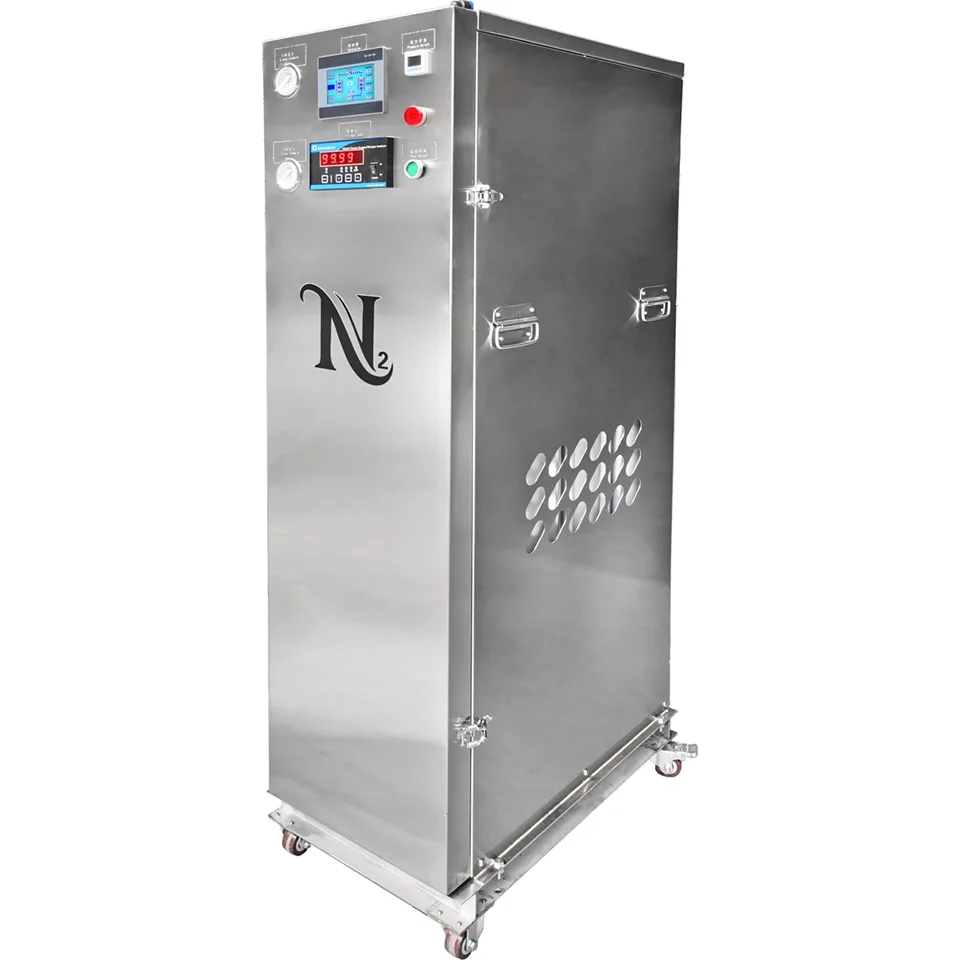
What a Food-Grade Nitrogen Generator Is Used For
A food-grade nitrogen generator separates nitrogen from compressed air and delivers it at controlled purity and pressure directly to a packaging line. In modified atmosphere packaging (MAP), nitrogen displaces oxygen inside the sealed tray or pouch. Lower oxygen slows oxidation, microbial growth, and color change, which extends shelf life for fresh meat, seafood, ready meals, sliced produce, coffee, snack foods, and bakery items. The same generator can also be used for inerting headspace in bottling, blanketing storage tanks, and purging transfer lines.
For an export buyer or food factory owner, the practical appeal is independence from cylinder deliveries. A unit sized at 5 Nm³/h running one shift can replace several liquid nitrogen or high-pressure cylinder deliveries per week, simplifying logistics and reducing supply interruption risk. Buyers planning a new packaging line, retrofitting an existing one, or specifying equipment for an overseas buyer should treat the nitrogen generator as part of the line specification, not as an afterthought added later.
Core Specifications Buyers Should Compare
The five parameters below are quoted on every reputable nitrogen generator specification sheet. Each one answers a practical buyer question, and the table shows the typical ranges seen on real product lines used in food packaging.
| Specification | Why It Matters | What Buyers Should Check |
|---|---|---|
| Nitrogen Output (Nm³/h) | Determines how many packaging machines the generator can feed simultaneously. | Confirm peak demand of the line, then add a 20–30% margin for growth. |
| Nitrogen Purity (%) | Sets oxygen residual inside the pack; higher purity means longer shelf life for sensitive products. | 99.9% suits general snacks and bakery; 99.99% is needed for fresh meat, seafood, coffee, and cheese. |
| Feed Pressure (MPa) | Compressed air enters the generator at this pressure. Under-sized air supply causes unstable purity. | Confirm the plant's air compressor can hold 0.7–0.8 MPa continuously. |
| Pressure Dew Point (°C) | Lower (more negative) dew point keeps moisture out of the sealed pack and the piping. | For food-grade lines, request a pressure dew point of -30°C or lower. |
| Dimensions & Weight (mm / kg) | Affects shipping cost, floor loading, and on-site placement next to the packaging line. | Match dimensions against the floor plan and the freight budget before ordering. |
How to Choose the Right Model
Production Capacity
Start with the line's actual nitrogen demand. A tray sealer running 30 trays per minute may consume around 2–4 Nm³/h depending on tray size, while a horizontal flow-wrapper on a snack line can pull 6–10 Nm³/h. Convert peak demand in Nm³/h into a model selection: if the line needs 6 Nm³/h, select a generator rated 8 or 10 Nm³/h so the unit does not run continuously at 100% load. Running at 70–80% steady load gives headroom for cycle peaks and extends sieve life.
Nitrogen Purity Requirements
Purity is the second non-negotiable parameter. Most food packaging lines run comfortably at 99.9% nitrogen. Sensitive categories such as fresh red meat, fish, sliced deli meats, roasted coffee, and certain cheeses require 99.99% to keep residual oxygen below 100 ppm inside the pack. Some product categories also benefit from blended gases (for example, 70% N2 / 30% CO2 for red meat), in which case the generator must be paired with a gas mixer, not just a single-gas source.
Feed Air Quality and Pressure
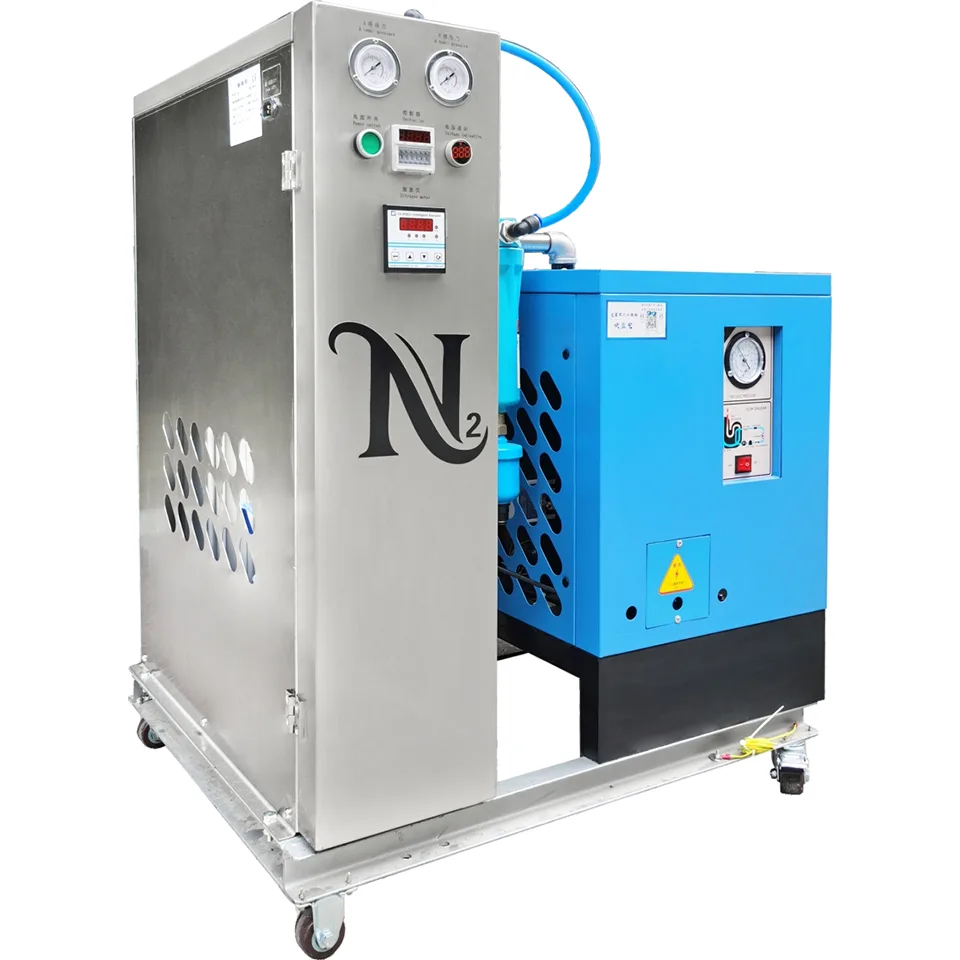
PSA nitrogen generators need dry, clean compressed air at a defined pressure. Most food-grade units quote a feed pressure range of 0.7–0.8 MPa. A refrigerated air dryer and a particulate filter should be installed upstream of the generator; without them, the carbon molecular sieve loads with moisture and oil, purity drops, and sieve replacement becomes a recurring cost. Buyers should plan for an air receiver tank between the compressor and the PSA unit to buffer demand spikes.
Food Contact Materials and Hygiene
Look at the cabinet and the gas path. The cabinet is usually SUS 201 stainless steel for economy models and SUS 304 for higher-spec builds. The piping inside the generator should be stainless or copper with sanitary fittings, and any seals exposed to the gas stream should be food-grade elastomers. Smooth cabinet surfaces, removable side panels, and accessible filters make daily wipe-down easier in a hygienic zone.
Cleaning and Maintenance
Plan a maintenance schedule before the unit arrives. Typical PSA nitrogen generators require: inlet filter element replacement every 2,000–4,000 hours, activated carbon filter change every 6–12 months, carbon molecular sieve replacement every 4–6 years (depending on feed air dryness), and annual purity calibration. Buyers should confirm the local service network or the supplier's remote diagnostic capability before purchase, especially for export markets.
Buyer Checklist
- Define product type, pack format, and target shelf life before model selection.
- Calculate peak nitrogen demand in Nm³/h at the packaging machine inlet.
- Decide required purity (99.9% or 99.99%) based on product oxygen sensitivity.
- Confirm available feed air pressure (0.7–0.8 MPa typical) and air dryer capacity.
- Check dimensions, total weight, and floor load for the planned installation room.
- Ask for cabinet material grade (SUS 201 vs SUS 304) and gas-path material list.
- Request pressure dew point specification and verification method.
- Confirm power supply voltage, frequency, and total connected load.
- Ask for sieve life, filter change intervals, and recommended spare parts list.
- Request FAT video, purity test report, and CE / ISO documentation before shipment.
- Clarify warranty terms, on-site commissioning scope, and remote support availability.
Common Mistakes to Avoid
One of the most common selection errors is matching the generator output to the average line demand instead of the peak. The demand when the sealing jaws close is higher than during idle periods, and an undersized generator loses purity at every cycle peak. The second common error is ignoring feed air quality. A compressor that delivers wet, oily air destroys the carbon molecular sieve and turns a five-year payback into a one-year retrofit. The third error is buying on first cost alone: buyers should always request the spec sheet, the FAT test video, and the warranty terms in writing before paying the deposit.
Typical Specification Comparison
The table below shows real specification data taken from currently available food-grade nitrogen generator lines. Use it as a reference when comparing quotes from different suppliers. Final selection should always be confirmed against the specific product datasheet provided by the manufacturer.
| Model Series | Output Range (Nm³/h) | Purity | Feed Pressure (MPa) | Pressure Dew Point (°C) | Cabinet Material |
|---|---|---|---|---|---|
| EAD Series | 1 – 10 | 99.99% | 0.7 – 0.8 | -30 | SUS 201 |
| UGN-DE Series | 3 – 12 | 99.99% | 0.7 – 0.8 | -30 | SUS 201 |
| Small EBD Series | 3 – 12 | 99.99% | 0.7 – 0.8 | -30 | SUS 201 |
| EB Series | 2 – 10 | 99.9% | 0.7 – 0.8 | -20 | SUS 201 |
FAQ
What purity of nitrogen is required for MAP packaging?
For most food MAP applications, 99.9% nitrogen is the minimum. Fresh meat, seafood, sliced cheese, and roasted coffee usually require 99.99% nitrogen to keep residual oxygen below 100 ppm inside the pack. Final purity should be confirmed according to the specific product, the headspace gas mixture, and the regulatory target of the destination market.
How is the nitrogen output (Nm³/h) sized for a packaging line?
Output is sized by measuring the actual nitrogen consumption of the sealing machine in Nm³/h at peak cycle, then adding a 20–30% margin for future capacity and demand spikes. Buyers should request consumption data from the packaging machine supplier and verify it on-site after installation.
Does a food-grade nitrogen generator need a separate air dryer?
Yes. PSA nitrogen generators need dry, clean compressed air at the inlet. A refrigerated air dryer plus a particulate filter and an activated carbon filter should be installed upstream. Without them, moisture and oil load the carbon molecular sieve and purity drops within months. Some generator models integrate a small dryer; most expect a separate unit on the compressed air line.
What is the difference between PSA and membrane nitrogen generators?
PSA (Pressure Swing Adsorption) units use two adsorption towers filled with carbon molecular sieve to separate nitrogen from compressed air at high purity (up to 99.99%). Membrane units use hollow fiber membranes and typically reach 95–99.5% purity. For most food packaging applications that require 99.9% or higher, PSA is the standard choice. Final selection should be confirmed according to the selected model and supplier documentation.
How much compressed air does a nitrogen generator consume?
As a rule of thumb, a PSA nitrogen generator consumes roughly 1.5–2.0 Nm³ of compressed air for every 1 Nm³ of nitrogen produced, depending on target purity. Size the air compressor with at least 30% margin above the generator's feed air demand to avoid unstable purity and excessive compressor cycling.
What maintenance does a food-grade nitrogen generator require?
Routine maintenance includes inlet filter element replacement (typically every 2,000–4,000 hours), activated carbon filter change every 6–12 months, valve inspection annually, and carbon molecular sieve replacement every 4–6 years if feed air quality is maintained. Purity calibration should be checked at least once per year using an independent oxygen analyzer.
The right food-grade nitrogen generator is the one that matches the product's purity requirement, delivers the line's peak demand with margin, and runs on the available compressed air supply without overloading the sieve. Confirm the cabinet material, the dew point, the dimensions, and the supplier's documentation before placing the order. Final specifications should always be confirmed according to the selected model and supplier documentation.