
Practical engineering guide for selecting heat shrink packaging machines for food factories, contract packers, and importers. Covers tunnel length, conveyor speed, film gauge, and buyer checklist.
A commercial heat shrink packaging machine wraps products in polyolefin (POF) or polyethylene (PE) shrink film and passes them through a heated tunnel so the film conforms tightly to the pack. The result is a sealed, tamper-evident multi-pack used in food, beverage, cosmetics, stationery, hardware, and pharmaceutical secondary packaging. This guide walks through the engineering parameters an experienced buyer should confirm before signing a purchase order — tunnel length, conveyor speed, chamber opening, film gauge, and power supply — written for procurement engineers at food factories, central kitchens, contract packers, and importers.
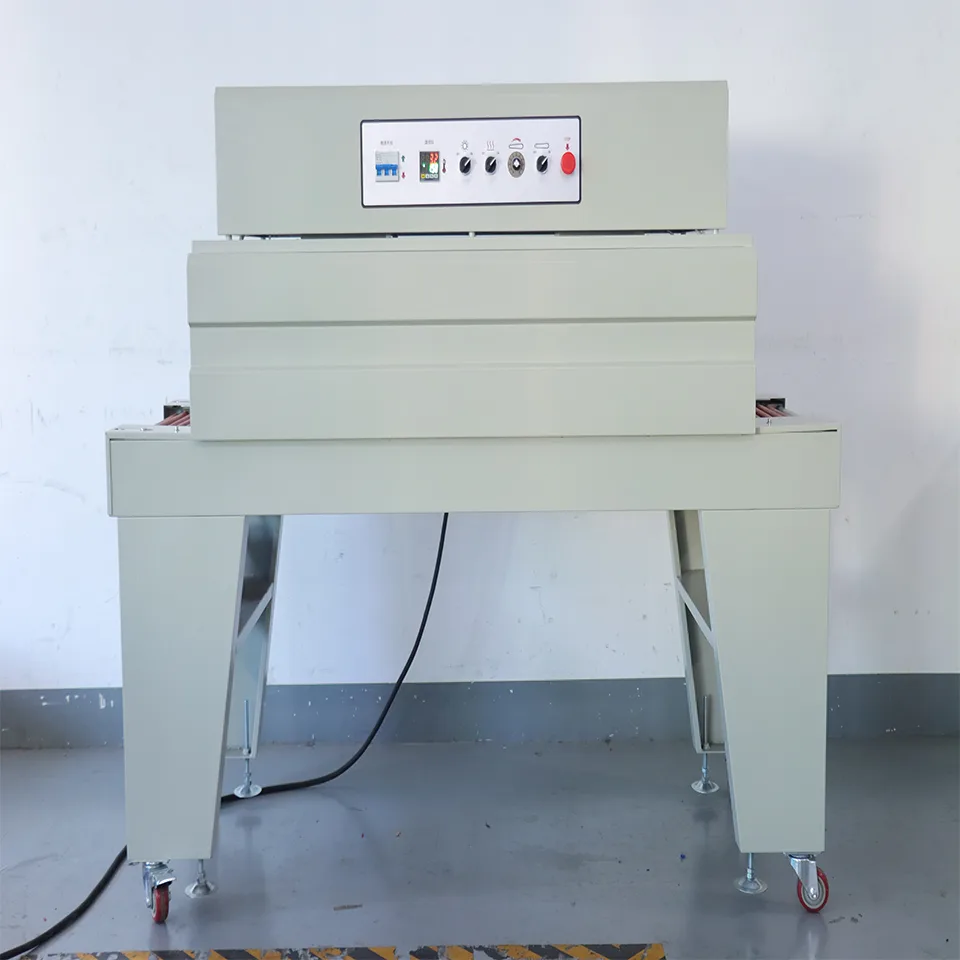
Key Takeaways
- Heat shrink packaging is a two-stage system: a sealer (L-bar or automatic sleeve wrapper) plus a heat shrink tunnel; the tunnel is the part most buyers under-spec.
- Common configurations deliver 0–15 m/min conveyor speed with chamber openings from 200 mm to 600 mm height; oversizing wastes energy, undersizing limits product range.
- POF film (15–25 µm) suits most food and consumer-goods packs; PE film (50–80 µm) is used for heavier or pallet-style bundles.
- Working temperature 100–250 °C and dwell time 5–20 seconds are the two variables a buyer must verify with the actual product, not at idle.
- Confirm voltage (220V/380V/415V, 50/60 Hz), air supply (0.6–0.8 MPa), and exhaust ventilation before container loading.
What This Equipment Is Used For
Heat shrink machines are most commonly used on secondary packaging lines where individual units are already filled, sealed, or labeled. Typical applications include:
- Bottled water, soft drinks, and canned beverages in 6-, 12-, or 24-pack configurations.
- Cosmetics, stationery, and pharmaceutical boxes bundled for retail display.
- Bakery trays, ready-meal sleeves, and snack multi-packs where a tight film improves shelf presence.
- Hardware, fasteners, and building materials grouped into retail-sized multi-packs.
- Printed books, magazines, and gift sets requiring tamper-evident overwrap.
The machine is not a primary food processing machine — it does not cook, freeze, or sterilize. It is a finishing line that adds a sealed film layer for transport protection, retail display, or bundle pricing. Buyers who try to use a shrink tunnel to compensate for a weak primary seal will see film failures at high speeds.
Core Specifications Buyers Should Compare
| Specification | Why It Matters | What Buyers Should Check |
|---|---|---|
| Tunnel length | Determines dwell time at a given conveyor speed. | 800–1500 mm for small packs; 1800–2500 mm for full cases or pallet bundles. |
| Chamber opening (W × H) | Sets the maximum product cross-section that can be wrapped. | Common sizes: 400 × 200 mm, 500 × 300 mm, 600 × 400 mm. Match to your tallest pack. |
| Conveyor speed | Sets throughput in packs per minute. | 0–10 m/min for hand-fed lines; 0–15 m/min or 0–20 m/min for auto sleeve wrappers. Variable frequency drive is preferred. |
| Working temperature | Film shrinks within a defined window; too low causes loose film, too high burns or warps product. | Adjustable 0–250 °C or 0–300 °C; PID digital controller recommended for repeatable settings. |
| Heater power | Affects warm-up, recovery time, and energy cost. | Compact tunnels: 6–10 kW. Larger tunnels (1500 mm+): 13–22 kW. Confirm kW per running hour at your typical line speed. |
| Film type | POF is general-purpose; PE suits heavy or pallet packs; PVC is being phased out for food contact in many markets. | Confirm film gauge (15–25 µm POF, 50–80 µm PE) and roll diameter compatibility with the machine. |
| Power supply | China-made machines often default to 380V/3-phase/50Hz; many export markets require 415V/3-phase or 220V/single-phase. | Ask for a wiring diagram and confirm whether a transformer is in scope. |
| Air supply (if pneumatic) | Some automatic sleeve wrappers need compressed air for cutting and pressing. | 0.6–0.8 MPa clean, dry air; check whether a compressor is in scope. |
How to Choose the Right Model
Product and Pack Size
Start with the largest and the smallest pack you intend to run on this line. The tunnel chamber opening (W × H) must clear the largest pack with at least 30–50 mm of headroom on each side, otherwise the film will catch on the chamber wall. For a small bakery or cosmetic line, a 400 × 200 mm chamber is usually enough. For 24-pack beverage cases, you are typically in the 500 × 300 mm to 600 × 400 mm range. A buyer who orders a 600 × 400 mm tunnel for a line that only runs 250 mm tall boxes is paying for unused heating capacity and energy waste.
Throughput and Conveyor Speed
Throughput depends on conveyor speed and pack length. A 300 mm long pack moving at 10 m/min produces roughly 33 packs per minute from the tunnel; the sealer upstream usually limits the actual line. If your target is 20 packs per minute, a 0–10 m/min variable-speed conveyor covers it with margin. If you expect to scale up, choose a 0–15 m/min or 0–20 m/min drive. Confirm the drive is VFD-controlled (variable frequency drive), not fixed-speed with mechanical pulleys, so you can tune during factory acceptance testing.
Film Type and Gauge
Polyolefin (POF) shrink film at 15–25 µm is the workhorse for food, cosmetic, and stationery packs: clear, strong, FDA/EU food-contact compliant for most applications, and shrinks at 130–160 °C. Polyethylene (PE) film at 50–80 µm suits heavier bundles, larger cases, or pallet overwrap. PVC film is still used in some regions but is being restricted for food contact. Confirm the film roll outer diameter your sealer accepts (commonly 250 mm or 300 mm) and core size (commonly 76 mm).
Heating and Airflow Design
The quality of the shrink result depends on even heat distribution inside the tunnel. Two engineering details separate a usable tunnel from a problematic one:
- Heater placement and baffle design: top-and-bottom heater banks plus side airflow produce a more uniform shrink than a single top heater. Confirm at least two heater zones for tunnels over 1000 mm.
- Exhaust and ventilation: a heat shrink tunnel exhausts hot air; production halls need a vent hood or extraction fan rated for the tunnel's airflow. Confirm whether the supplier's scope includes the vent stack or only the tunnel.
Cleaning, Maintenance, and Food Safety
For food factories and central kitchens, the tunnel must be accessible for daily cleaning. Look for:
- Stainless steel (SUS304) heater covers and conveyor frames in the food-contact zone.
- Removable conveyor mesh or rod for wash-down.
- Access panels on both sides of the tunnel for clearing film jams.
- Cooling fan or air-curtain at the tunnel exit to set the film before it hits the take-away conveyor.
Controls and Connectivity
A basic machine has a PID temperature controller plus a conveyor speed dial. For export buyers integrating the shrink line with an upstream sleeve wrapper, ask whether the supplier supports:
- 0–10 V or 4–20 mA speed reference from a host PLC.
- Start/stop interlock signals with the upstream sealer.
- English-language HMI (touch screen) with temperature and speed setpoints in °C and m/min.
- Remote diagnostics via VPN or industrial 4G router (common add-on for export lines).
Buyer Checklist
- Confirm the largest and smallest pack dimensions and ensure chamber opening clears both with margin.
- Confirm target throughput in packs per minute and choose VFD conveyor speed range accordingly.
- Specify film type (POF, PE) and gauge; ask the supplier to ship a sample of compatible film with the machine.
- Confirm voltage, phase, and frequency (e.g., 415V/3-phase/50Hz for GCC and UK markets, 220V/single-phase/60Hz for some LATAM markets).
- Confirm whether a transformer, compressor, exhaust hood, and take-away conveyor are in scope.
- Ask for a factory acceptance test (FAT) video at your line speed with your product sample.
- Ask for spare parts list with part numbers, especially heater elements, conveyor mesh, PID controller, and thermocouple.
- Confirm warranty terms (commonly 12 months), on-site commissioning availability, and after-sales response time.
- Ask for English-language operation manual, electrical schematic, and maintenance schedule.
- Confirm packaging dimensions and gross weight for container loading; tunnels over 1500 mm often need an oversized or break-bulk shipment.
Common Mistakes to Avoid
The same avoidable mistakes come up across most heat shrink projects: ordering a 380V/3-phase/50Hz machine for a 415V site without a transformer in scope; buying the smallest chamber opening that fits today and finding the next SKU does not clear; specifying a tunnel at the same length as the upstream conveyor with no buffer for film timing variation; skipping the exhaust hood and having the production hall HVAC fight the tunnel's hot air. Most of these surface during factory acceptance testing if you ask the supplier to run your product at your target speed. Final specifications should be confirmed according to the selected model and supplier documentation.
FAQ
What is the difference between a heat shrink tunnel and a shrink wrap machine?
A shrink wrap machine is the complete system — typically an L-bar sealer or automatic sleeve wrapper plus a heat shrink tunnel. The sealer cuts and wraps the film around the product; the tunnel applies heat so the film shrinks to the product shape. Some compact machines combine both functions in one frame, but for higher throughput they are kept as two separate modules connected by a conveyor.
What film thickness should I use for a heat shrink packaging machine?
For most food, beverage, cosmetic, and stationery packs, POF film at 15–25 µm is the standard. For heavier bundles, multi-pack cases, or pallet-style packs, PE film at 50–80 µm is more common. PVC film is still available but is being restricted for food contact in several export markets; confirm local regulation before specifying.
What chamber opening size do I need?
Measure your tallest pack and add 30–50 mm of headroom on height and 20–30 mm on width. A bakery line running 80 mm tall trays can use a 200 mm chamber opening; a beverage line running 300 mm tall 24-pack cases typically needs 400 mm or 500 mm. Oversizing wastes energy; undersizing causes film jams.
What conveyor speed should I specify?
Match it to your packs-per-minute target and pack length. A 300 mm pack at 10 m/min produces roughly 33 packs per minute; at 15 m/min, around 50 packs per minute. For lines under 30 packs per minute, a 0–10 m/min VFD conveyor is usually enough. For higher speeds, choose 0–15 m/min or 0–20 m/min.
What utilities does a heat shrink tunnel require?
Most tunnels need only electrical power — typically 380V/3-phase/50Hz or 415V/3-phase/50Hz for export markets. If the line includes an automatic sleeve wrapper, you will also need compressed air at 0.6–0.8 MPa. A vent hood or extraction fan is recommended for the tunnel exhaust, especially in warm climates or sealed production halls.
Can one heat shrink machine handle both food and non-food products?
Yes, as long as the chamber opening, conveyor speed, and film gauge fit. Most food factories run both food and non-food SKUs on the same tunnel. Clean the conveyor mesh between changeovers if your HACCP plan requires it.
Related Products
- Industrial Heat Shrink Machine — 0–15 m/min adjustable speed: compact heat shrink tunnel with VFD conveyor, suitable for small to mid-size food and consumer-goods packs.
- 4522-15 Heat Shrink Tunnel — 1500 mm length, 13 kW: longer tunnel for higher dwell time and larger case packs.
- Heat Shrink Machine category: full range of shrink tunnels and shrink wrap systems from Huayi.
- Overwrapping Machine category: complementary overwrapping and skin-packaging equipment.
- Tray Sealer category: MAP tray sealers for fresh meat, ready meals, and produce — pair with shrink wrap for two-stage retail packs.
- Double Chamber Vacuum Sealer category: vacuum packaging machines for food products that need MAP or vacuum before secondary shrink wrap.
Last updated
Published 2026-08-27 by Huayi Smart Solutions. Final specifications should be confirmed according to the selected model and supplier documentation before placing a purchase order.