
Dual pump systems in 380V commercial vegetable washers: what a 2HP water pump and a 1HP hydraulic pump each do, and why 380V/50Hz is the commercial boundary.
A dual-pump 380V layout splits washing water circulation from hydraulic power, and separating those two jobs is what makes the specification readable.
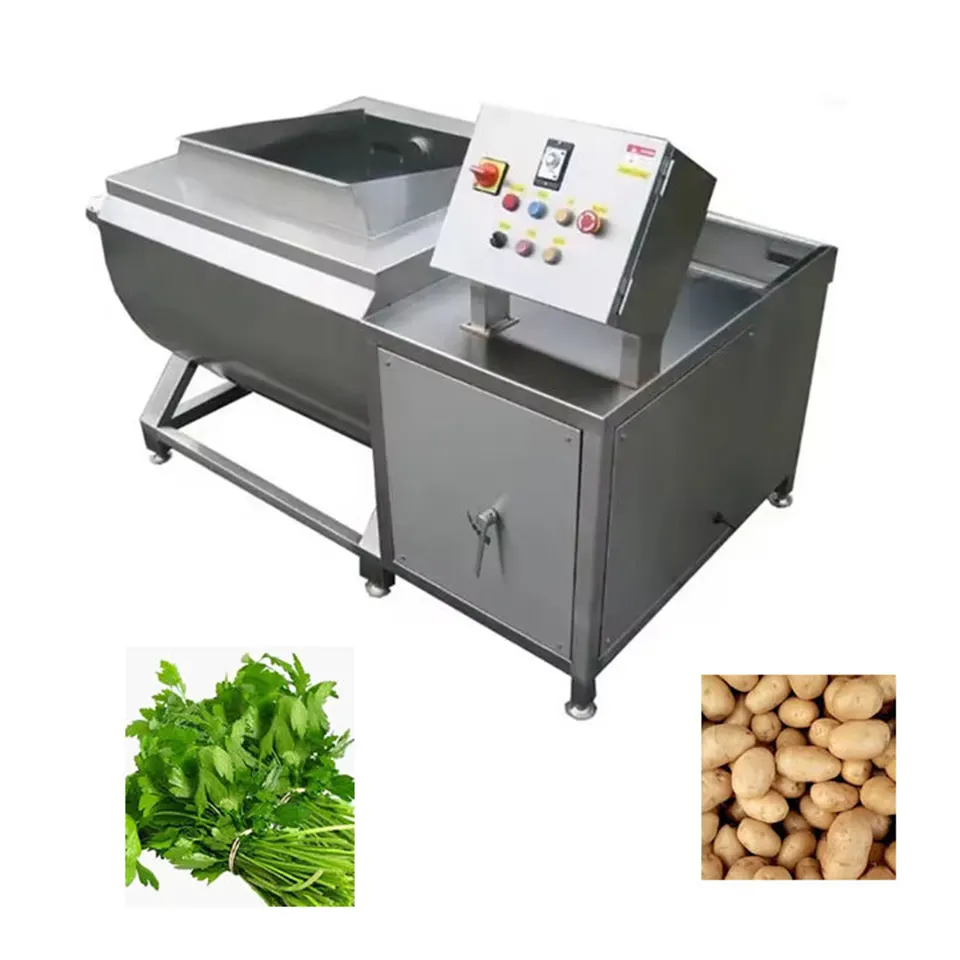
The phrase "dual pump" appears in most listings for a commercial vegetable washer and rarely comes with an explanation. A reader sees "2HP water pump + 1HP hydraulic pump", files it under useful numbers, and moves on. Two questions are left hanging: which pump actually touches the produce, and whether the hydraulic side automatically delivers a discharge feature. Both answers come from reading the power layout as a set of separate jobs rather than a single performance figure, and that reading is what this guide walks through.
| Water pump | 2 HP — wash bath circulation |
|---|---|
| Hydraulic pump | 1 HP — separate hydraulic circuit |
| Power supply | 380V / 50Hz three-phase |
| Batch capacity | 20–30 kg per cycle |
| Cycle time | 3–5 minutes |
| Body material | 304 stainless steel |
| Installed weight | 380 kg |
What the dual-pump power layout includes in a batch washer
On a batch vegetable washer such as the TY106, the dual-pump layout is a division of labour rather than a single drive. A 2HP water pump moves water. A 1HP hydraulic pump drives a hydraulic circuit. They are separate units, sized differently, and they serve different phases of a cycle. Industrial pump standards follow the same logic: a pump is described by its duty, its fluid, and its operating point, not by one headline number. Reading the two ratings that way turns a specification line into a usable picture of what the machine is doing.
1. The water pump supports circulation during a wash cycle
In a 20–30 kg batch machine, a cycle runs about three to five minutes, and water circulation is the part of that cycle doing the heavy lifting. A 2HP pump provides enough flow and head to keep the wash bath moving around and through a loaded batch, so soil shifts off leaves and tubers instead of produce sitting in still water. Moving water also stops a load from packing into one corner of the tank. That is the practical meaning of the 2HP figure: a circulation unit matched to a batch of this size, running on a 380V/50Hz supply.
2. The hydraulic pump powers a mechanical function separate from washing
The 1HP hydraulic pump stands apart from the wash circuit entirely. Hydraulic power packs convert a small electric motor into linear or rotary force, which is why they turn up on food processing machinery wherever a heavy lid, tank, or discharge element has to move under load. On batch produce washers, hydraulic power is commonly used for load handling such as a discharge tilt, a tank lift, or a powered cover, and the technical documentation for a given build names which one applies. Two machines can carry an identical 1HP rating and still differ in what that force is applied to, so the rating describes the power source while the mechanism sits in the mechanical specification.
Why 380V/50Hz is a commercial power boundary rather than a household feature
380V/50Hz is three-phase industrial supply, and it is the line that separates a commercial vegetable washer from anything domestic. The reason is arithmetic. A 2HP pump plus a 1HP hydraulic pump draws a current that single-phase household wiring cannot carry comfortably, while three-phase distribution delivers the same load at lower current per conductor and keeps motor starting behaviour predictable. Electrical configuration on industrial machinery is treated as part of the machine itself in major markets, which is why the EU machinery rules address the electrical supply alongside guarding and controls rather than as an add-on. For anyone planning a site, the 380V/50Hz line is a facilities question before it is a machine question. The installation needs a three-phase supply at the right voltage and frequency, correct circuit protection, and an earthing arrangement that satisfies local rules — all of which belongs to the electrical contractor rather than the equipment listing. Where a site already runs 380V at 50Hz, the standard configuration drops in without adaptation. Sites on a different supply standard need a separate engineering conversation before anything is ordered, and that conversation is where the answer lives.
What the published power facts tell you about the machine
Put the stated specifications side by side and a clear picture forms: a 2HP water pump, a 1HP hydraulic pump, a standard 380V/50Hz configuration, a 20–30 kg batch, a 3–5 minute cycle, a 304 stainless steel body, and a 380 kg installed weight. Those numbers answer four questions a power-system reader genuinely has. How much force sits behind the wash circuit. Whether a separate hydraulic circuit is included. What supply the machine expects at the wall. And what the whole assembly weighs once it is on the floor. Each one is a configuration fact a buyer can check against a real site. The same facts leave the internal wash action, water consumption, drain sizing, and the exact motion the hydraulic circuit drives to the mechanical documentation. That split is ordinary in this industry: the power datasheet describes sources and ratings, the mechanical drawing set describes what those sources move. A reader who needs tipping discharge gets a straight answer by asking which mechanism the hydraulic pump drives on the build being quoted, because the pump rating describes the power source and the mechanism describes the machine. Asking that one question early is what separates a good match from a retrofit.
Conclusion
A dual-pump 380V layout is easier to read once the two pumps are treated as two jobs. The 2HP water pump carries circulation through a three-to-five-minute batch. The 1HP hydraulic pump is a separate power unit whose motion belongs to the mechanical specification, not the electrical one. The 380V/50Hz line tells a buyer what the site must supply before the machine ever arrives. Reading those three facts separately — and asking for the mechanism when discharge handling matters — gives a far more accurate picture than any single horsepower number on its own.
FAQ
Q: What does a dual pump system mean on a 380V commercial vegetable washer?
A: It means the machine carries two independent power units. One pump circulates wash water through the batch, and a second pump drives a hydraulic circuit for a mechanical function. The 380V/50Hz part describes the three-phase supply both units run on. Together they tell you the machine has a dedicated circulation circuit plus hydraulic capability, with each unit sized for its own job rather than sharing one drive.
Q: What is the difference between the 2HP water pump and the 1HP hydraulic pump?
A: The 2HP water pump handles fluid movement during the wash cycle, pushing water around and through a 20–30 kg batch for the three to five minutes a cycle runs. The 1HP hydraulic pump instead pressurises hydraulic fluid to produce mechanical force for a load-handling element. Different fluids, different duties, different ratings — one works on the wash water, the other works on a moving part of the machine.
Q: Does a 1HP hydraulic pump always mean automatic dump discharge?
A: No. A 1HP hydraulic pump confirms that a hydraulic power unit is part of the build. Whether that unit drives a dump discharge, a tank lift, or another mechanism is a separate mechanical specification. Hydraulic power on batch washers is commonly used for load handling, and the exact motion is named in the technical documentation for the specific build. Buyers who need automatic dump discharge should ask for that mechanism explicitly when a unit is configured.