
Commercial noodle cooker sizing: 12 models from 5 kW to 18 kW compared on basket count, voltage, footprint and gas versus electric for restaurant and central kitchens.
A commercial noodle cooker boils fresh noodles, pasta and dumplings in a stainless steel tank with wire mesh baskets, and the purchase comes down to three numbers: heating power, basket count and voltage. In the Huayi Equipment range the XKE-DM-900 runs 18 kW on 380 V/50 Hz across 800 × 900 × (850 + 120) mm at 105 kg, the E-DM-700X cooks in 12 baskets on 12 kW, and the E-RQM-600 brings 14 kW into 600 × 650 × (370 + 150) mm at 35 kg with gas or electric energy. This guide is for buyers sizing a noodle station in a ramen shop, a food court, a hotel kitchen or a central kitchen that cooks pasta in batches.
Key Takeaways
- Basket count sets the batch size, not the wattage. A 12-basket E-DM-700X at 12 kW and a 9-basket E-DM-9T at 6 kW serve different service windows because tank geometry, not only the heater, decides how fast the water recovers.
- Confirm the electrical supply before the model. The E-DM-400X and the XKE-DM-900 both need 380 V/50 Hz three phase, while the E-DM-9T runs on 220 V/50 Hz and the E-DM-600 on 220-240 V/50 Hz.
- Gas is a site-infrastructure decision, not a taste decision. The E-RQM-400X uses a 5 kW burner on NG/LPG and the E-RQM-700X a 10 kW burner; both avoid a three-phase connection but need a gas line, a hood and a serviceable burner.
- Automatic basket lifting changes the labour maths. The XKE-DM-900 and the E-DM-700X raise baskets out of the water instead of waiting for an operator, which removes the scald risk that keeps kitchens from adopting continuous 100 °C work.
- Ask for pot volume and fill depth in writing. Published basket counts describe what fits in the tank, not how many kilograms of product it holds at 100 °C.
- Measure the service window, not the day. A canteen kitchen cooking 400 kg of noodles across three shifts needs a different tank from a ramen shop that cooks 60 kg between 12:00 and 13:00.
- Spare parts decide downtime. Order the heating elements, thermostat, basket mesh, drain valve and gas jet set with the machine, not after the first breakdown.
Start With the Basket Count, Not the Kilowatts
A noodle cooker's capacity is a water problem before it is a power problem. Water at 100 °C holds a fixed amount of heat, and every kilogram of pasta or noodle entering the tank takes that heat away. That is why the E-DM-700X pairs 12 kW with 12 baskets across 800 × 700 × 420 mm, while the E-DM-9T runs 6 kW over 600 × 700 × 915 mm for 9 baskets. The smaller heater sits on a taller, narrower footprint and works on a smaller product load per basket.
Buyers who start with wattage alone often end up with a machine that boils fast and then sits at 85 °C for the rest of the service. Buyers who start with the basket count understand the constraint: nine baskets in one lift means nine portions of one product moving together, and the drain-down of that mass takes time before the next batch can go in.
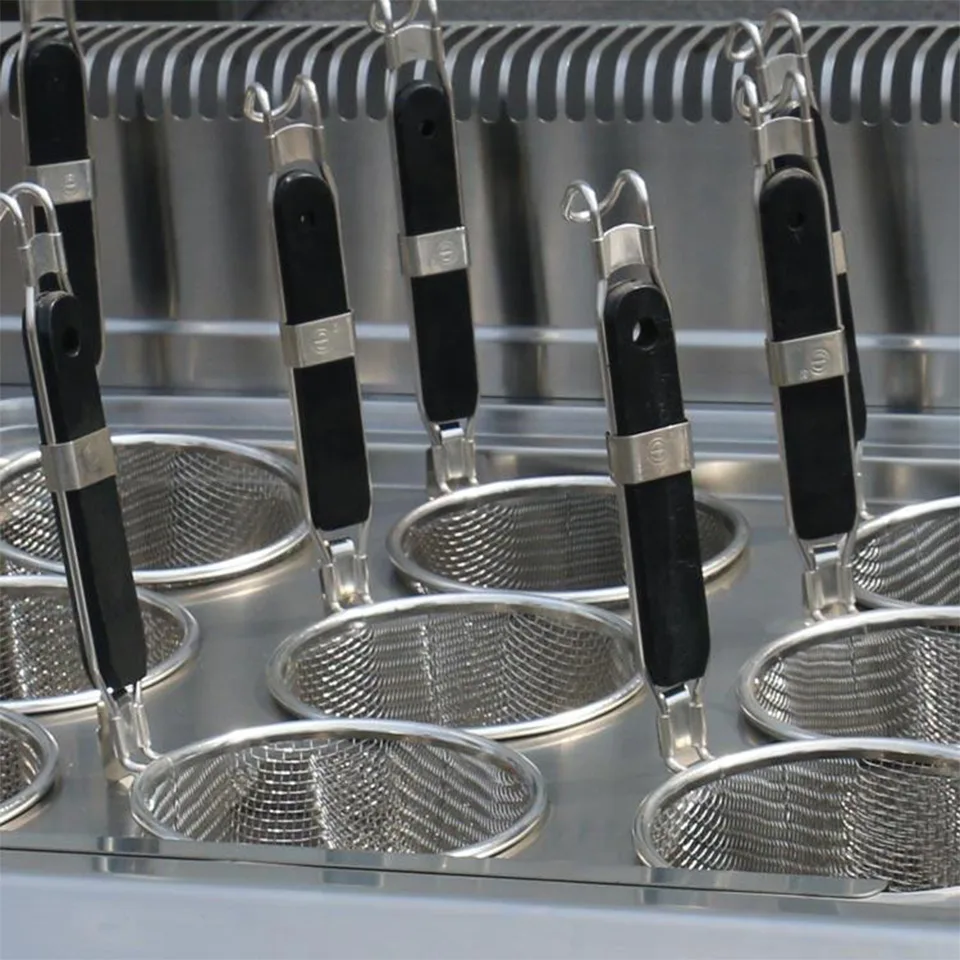
- Count the baskets you need in one lift. The E-RQM-700X holds 12 baskets on 10 kW gas, and the E-DM-700X holds 12 on 12 kW electric. Match the number to the order sheet, not to the price list.
- Decide how the batch leaves the tank. Manual basket units such as the E-RQM-400X and the HKE-RQY-900S need a worker with a lifting arm, a heat glove and a drain tray beside the machine. Automatic lifting units remove that step entirely.
- Set the number of cycles per hour before asking for a price. A tank that recovers to 100 °C in 12 minutes gives five cycles an hour; one that needs 20 minutes gives three. Ask for recovery time on the full tank with your heaviest product and put it in the purchase order as a witnessed test.
That recovery figure is the number that decides a noodle station. In practice it is the one a buyer rarely gets from a brochure, because it depends on the fill level, the incoming water temperature and the product load. Treat it as a selection limit rather than a marketing feature.
Match the Cooker to the Service Window
A commercial noodle cooker does two jobs in a working kitchen: it holds temperature through a service, and it cooks to order. Those jobs pull in different directions. The E-DYF-900S pairs a 6 kW pot with a storage cabinet at 400 × 900 × (850 + 120) mm and 63 kg, which suits a kitchen that cooks in batches and stores pans below. The SZ-60 rice noodle machine is a different machine entirely, extruding at 60 L/h from a 5.5 kW motor at 960 × 450 × 1250 mm and 240 kg.
Typical stations fall into three groups. Ramen shops and noodle bars need short cycles, immediate service and a small footprint, so tabletop units such as the E-RQM-400X at 400 × 700 × 420 mm and 20 kg fit where floor space is charged by the square metre. Central kitchens and canteens cook to a schedule, so multi-basket units such as the E-DM-700X with 12 baskets serve a shift rather than a queue. Food courts and market stalls run on gas because a cylinder or an NG line is available where a three-phase supply is not.
In every case the equipment sits in the middle of a flow: raw baskets in, cooked baskets out, and a drain point within reach of the basket arms. A noodle cooker installed away from its drain will be slow in service no matter what the nameplate says.

Compare the Huayi Commercial Noodle Cooker Range
| Model | Power and energy | Voltage | Footprint and weight | Where it fits |
|---|---|---|---|---|
| XKE-DM-900 | 18 kW electric, automatic lifting | 380 V/50 Hz | 800 × 900 × (850 + 120) mm, 105 kg | Central kitchens cooking to a shift schedule |
| E-DM-700X | 12 kW electric, 12 baskets, automatic lifting | 380 V/50 Hz | 800 × 700 × 420 mm | High-volume canteens and ramen chains |
| E-RQM-700X | 10 kW gas burner, 12 baskets | 380 V/50 Hz for the controls | 800 × 700 × 420 mm, 50 kg | Gas-fed kitchens without three-phase supply |
| E-DM-9T | 6 kW electric, 9 baskets | 220 V/50 Hz | 600 × 700 × 915 mm, 50 kg | Single-phase sites cooking several products at once |
| E-DM-400X | 6 kW electric, tabletop | 380 V/50 Hz | 400 × 700 × 420 mm, 30 kg | Compact restaurant lines and food courts |
| E-RQM-400X | 5 kW gas burner, tabletop | 380 V/50 Hz for the controls | 400 × 700 × 420 mm, 20 kg | Small kitchens, stalls and mobile sites |
| E-RQM-600 | 14 kW, gas or electric energy source | 380 V/50 Hz | 600 × 650 × (370 + 150) mm, 35 kg | Where the fuel decision is made late |
| E-DYF-900S | 6 kW electric with storage cabinet | 380-415 V/50 Hz | 400 × 900 × (850 + 120) mm, 63 kg | Kitchens that cook in batches and store pans |
Read the table across rather than down. Two units with the same wattage can sit in different parts of a building: the E-DM-400X at 6 kW draws on 380 V/50 Hz and 30 kg, while the E-DM-9T at 6 kW runs on 220 V/50 Hz and weighs 50 kg because the tank is deeper and the basket arms sit higher. In a site with 220 V supply and a floor that has to carry 50 kg per point, that difference decides the layout.
Final specifications should be confirmed according to the selected model and supplier documentation.
Choose Between Gas and Electric Before You Choose a Model
| Decision point | Gas units such as the E-RQM-400X and E-RQM-700X | Electric units such as the E-DM-400X and E-DM-700X |
|---|---|---|
| Site supply | NG or LPG line and a hood; burner ratings from 5 kW upward | 220 V or 380 V connection; element ratings from 6 kW to 18 kW |
| Heat behaviour | Burner output is fixed by the jet set, so the fuel type must be confirmed in writing | Element output is fixed by the model and the thermostat controls the cycle |
| Service access | Burner, gas jet and ignition parts need a gas technician | Heating elements and thermostats are standard electrical parts |
| Cleaning | Open burner trays collect condensate and scale around the jets | Sealed elements leave fewer crevices around the tank base |
| Running cost | Follows the local gas tariff against the burner rating in kW | Follows the local electricity tariff against the element rating in kW |
Neither fuel wins by itself. A gas unit on a site with an unstable NG supply will hold temperature worse than an electric unit of similar size, and an electric unit on a site with a weak 380 V board will draw more current than the panel was designed for. The E-RQM-600 exists precisely for this uncertainty, because the same 600 × 650 × (370 + 150) mm body at 14 kW can be specified with gas or electric energy when the site decision comes late.
Buyers should check the electrical supply against the rating plate before the container is booked: voltage, phase, frequency, breaker size and cable run. On gas units, confirm the gas family, the inlet pressure and the jet set with the supplier, and draw the flue route before the order, because the pipework is usually the part that delays a food-court opening.
Place the Noodle Station in the Line
Position the cooker between raw supply and service, not at the end of the room. The basket arm sweeps a radius that needs clear space above and in front of the tank, and the drain point has to sit under that radius. On the XKE-DM-900 at 800 × 900 × (850 + 120) mm and 105 kg, plan the floor loading and the service access before the unit is craned into position. That capacity also demands clearance: room on the infeed side for loaded baskets, and space at the back for the gas line or the isolator switch.
Temperature control at the point of service is a separate decision. GB 31654-2021, effective 22 February 2022, requires cooked food to reach a core temperature of 70 °C or above, and a noodle station that holds product at 100 °C in the tank has a margin that a holding cabinet does not need to create. Where the product is boiled and then held, the holding step needs its own temperature record.
Run the Buyer Checklist Before You Order
- Product type confirmed: fresh wheat noodles, egg noodles, pasta, dumplings or rice noodles, each with its own cooking time.
- Basket count per lift set from the order sheet, not from the model name.
- Target cycles per hour written down, with the recovery time to 100 °C requested on a full tank.
- Pot volume and fill depth confirmed with the supplier, in litres and in millimetres.
- Voltage, phase, frequency, breaker and cable run checked against the rating plate, or the gas family, pressure and jet set confirmed.
- Ceiling height, door opening and the packed footprint measured against the delivery route.
- Heating method and the energy source decided before the model, because it changes the order.
- Drain position, floor loading and service access drawn on the kitchen layout.
- Food contact surfaces confirmed against GB 4806.9-2023 for stainless steel food contact materials, effective 6 September 2024.
- Spares kit ordered with the machine: heating elements, thermostat, basket mesh, drain valve and gas jet set.
Avoid the Mistakes That Cost a Reorder
The common failure is choosing by power rating alone. A buyer sees 18 kW on the XKE-DM-900 and assumes it will out-cook a 6 kW machine, then discovers the tank on the smaller unit holds its heat better during a slow service. The second failure is specifying the fuel after the model is chosen, which turns a 12-basket order into a gas conversion, a new jet set and a delayed delivery. The third is leaving the basket mesh and the drain valve out of the spare parts kit, which turns a five-minute stop into a two-week wait.
None of these are visible in a product photograph. They only show up in the order confirmation, which is why the checklist above belongs with the purchase order rather than in a folder.
FAQ
Q: What is a commercial noodle cooker?
A: It is a stainless steel tank with wire mesh baskets, heating elements or a burner, and a control that holds the water at 100 °C. The Huayi Equipment range covers tabletop units of 5-6 kW up to the XKE-DM-900 at 18 kW with automatic basket lifting, from 400 × 700 × 420 mm at 20 kg to 800 × 900 × (850 + 120) mm at 105 kg.
Q: How do I choose the right size commercial noodle cooker?
A: Start from the baskets you need in one lift and the cycles per hour you have to hit, then check the recovery time on a full tank. A 12-basket E-DM-700X at 12 kW and a 9-basket E-DM-9T at 6 kW fit different service windows even though both are electric stainless steel units.
Q: What capacity does a commercial noodle cooker need for a central kitchen?
A: Size it from the kilograms of product per service window, not from the daily total, and ask the supplier for pot volume and fill depth in writing. Published basket counts and kW ratings describe the machine, not how much product it holds at 100 °C.
Q: Should I choose gas or electric for a noodle cooker?
A: Choose on site infrastructure, not on running cost estimates. Gas units such as the E-RQM-400X at 5 kW and the E-RQM-700X at 10 kW need an NG or LPG line and a hood; electric units from 6 kW to 18 kW need a 220 V or 380 V supply. The E-RQM-600 at 14 kW can be built for either energy source.
Q: What material should the parts in contact with food be?
A: Ask the supplier to state the steel grade for the tank, baskets and any removable tool, and check it against GB 4806.9-2023 for food contact metal materials. For the E-DM-600 the product data lists 304 stainless steel; other models in the range list stainless steel, so the grade must be confirmed per model rather than assumed for the series.
Q: How do I clean and maintain a commercial noodle cooker?
A: Clean the tank, the basket mesh and the drain valve daily, and keep the thermostat and heating elements clear of scale. Open burner trays need condensate and scale removed around the gas jets. GB 31654-2021 sets the general hygiene framework for catering kitchens, and the machine manual should carry the cleaning intervals for the specific model.
Sources and Standards
- GB 31654-2021, Safety and Hygiene Practice for Catering Services, published 18 March 2021 and effective 22 February 2022: cooked food core temperature of 70 °C or above.
- GB 4806.9-2023, National Food Safety Standard for Food Contact Metal Materials and Articles, issued 6 September 2023 and effective 6 September 2024.
- GB 14881-2013, General Hygiene Practice for Food Service: facility, equipment and cleaning requirements.
- EN 12268:2014, Food machinery, production of and recommendations for stainless steel and other metal food contact surfaces.
- FDA 21 CFR Part 110, Current Good Manufacturing Practice for Food, and Codex HACCP principles CXC 1-1969 (2022 revision) for process control in food plants.
Related Examples
- XKE-DM-900 automatic lifting commercial noodle cooker, 18 kW, 380 V/50 Hz, 800 × 900 × (850 + 120) mm
- E-DM-700X 12-basket electric noodle boiler, 12 kW, 380 V/50 Hz, 800 × 700 × 420 mm
- E-RQM-700X 12-basket gas noodle boiler, 10 kW burner, 800 × 700 × 420 mm, 50 kg
- E-DM-9T 9-basket electric pasta cooker, 6 kW, 220 V/50 Hz, 600 × 700 × 915 mm
- E-RQM-600 gas or electric noodle cooker, 14 kW, 600 × 650 × (370 + 150) mm, 35 kg
- HKE-RQY-900S stainless steel noodle boiler, 7.5 kW, 400 × 900 × (850 + 120) mm, 56 kg
- E-DYF-900S single-pot pasta cooker with storage cabinet, 6 kW, 380-415 V/50 Hz, 63 kg
- Send your product type, basket count per lift, cycles per hour and site supply to start a size recommendation
Sizing a commercial noodle cooker comes down to three moves in order: the basket count from the order sheet, the energy source from the site supply, and the recovery time from the service window. Model numbers follow from those three answers — the XKE-DM-900 for 18 kW shifts with automatic lifting, the E-DM-700X for 12-basket electric service, the E-RQM-700X where gas is the only supply, the E-DM-400X and E-RQM-400X for compact single-station work — and not from the price list. Final specifications should be confirmed according to the selected model and supplier documentation.
Published on 2026-11-19. Author: 苏涛;舜翔央厨、华艺智能