
Where a commercial meat bone saw sits in the workflow, how band saw cutting differs from mincing and dicing, and why material state changes the saw task.
Introduction: A commercial meat bone saw divides large chilled or frozen meat and bone pieces before mincing, dicing, or portioning ever begins.
Most people first meet meat equipment as a grinder on a kitchen counter, so a bone saw can look like a mystery machine with a very large footprint. In commercial processing, though, it does one clear job: it takes whole carcasses, quarters, bone‑in blocks, or hard frozen pieces and reduces them to a size that other machines, or a skilled butcher's knife, can handle. Understanding that dividing role is the fastest way to tell a bone saw apart from mincers, dicers, slicers, and bowl choppers. this guide explains where the saw sits in the workflow, how its cutting action differs from comminuting and portion cutting, and why material state changes the task.
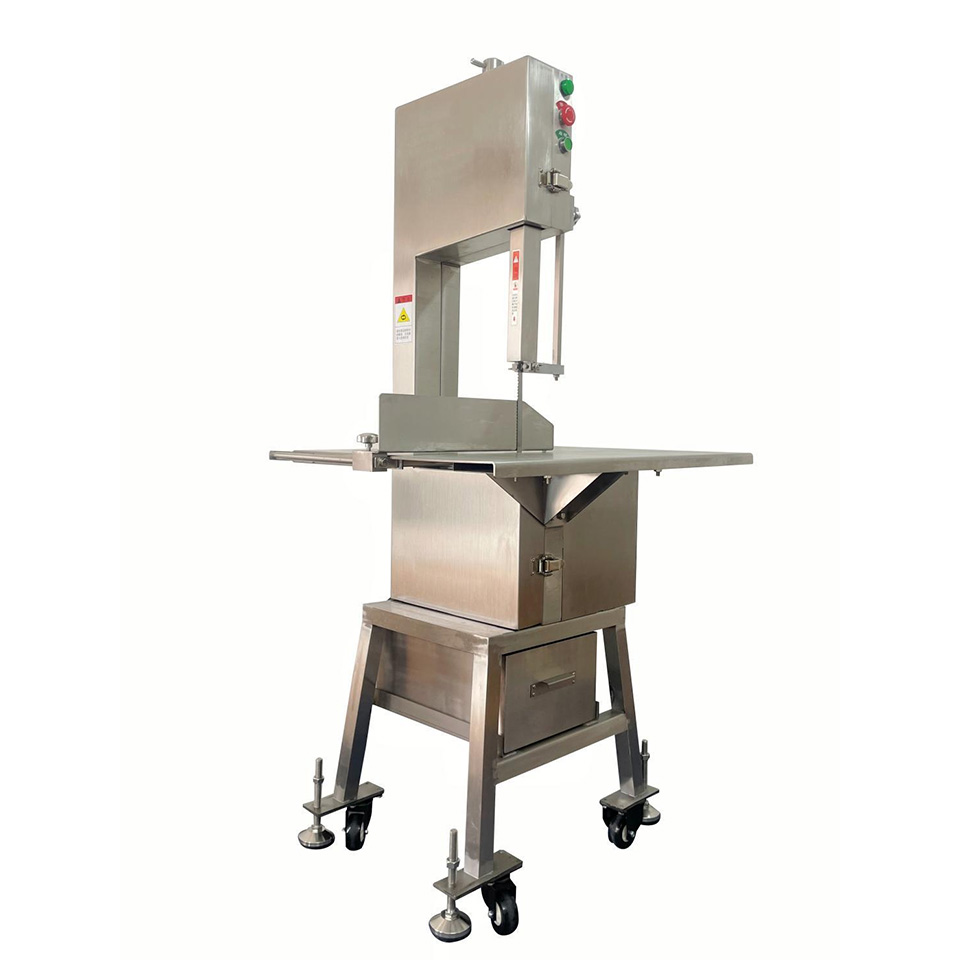
What a commercial meat bone saw does in a meat processing workflow
A band saw sits near the front of the line. Carcasses and large primals arrive as awkward, heavy, uneven pieces, and the saw's table, fence, and continuous loop blade let an operator break them into sections, chops, ribs, and blocks that will fit trays, kettles, or the next machine. In most plants the output is not a finished retail cut; it is a size‑reduced input that feeds everything downstream. That is why processing literature treats band saws as portioning equipment rather than finishing tools, with the FAO meat processing technology guide listing them among the standard machines used to break down carcasses in small and medium plants. A category example shows what this class of machine looks like in practice. The HC-95 is an elevated‑table commercial meat bone saw with a 2200 W motor running on 380 V/50 Hz, a published cutting height of 450 mm and cutting width of 280 mm, and an 80 × 63 cm stainless steel worktable. The listing also names a thickness scale, a blade tensioning system, and upper and lower tungsten carbide limit parts. Together those details describe the tooling of the category: a raised table that carries heavy pieces at working height, a blade held under tension so it tracks through dense material, and limit parts that keep the blade positioned as bone passes through the cut.
How band-saw cutting differs from mincing, dicing, and other meat preparation methods
Dividing and comminuting both reduce size, but they do very different things to the material, and confusing them leads to buying the wrong machine. Within the wider family of industrial meat cutting machines, a saw separates a piece into smaller pieces that each keep their own internal structure, so muscle, fat, and bone stay where they were inside every new piece. A mincer, dicer, or bowl chopper changes that structure. The clearest way to see the difference is to follow one piece of meat through each machine type.
1. A band saw divides large pieces while a mincer changes texture
A band saw runs a continuous loop blade between two wheels, and material is fed into the blade along a table so the blade cuts a narrow path through muscle and bone alike. What comes out is a smaller version of what went in. A mincer works from the opposite direction: an auger presses meat against a rotating blade and then through a perforated plate, so the output is ground material with a new texture, a new density, and different behavior during cooking and binding. Hard bone is not something a mincer is built to pass, which is why bone‑in work usually happens on the saw before anything reaches a grinder.
2. Dicing and slicing equipment serve different repeatable portion tasks
Dicers push material through a grid of blades to produce cubes, slicers draw a blade across a piece to give thin even slices, and portion cutters repeat a fixed shape. These machines are built around repetition: once the material is the right size and shape, they deliver consistent results quickly. They also assume the material already fits their feed opening. That is exactly where the saw earns its place, turning irregular carcasses and frozen blocks into pieces a dicer or slicer can accept. A dicer cannot start from a whole frozen carcass, and a slicer cannot start from a bone‑in quarter.
Why material state and piece size change the meat saw task in practice
The same saw handles quite different work depending on what is put on the table. Chilled meat is soft and compliant, so it can fold, compress, and shift slightly against the blade. Frozen meat is rigid: freezing turns a large share of the water in the tissue into ice, so the piece behaves like a solid block and the blade is making a true cut rather than slicing through yielding tissue. Piece size matters just as much, because the shape of a piece, long and thin versus short and thick, determines how it meets the blade and how much of the load lands on the table rather than the cut itself. This is why published use descriptions are a better guide than motor numbers alone. The HC‑95 listing names large frozen carcasses, thick bones, dense meat blocks, and frozen fish as materials it is intended for. Those names tell a reader what kind of work the machine belongs to: primary breakdown of hard, heavy, or dense material rather than delicate trimming. They describe intended material rather than a guaranteed output rate, so throughput, maximum piece size, precision, and continuous running time still depend on the real material and how the machine is run. A saw set up for frozen blocks and one used for chilled primals can look almost identical from the outside while being asked to do very different jobs.
Conclusion
The simplest way to understand a meat bone saw is to look at what it produces: large pieces separated into smaller ones, with their structure intact, at the start of the process. Mincing, dicing, and slicing all happen after that division, and each of them depends on the saw's output being the right size and shape. Material state and piece size are the variables that decide how demanding the dividing job is. Anyone comparing models should first ask whether the machine is documented for the material they actually handle, then read the specifications in that light.
FAQ
Q: What kinds of cutting tasks are usually handled by a commercial meat bone saw?
A: A commercial meat bone saw handles primary division work: breaking whole carcasses and quarters into sections, cutting bone‑in chops and ribs, reducing dense meat blocks to manageable pieces, and portioning hard frozen material such as frozen carcasses or frozen fish. In all of these tasks the goal is a smaller piece with its structure intact, ready for trimming, packing, or further processing on another machine.
Q: How is a meat bone saw different from a meat mincer or dicer?
A: A band saw divides material with a continuous loop blade, so each piece keeps its own muscle, fat, and bone structure. A mincer presses meat through a plate and changes the texture completely, while a dicer cuts material into cubes using a fixed blade grid. Mincers and dicers need material that already fits their feed, which is why the saw typically comes first in the sequence.
Q: Why do piece size and material state matter in meat band saw work?
A: Chilled meat is soft and can compress against the blade, while frozen meat behaves like a rigid block, so the cutting task changes with temperature. Piece size and shape decide how the material meets the blade and how much load the table carries. Those two factors explain why the same machine is described for some materials and not others.
Sources / References
Meat Processing Technology for Small- to Medium-Scale Producers
Freezing and Food Safety
Related Examples
HC-95 Elevated Table Meat Bone Saw
Further Reading
Freezing and refrigerated storage in fisheries
Final specifications should be confirmed according to the selected model and supplier documentation.
Author: 苏涛;舜翔央厨、华艺智能