
A B2B buying guide to commercial hot-air sterilizer cabinets for food plants and central kitchens. Covers chamber size, SUS304 contact surfaces, cycles, validation.
A commercial hot-air sterilizer cabinet (commonly specified at 360L single-door or 930-plate double-door formats) uses dry-heat convection at 160-250°C to inactivate bacterial spores, mould, and heat-resistant pathogens on metal tools, glassware, packaging containers, and stainless-steel food-contact surfaces. For food plants running retort lines, ready-meal packaging, aseptic filling, or central-kitchen utensil sanitation, a correctly specified sterilizer is the difference between passing an export audit and getting a non-conformance report. This guide is written for B2B buyers evaluating commercial steam sterilizers and dry-heat sterilizer cabinets before placing a procurement order.
Key Takeaways
- A 360L hot-air sterilizer typically reaches +5°C above setpoint within 18-25 minutes from cold start when loaded with full trays; 930-plate double-door cabinets reach the same stability within 28-40 minutes.
- Inner chamber dimensions matter more than outer cabinet size: confirm usable depth (≥450mm) and usable height (≥600mm) for your tallest tooling or largest containers.
- Insulation class should be rock wool or ceramic fibre rated to 250°C continuous; PU foam degrades above 120°C and will outgas into the chamber.
- Temperature uniformity across the chamber must be within ±3°C when empty, and ±5°C when fully loaded — these are the figures your validation engineer will ask for.
- Dry-heat sterilization is not interchangeable with steam sterilization: confirm whether your product, packaging, or load requires dry-heat (no moisture) or saturated steam (more aggressive microbial kill).
- Buyers should request the IQ/OQ/PQ validation documents, the controller firmware version, and the chamber material certificate (SUS304 or higher) before issuing a PO.
What This Equipment Is Used For
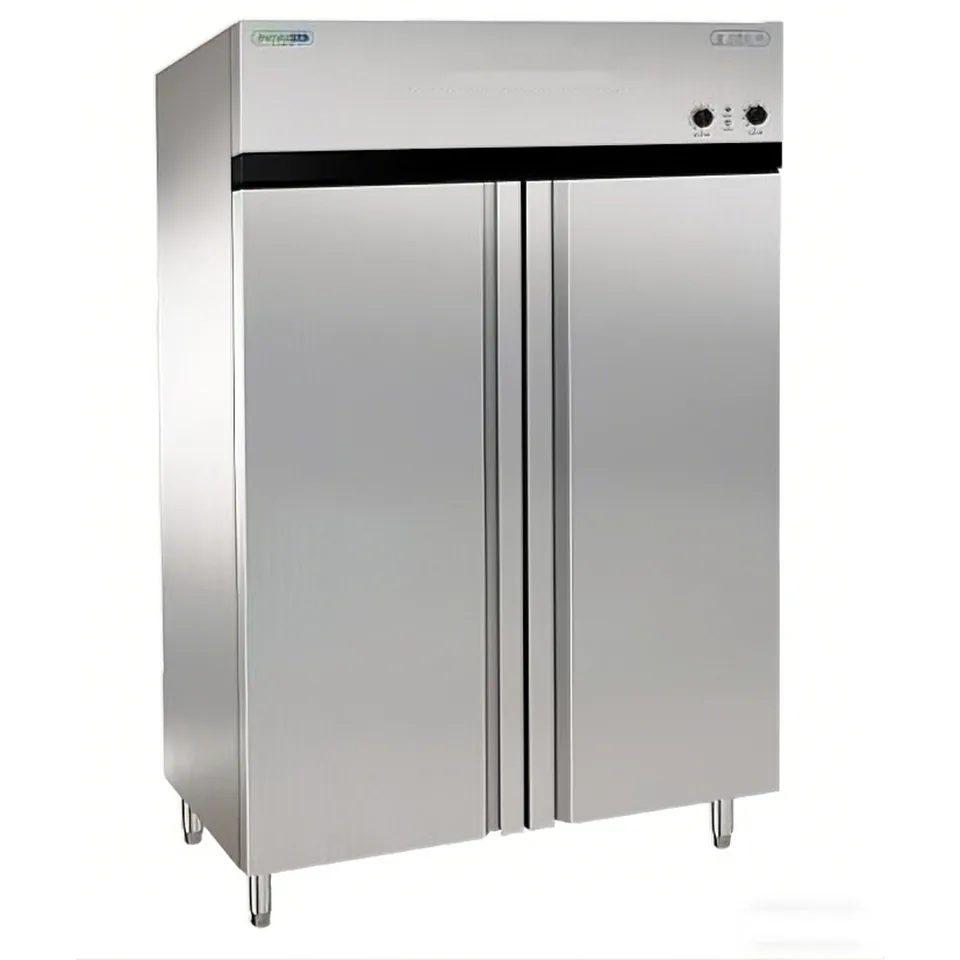
Hot-air sterilizer cabinets are used across three main food-industry scenarios. First, central kitchens and commissaries sanitize cutting boards, knives, mixing bowls, and stainless-steel utensils where steam autoclaves are not installed. Second, ready-meal and retort-packaging plants sterilize empty cans, glass jars, lids, metal trays, and aluminium containers before aseptic filling. Third, bakeries and confectionery lines use them to sanitize baking moulds, cooling racks, and decorating tools between production runs.
Dry-heat sterilizers are particularly relevant when the load is sensitive to moisture, when the facility already runs hot-air ovens, or when local regulations specify dry-heat sterilization for specific food-contact surfaces. They are not the correct choice when you need to sterilize liquids, porous textiles, or heat-sensitive plastics — for those applications, a steam autoclave or a wet pasteurization skid is more appropriate.
Core Specifications Buyers Should Compare
| Specification | Why It Matters | What Buyers Should Check |
|---|---|---|
| Chamber volume | Drives batch size and loading flexibility | Confirm 360L / 500L / 930-plate for your daily output |
| Temperature range | Drives kill profile for heat-resistant spores | Confirm 50-250°C (or 300°C) range and time-to-setpoint |
| Temperature uniformity | Validates every load position meets spec | Request ±3°C empty / ±5°C loaded data, with sensor map |
| Insulation material | Affects external temp, energy use, and chamber purity | Rock wool or ceramic fibre rated ≥250°C, NOT PU foam |
| Inner liner material | Food-contact surface must be corrosion-resistant | SUS304 stainless steel (or SUS316 for aggressive CIP) |
| Controller | Defines cycle programming and traceability | Digital PID controller with cycle log export (USB or RS485) |
| Air circulation | Drives uniformity and recovery after door opening | Forced convection fan, axial or centrifugal, with filter |
| Door type | Affects heat loss and operator ergonomics | Single-door hinged vs double-door sliding (clean-side pass-through) |
| Power supply | Drives installation cost and site readiness | Confirm 220V/380V three-phase, total kW, breaker sizing |
| Cycle time at 160°C | Drives daily batch throughput | Typical holding time 30-120 min depending on load and validation |
How to Choose the Right Model
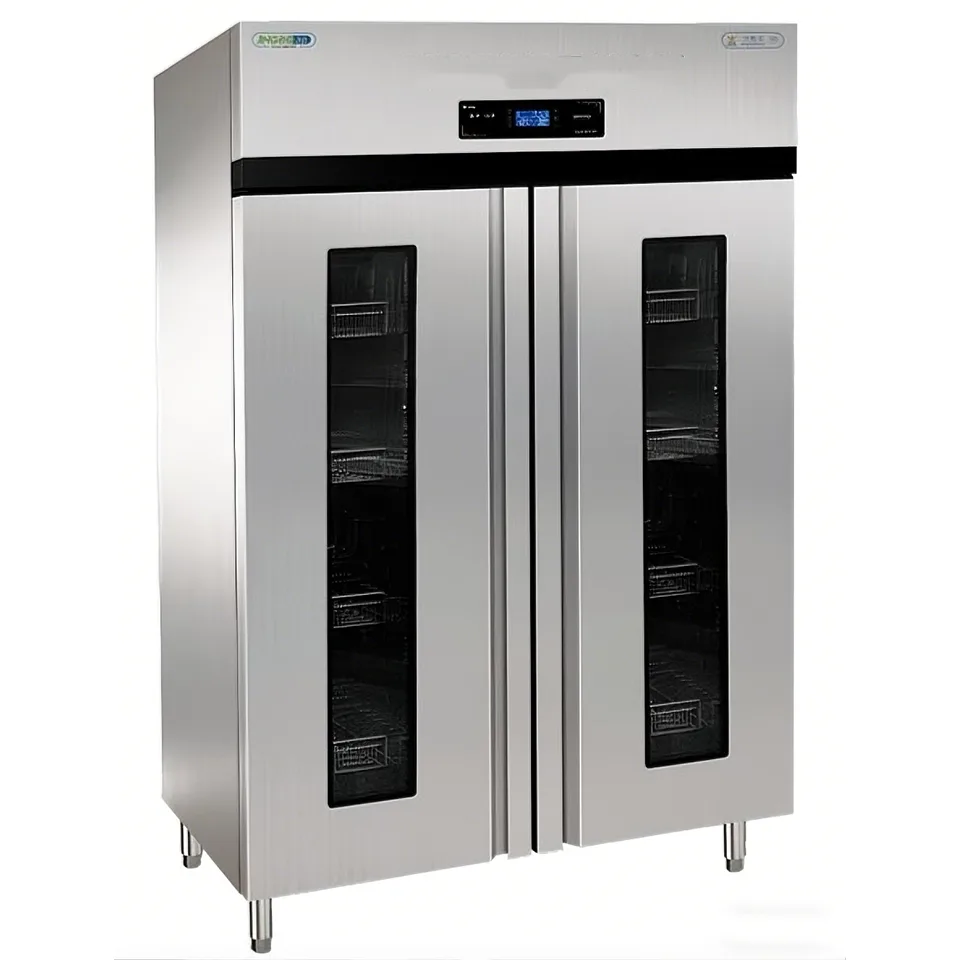
Chamber Size and Daily Throughput
A 360L single-door sterilizer is the entry-level choice for central kitchens serving 500-2,000 meals per day, small bakeries, and test kitchens. A 930-plate double-door pass-through cabinet suits plants running 2,000-10,000 meals per day, aseptic filling lines, and any facility with a clean-side / dirty-side segregation requirement. Buyers should always specify usable chamber dimensions rather than gross exterior dimensions: a 360L cabinet with external width 700mm and depth 600mm typically offers a usable chamber of approximately 600mm wide × 500mm deep × 600mm tall, which determines how many trays or moulds fit per cycle.
Temperature Range and Cycle Recipes
Standard dry-heat sterilization cycles operate between 160°C and 180°C with holding times of 30-120 minutes. Pharma-grade cycles may go up to 250°C or 300°C. Confirm with your QA team whether your facility follows GB 15982-2012 (hospital disinfection standard), ISO 17665 (moist-heat sterilization), or a company-internal validation protocol. The controller should support multiple programmable recipes, each with ramp rate, hold temperature, hold time, and cool-down phase. Memory retention across power loss is essential: a sterilizer that forgets its recipe after a power blip is a non-starter for validated production.
Food-Contact Material and CIP Compatibility
The inner chamber, trays, and racks should be SUS304 stainless steel at minimum. If your facility uses chlorine-based CIP or quaternary ammonium sanitizers, ask for SUS316L or specify a higher nickel content. Mirror-polished internal surfaces clean more easily than brushed surfaces. Confirm the gasket material is silicone rubber rated to 250°C, not EPDM or nitrile, which degrade and shed particles at high temperatures.
Validation, Documentation, and Calibration
For export-oriented food plants (FDA, EU 852/2004, HACCP), the sterilizer supplier must provide FAT (Factory Acceptance Test) reports, IQ/OQ protocols, and a calibration certificate traceable to a national metrology institute. The temperature controller should support external sensor calibration at minimum three points (low, mid, high). Buyers should ask whether the chamber's temperature uniformity was mapped with a 9-point or 15-point grid — a single-point sensor does not prove uniformity.
Installation Footprint and Electrical Supply
A 360L cabinet typically draws 6-9 kW at 380V three-phase; a 930-plate double-door unit draws 12-18 kW. Confirm the supply breaker, cable cross-section, and earthing before the cabinet arrives on site. Plan for at least 600mm clearance on the door-swing side and 200mm clearance on the rear for the exhaust duct. If your facility uses gas-fired heating elsewhere, check whether a hot-air sterilizer that uses electric heating will overload your existing transformer.
Buyer Checklist
- Confirm load type (utensils, trays, glass jars, moulds) and maximum load dimensions before quoting.
- Confirm chamber volume: 360L / 500L / 930-plate based on daily batch count.
- Confirm temperature range required: 160-180°C standard, or up to 250-300°C for pharma-grade cycles.
- Request temperature uniformity data: ±3°C empty and ±5°C loaded, with sensor position diagram.
- Confirm inner liner material: SUS304 minimum, SUS316L for chlorine CIP.
- Confirm insulation: rock wool or ceramic fibre rated ≥250°C, not PU foam.
- Request controller cycle log export: USB, RS485, or Ethernet for traceability.
- Ask for IQ/OQ/PQ validation templates and FAT report sample.
- Confirm electrical: 220V single-phase vs 380V three-phase, total kW, breaker sizing.
- Confirm door style: single-door vs double-door pass-through for clean-side segregation.
- Confirm spare parts availability: heating elements, fan motor, door gasket, controller board.
- Ask for cycle time benchmarks at your target temperature with your typical load weight.
Common Mistakes to Avoid
The most common mistake is selecting a sterilizer based on external dimensions instead of usable chamber volume. A cabinet quoted at 500L may offer only 380L of usable space if the side walls are thick for insulation. The second mistake is assuming dry-heat and steam sterilization are interchangeable. They are not: dry-heat at 170°C for 60 minutes and saturated steam at 121°C for 15 minutes deliver different lethality profiles and are not equivalent in validation. The third mistake is ignoring ventilation: a sterilizer running at 200°C exhausts hot, dry air continuously, which can disrupt HVAC balance in a sealed cleanroom.
A fourth mistake is under-specifying the controller. A simple ON/OFF thermostat with one fixed setpoint cannot run validation cycles, cannot log for traceability, and cannot pass an FDA or EU audit. Buyers should specify a digital PID controller with at least four programmable recipes, ramp-and-soak capability, and password-protected parameter changes. Final specifications should be confirmed according to the selected model and supplier documentation before issuing a purchase order.
FAQ
What is the difference between a commercial steam sterilizer and a hot-air sterilizer?
A commercial steam sterilizer (autoclave) uses saturated steam at 121-134°C under pressure to achieve microbial kill in 15-30 minutes. A hot-air sterilizer uses dry convection heat at 160-250°C for 30-120 minutes. Steam is faster but adds moisture and is incompatible with powders, oils, and moisture-sensitive loads. Hot-air is slower but reaches higher temperatures, penetrates less aggressively, and is preferred for metal tools, glassware, and food-contact stainless-steel surfaces.
How long does a typical sterilization cycle take at 160°C?
For a 360L single-door sterilizer loaded with clean stainless-steel utensils, total cycle time is typically 90-120 minutes including 18-25 minutes heat-up, 60 minutes holding at 160°C, and 15-25 minutes cool-down. Heavier loads, higher setpoints, or fully-loaded 930-plate cabinets extend the cycle to 150-180 minutes. Cycle time varies by load density, initial product temperature, and ambient temperature.
Can a hot-air sterilizer be used for liquid products or beverages?
No. Dry-heat sterilizers are designed for solid loads, utensils, and packaging components. For in-pack liquid products, an autoclave with overpressure cooling or a continuous pasteurization skid (HTST or UHT) is the correct technology. Attempting to sterilize sealed liquid containers in a hot-air cabinet risks container rupture, inconsistent lethality, and burn hazards from hot glass or metal.
What maintenance does a hot-air sterilizer require?
Routine maintenance includes monthly inspection of door gaskets for cracks, quarterly cleaning of the air circulation fan and filter, annual calibration of the temperature sensor, and replacement of heating elements every 2-3 years depending on cycle count. Buyers should request a recommended spare parts list with part numbers, lead times, and prices before procurement.
Is a 930-plate sterilizer always better than a 360L sterilizer?
Not necessarily. The 930-plate double-door pass-through cabinet is the right choice when daily batch count exceeds 2,000 units or when the facility needs clean-side / dirty-side segregation. For central kitchens producing under 1,000 meals per day, a 360L single-door cabinet is more cost-effective, fits in a smaller footprint, and uses less power. The right answer depends on throughput, layout, and validation requirements — not on headline capacity.
Related Links
- 360L Single-Door Hot-Air Sterilizer Cabinet — Huayi
- 930-Plate Double-Door Sliding Sterilizer — Huayi
- SUS304 Steam Sterilization Kettle 50-900kg
- Food Metal Detector for Packaged Lines
- Horizontal Food Mixer 190L for Central Kitchens
- Commercial Combi Oven 10 Trays for Central Kitchens
For B2B procurement of hot-air sterilizer cabinets, retort sterilization equipment, and related food-processing machinery, contact Huayi Smart Solutions with your load type, daily batch count, target temperature, and facility layout. Final specifications should be confirmed according to the selected model and supplier documentation before issuing a purchase order.